Skip to content

Guide and tips

Calculate stopping and braking distances

Anyone driving a vehicle must be able to calculate the stopping distance in order to correctly assess and maintain the necessary safety distance and appropriate speed. Here you can find out how to calculate the braking distance and stopping distance and what the actual stopping distance ultimately depends on.
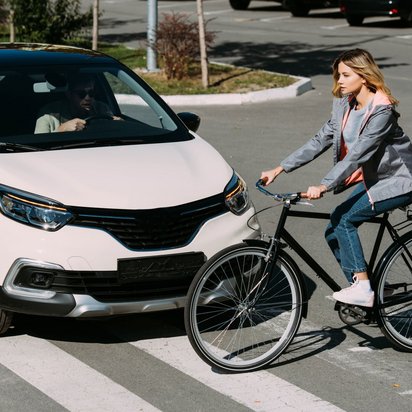
Frau fährt mit dem Fahrrad über einen Zebrastreifen und ein weißes Auto hält davor an

Calculating braking distance: How does it work?

The braking distance is the distance travelled by a vehicle from applying the brakes to a complete stop. If it is a normal braking manoeuvre, the distance is one tenth of the moving speed times one tenth of this speed in metres.

Rule of thumb for braking distance

Normal braking distance:
(speed : 10) x (speed : 10)


Braking distance for emergency braking:
(speed : 10) x (speed : 10): 2

Braking distance at 100 km/h Example

At 100 km/h, the braking distance is 100 metres.

The braking distance is calculated as follows: (100 km/h : 10) x (100 km/h : 10) = 100 metres.


In the case of emergency braking, the braking distance is halved to 50 metres.

Calculation: (100 km/h : 10) x (100 km/h : 10) : 2 = 50 metres.

Calculating stopping distance: How does it work?

In addition to the braking distance, there is the reaction distance, i.e. the distance you cover before you recognise the danger and are able to react at all.

To calculate the reaction distance, divide the speed by ten and multiply the result by three.

Stopping distance formula

Rule of thumb for stopping distance:
Stopping distance = reaction distance + braking distance

There is also a rule of thumb for the reaction distance:
Reaction distance = (speed : 10) x 3

Braking distance at 50 km/h Example

At a speed of 50 km/h, the stopping distance is 40 metres.

The reaction distance is calculated as follows:
(50 km/h : 10) x 3 = 15 metres

In addition, the braking distance:
(50 km/h : 10) x (50 km/h : 10) = 25 metres.

And then you add the reaction distance and braking distance to get the stopping distance:
15 metres + 25 metres = 40 metres

Taken together, the braking distance and reaction distance give the stopping distance.

TÜV NORD tip

In the event of emergency braking, increase the brake pressure as quickly and as strongly as possible! As a precaution for this dangerous situation, always ensure that the driver's seat is correctly adjusted with a steep backrest to enable a strong transfer of force to the brake pedal.

What does the actual stopping distance depend on?

The actual stopping distance ultimately depends on many factors: In addition to the driver's ability to react, the following factors also play a role:

  • Road conditions
  • Tyre pressure
  • Total weight of the vehicle
  • Weather conditions

In order to minimise the risk of accidents as much as possible, increased attention is required in winter and speed must always be adapted to the circumstances.

How does stopping distance increase in winter?

In winter, it can be assumed that the roads may be slippery due to the weather and that the stopping distance will be correspondingly longer. If there is snow on the carriageway, the stopping distance is around three times longer than in ideal conditions. If the roads are icy, it is even longer - up to seven times longer. Icy roads should not be underestimated, as moisture does not only freeze at sub-zero temperatures. Slippery roads can therefore occur, especially in the early morning and evening hours. This means extra caution and a calm driving style:

  • Avoid high speeds and unnecessary overtaking
  • Avoid accelerating and braking just as hard
  • Make sure you keep a safe distance from the car in front
  • If you do start to skid, hold the steering wheel firmly with both hands
  • Avoid hectic steering movements so that the car remains stable in the lane
TÜV NORD tip

In the event of emergency braking, increase the brake pressure as quickly and as strongly as possible! As a precaution for this dangerous situation, always ensure that the driver's seat is correctly adjusted with a steep backrest to enable a strong transfer of force to the brake pedal.

Contact

We look forward to receiving your inquiry!