Guides and tips
Camper conversion
Make your dream of a customised motorhome a reality: with a panel van conversion, you can design your mobile home exactly as you wish – TÜV NORD is here to guide you with expert advice and practical tips.
Guides and tips
Make your dream of a customised motorhome a reality: with a panel van conversion, you can design your mobile home exactly as you wish – TÜV NORD is here to guide you with expert advice and practical tips.
The dream of owning your own motorhome often starts with a panel van. With the right know-how and careful planning, such a van can be converted into a comfortable and safe motorhome. TÜV NORD is here to guide you through the process with valuable tips and practical examples.
A successful campervan conversion starts with careful planning. Think about how you want to use the van: for weekend trips, longer journeys, or as a permanent home? Decide on your requirements for sleeping arrangements, the kitchen, storage space and self-sufficiency. A detailed conversion plan will help you save time and money.
Popular models for converting into panel vans include the Citroën Jumper, Fiat Ducato and Mercedes Sprinter. Bear the following criteria in mind:
Please note that modifications to the vehicle may affect its registration.
To be registered as a motorhome, certain criteria must be met:
We recommend consulting one of our TÜV NORD experts at an early stage to ensure all requirements are met.
Once the conversion is complete, the vehicle must be inspected by a certified TÜV NORD expert. This inspection will verify that all legal requirements have been met. Only then can the vehicle be registered as a motorhome. Please note that temporary fittings that can be easily removed will not result in the vehicle being recognised as a motorhome.
To avoid problems, the following mistakes should be avoided:
Careful planning and execution are crucial to the success of the project.
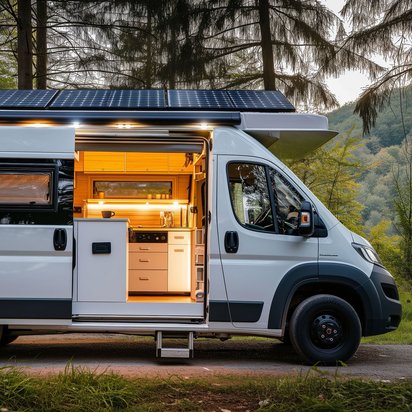
A good example is Ulf’s conversion project, in which he transformed his Citroën Jumper into a bespoke campervan with the support of TÜV NORD. The conversion included, amongst other things:
Ulf dreams of a compact, functional and low-maintenance motorhome for spontaneous weekend getaways and extended trips across Europe – occasionally even outside the summer months, such as spending New Year’s Eve in Scandinavia or going skiing in the Alps. What matters most to him is that it isn’t a DIY project, but a reliable vehicle with the latest technology and as little hassle as possible in day-to-day use.
His requirements at a glance:
Ulf values a well-thought-out layout, a comfortable interior even in bad weather, and ease of use – without modifications, without large tanks, without sensitive technology.
Traditional semi-integrated or fully integrated motorhomes were out of the question for Ulf – too big, too cumbersome, too technically complex. Many ready-built campervans also fell short on the details: uncomfortable seating, an unnecessary bathroom with a shower (which is hardly ever used in such small vehicles), and an overload of technology.
A van conversion tailored to his own specifications was the solution – “as much as necessary, as little as possible”.
Ulf opted for a Citroën Jumper L2H2 with 140 hp, a gross vehicle weight of 3.3 tonnes and Euro 6d emissions technology. The new vehicle cost around €25,000. Advantages:
Cost centre Amount
Base vehicle (new) €25,000
Conversion / Equipment €12,000
Total cost approx. €37,000
The interior design concept follows clear design principles:
Design principle Implementation
Horizontal surfaces Natural wood
Vertical surfaces Coloured surfaces
Choice of materials Natural, homely feel
Shelving Flexible and easily accessible
Aim: A space where people enjoy spending time even in bad weather – cosy, practical and stripped back to the essentials.
Ulf’s van conversion is a striking example of how a customised motorhome doesn’t have to be expensive, oversized or overloaded with technology. With a clear focus, a well-thought-out layout and practical technology, the result is a campervan suitable for everyday use in all seasons – perfect for two people and ready for long trips.
Well-thought-out space planning is key to creating efficient storage in a campervan. Make use of multifunctional furniture such as lift-up table beds or benches with built-in storage. Additional solutions include:
These measures help to make the most of the available space and keep things tidy.
Choosing the right insulation depends on your travel plans:
It is also advisable to use sound-deadening mats underneath the insulation to reduce noise levels in the vehicle.
A sustainable camper conversion takes both environmental and economic factors into account:
These measures help to reduce environmental impact and save costs in the long term.