Skip to content

Guides and tips

Damage to a car caused by a pothole – what should you do and who is liable?

After winter, many potholes appear and can cause costly damage to tyres, wheel rims or the chassis. Find out how to document damage properly, when you are entitled to compensation, and what specific aspects of liability you need to be aware of.

Check pothole adhesion
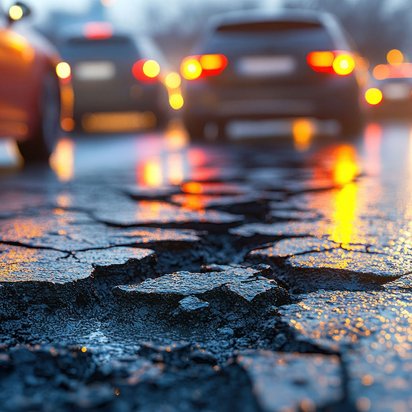
Schlagloch auf einer stark befahrenen Straße bei Nacht

Recognising damage caused by potholes and reacting correctly

Cracks in the tarmac, broken road surfaces and deep potholes are typical consequences of periods of frost. Anyone who drives into a pothole often only realises the damage later. This makes it all the more important to act quickly and systematically.

What to do after pothole damage?

1

Check for damage

Check your tyres, wheel rims and suspension. Look out for any unusual noises, vibrations or changes in steering behaviour.

2

Secure evidence

Take photos of the damage to the vehicle and the pothole from several angles. Make a note of the date, time and exact location.

3

Notify the police

Make sure the incident is recorded, especially if there is significant damage. Witnesses should also be noted down.

4

Workshop & Quote

Have the damage assessed by a professional and obtain a quote.

5

Make a claim

Submit the claim form, police report and cost estimate to the relevant authority responsible for road safety – usually the local council or district authority.

Why do potholes occur?

Potholes are a typical form of frost damage:

  • Moisture penetrates small cracks in the asphalt
  • When temperatures drop below freezing, the water freezes and expands
  • The asphalt is split open
  • As the ice thaws and under the weight of traffic, sections break away

This damage occurs particularly frequently after winter.

Note: Not every pothole is equally dangerous. Road users generally have to put up with smaller potholes – particularly on minor roads.

Who is liable for damage caused by potholes?

In urban areas and on country roads

Local and regional authorities are obliged to maintain roads in a condition that ensures road safety. However, drivers must adjust their speed to the road conditions.

Practical note: It is often not possible to repair potholes quickly in winter, as the filling material does not set in frosty conditions. This can make it difficult to claim compensation.

Consequently, contributory negligence is often examined. Courts rule differently depending on the individual case.

On motorways

On motorways, road users should not generally expect to encounter potholes. If there is no warning of significant road damage, there is a significantly better chance of claiming compensation from the relevant federal state.

Legal classification: the duty of local authorities/states to ensure road safety versus the driver’s duty to drive at an appropriate speed – both factors are weighed up in each individual case.

Frequently asked questions about potholes

Yes, for minor bumps, particularly on minor roads. More serious, hazardous damage must be cordoned off or repaired quickly.

Depending on the terms of your policy, either comprehensive or third-party, fire and theft cover may apply. It’s worth checking.

Whether compensation is awarded always depends on the individual case. The courts examine, in particular:

  • Was a warning given about the road damage?
  • Was the damage repaired promptly?
  • Was the speed appropriate for the road conditions?
  • Is it a motorway or a minor road?

Case law at a glance

The local authority’s duty to provide
warnings: If there are obvious hazards and no clear warning signs, there may be a good chance of success.
(Higher Regional Court of Celle, Case No. 8 U 199/06)

Contributory negligence due to inappropriate speed
Drivers must adjust their speed to road conditions. Minor potholes – particularly on minor roads – are to be expected.
(Braunschweig Higher Regional Court, Ref.: 3 U 47/02)

Special circumstances on motorways Road users are generally not expected
to anticipate potholes on motorways. If no warning is provided, the relevant federal state may be liable.
(Higher Regional Court of Koblenz, Ref.: 12 U 1255/07)

Conclusion: Whether a claim is worthwhile depends heavily on the circumstances of the individual case. Careful documentation significantly increases the chances of success.

Bear in mind that small potholes on minor roads are considered reasonable, that claiming compensation in winter can be more difficult due to practical constraints, and that every liability decision involves a balancing act between the duty to maintain safe roads and the driver’s duty of care.

Note

Without photos, witnesses or a police report, your chances of success are significantly reduced. Document the damage immediately.

Pothole damage? Get your money back.

Not every pothole results in liability. Familiarise yourself with the key details of the duty to maintain roads to protect your interests.

Other topics relating to vehicle technology & safety

Person wechselt Ersatzrad auf einer Autobahn

Tyre change

Whether you’re switching from summer to winter tyres or vice versa, changing your tyres in good time ensures greater safety, better vehicle control and optimal handling. TÜV NORD Mobilität explains what you should look out for: from tread depth and the right time to change them to professional fitting.
Find out more about changing tyres
Winterreifen auf schneebedeckter Straße im Winter

Winter tyres

Get your vehicle ready for winter – with certified winter tyres and tips from TÜV NORD, you’ll stay safe on the road even when temperatures drop below 7°C.
Find out more about winter tyres
Frau arbeitet konzentriert am Laptop in einem modernen Büro

Switch car insurance

Act now – switch your car insurance before 30 November: cancel, compare, save.
Find out more about switching car insurance

Contact

We look forward to your enquiry!

TÜV NORD Mobilität

Guide and tips