Skip to content

Guides and tips

Damage to cars caused by martens

Prevent costly damage to your car caused by martens – with TÜV NORD’s expertise for the best possible spring protection!
Martens don’t take a break in spring: they gnaw through cables, hoses or insulation mats – often causing further damage. Find out here which protective measures really work, how to neutralise unpleasant odours, and which insurance policies cover the damage.

Prevent marten damage
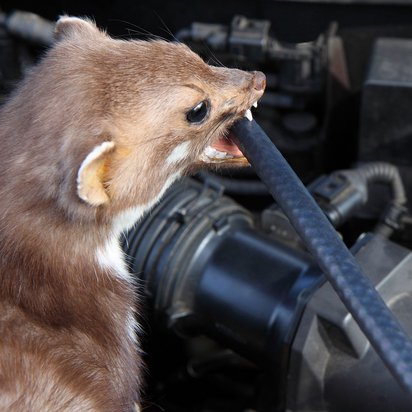
Marder beißt in ein Autokabel im Motorraum

Martens in the engine compartment? How to avoid expensive consequential damage

Damage caused by martens is an unpleasant and often costly spring surprise for many motorists: every year, these small rodents cause millions of euros’ worth of damage across the country. 

Whether it’s gnawed ignition cables, punctured coolant hoses or destroyed insulation – the consequences range from a rough-running engine to costly engine damage. In this guide, TÜV NORD experts show you how to deter martens early on, which protection methods you can really rely on, and what you should look out for when it comes to insurance cover. This way, your car stays safe and roadworthy – even during the martens’ mating season.

What damage do martens do to cars?

Martens tend to chew on the following car parts in particular:

  • Ignition cables
  • Coolant and windscreen washer hoses
  • Plastic hoses and bellows (drive shafts, steering)
  • Electrical cables and their insulation
  • Engine compartment insulation mats (for noise and heat insulation)
  • Vacuum hoses for the engine management system

These components are particularly susceptible to damage and often lead to further damage if damaged.

Typical consequences of marten damage to the car

Damaged rubber sleeves

Cracks or bite marks on rubber boots are often only noticed at a late stage. If water and dirt get in and bearing grease leaks out, drive and axle joints can be seriously damaged. Parts of the steering system are also at risk.

Bitten ignition cables

Ignition cables that have been gnawed by martens can cause one or more spark plugs to malfunction, resulting in the engine running unevenly. 

The engine warning light will then indicate that there is a problem with the engine management system. In this case, the control unit switches to an emergency mode, allowing you to drive to the nearest garage. This is strongly recommended, as the fuel is no longer being fully combusted and, in the worst-case scenario, the catalytic converter could be damaged. Furthermore, engine performance will drop dramatically.

Defective cooling water hoses

Perforated coolant hoses lead to coolant loss. The engine temperature rises – resulting in overheating, which in the worst case can lead to engine failure.

Damaged vacuum hoses

Damage caused by martens to the vacuum lines can reduce engine power and force the engine into emergency mode. The situation becomes critical if the brake booster fails – braking performance is then significantly reduced.

Effective protective measures against marten attacks

Odour defence

When it comes to keeping martens away, many people initially turn to strong smells – from mothballs and toilet blocks to dog hair. However, this isn’t really effective, as martens quickly get used to these scents. Even commercially available repellents offer only short-term protection.

Wire mesh

By placing a piece of fine-mesh wire netting, roughly one square metre in size, underneath the car, you can make it harder for martens to gain access to the engine compartment. It is more effective to seal the engine compartment from below.

Cable protection

Automotive retailers stock hard plastic hose sleeves that are slipped over exposed cables. These must, of course, be fitted with great care to ensure they can withstand even severe vibrations. Unfortunately, however, they cannot protect the hoses and axle boots that are frequently subject to wear and tear.

Engine wash

Martens are attracted by the scent of other martens and often react particularly aggressively as a result. It is therefore advisable to wash the engine as soon as you suspect that a marten has been in the vicinity.

Light

Martens are nocturnal and therefore avoid bright light. When parking your car in a public area, it is best to park under a street lamp. For carports and private parking spaces, it is advisable to install a spotlight or a strong light source and link it to a motion detector.

Ultrasound

Ultrasonic devices emit high-frequency sounds that are inaudible to the human ear but are designed to deter martens. The advantage is that they can be installed in just a few minutes. The disadvantage is that martens eventually get used to constant sounds. We therefore recommend high-quality devices with varying frequencies, which minimise this habituation effect.

Electric shock

One of the most effective methods of deterring martens is the use of commercially available electric shock devices, which deliver an electric shock to these unwelcome intruders via small electric plates when they come into contact with them. The plates are attached to vulnerable areas and access points to the engine compartment and connected to the car battery. There, a central module converts the battery voltage into a high voltage that is harmless to humans and animals. The plates consume very little power and are deactivated when the ignition is switched on or the bonnet is open.

TÜV NORD Tip

It is best to have a “stun gun” installed by a professional. The investment of around 300 euros is well worth it – as the potential damage caused by martens can end up costing considerably more.

Insurance cover for marten damage

Direct damage caused by martens is usually covered by third-party, fire and theft insurance and comprehensive insurance. In the event of a claim, third-party, fire and theft insurance will cover the damage up to the agreed sum insured, subject to any excess.

However, not all insurance policies include martens protection under third-party, fire and theft cover. Furthermore, consequential damage is excluded in many policies. So, if a marten gnaws through the coolant hoses and the vehicle is driven on despite the temperature gauge reading an abnormally high temperature, any resulting engine damage is not covered.

It is best to check with your car insurance provider whether indirect damage caused by martens is also covered.

What you should know

Frequently asked questions about martens causing damage to cars

A combination of:

  • engine washing,
  • mechanical protection (grilles, cable protection),
  • technical protection (electric shock + ultrasound) and
  • strategic parking (well-lit areas, garage) 

is considered particularly effective.

Partial comprehensive cover covers direct damage such as chewed-through cables or hoses. If this results in engine damage or a faulty engine, additional cover is usually required. You should therefore check your motor insurance cover.

No, martens do not have a preference for any particular type of engine. They most commonly attack cables, hoses and insulation in the engine compartment – all of which are found in both electric cars and combustion-engine vehicles.
Combustion-engine vehicles may actually be more susceptible, as they remain warmer after a journey and contain more vulnerable components, such as ignition cables.

Yes, in the long run, insurance cover for electric cars can become more expensive – especially if the policy offers no cover, or only limited cover, for consequential damage. This is due to the high repair costs: high-voltage cables usually have to be completely replaced after being chewed through by a martens.

Effective protective measures against marten attacks

Martens can damage cables, hoses and upholstery – often without you even noticing. Our practical tips show you how to prevent damage caused by martens and effectively protect your vehicle.

Other topics that might interest you

As well as damage caused by martens, there are other areas that are important for motorists – here you will find information on sales, vehicle inspections and comprehensive services at TÜV NORD.
Beratungsgespräch in einem Autohaus

Used cars: retaining value despite damage to the vehicle

Although a marten bite can affect the condition of your car, if you know how to assess, clean and document such damage, you can significantly increase the value of your used car when selling it. TÜV NORD shows you what potential buyers look out for and when it’s worth getting a valuation report.
Find out more about selling used cars at TÜV NORD
Unfallaufnahme mit Smartphone auf einer Straße bei Dämmerung

Accident report: Impartial damage assessment & legal certainty

If the damage caused by martens is extensive or involves insurance claims, an accident report can be crucial. An expert report from TÜV NORD accurately documents the extent of the damage, the costs, the loss of value and the evidence – so that you can make a claim.
Find out more about accident reports at TÜV NORD
Autopflege mit Politur für glänzendes Finish

Spring car check – stay safe on the road after winter

After the cold winter months, there are often hidden dangers lurking – from the battery to the braking system. Discover our tips for a comprehensive vehicle check and start the new season with peace of mind.
For the spring service

Contact

We look forward to your enquiry!

TÜV NORD Mobilität

Guide and tips