Skip to content

Guide and tips

Holidays with the e-car

Holiday trip with an electric car. In addition to the range of the vehicle and the network of charging stations, good travel preparation is crucial. Find out all about the advantages and disadvantages of a holiday trip with an electric car as well as tips for planning your trip and what else you need to consider.

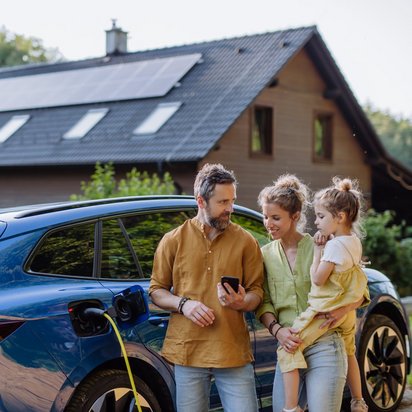
Familie lädt Elektroauto vor einem Haus mit Solaranlage

Vacationing with an electric car—is it possible?

The range of electric cars has increased significantly in recent years. Longer journeys in electric cars in Europe are possible without major obstacles. The network of fast charging stations is particularly well developed on motorways and also extends into neighbouring countries.

In the Netherlands and Scandinavia, there are significantly more charging options than in this country. The neighbouring countries of Austria, Switzerland and France have a similarly well-developed network as in Germany. In Italy or Croatia, however, the network is thinner. Here, holidaymakers with electric cars should find out more about the charging options along their travel route in advance.

The European agreement on the Combined Charging System (CCS) has firmly defined the charging standard in Europe. This means that plugs and charging methods are standardised. The navigation system will show you where the nearest charging station is located.

Towing a caravan with an electric car

Electric vehicles are fully suitable for holidays, even caravans can be towed electrically if the towing vehicle has an appropriate towing capacity. However, as with the combustion engine, larger models are more suitable for this.

If you want to take a caravan with you on holiday, you will of course need more energy. Experience has shown that recharging is necessary after approx. 200 kilometres. One advantage for caravan drivers has proven to be that fewer mechanical problems, such as gearbox wear, occur with electric towing vehicles.

TÜV NORD tip

When travelling, always ensure that the battery has sufficient charge remaining so that it will last until the next station.

More energy-saving tips for vacationing with an electric car

To save energy when driving an electric car, all electrical consumers that are not necessary should be switched off. If the energy reserve is running low, the e-mode, which is available in many electric cars, often helps. Here, the software optimises energy consumption. This has an effect on driving behaviour.

If you want to drive as many kilometres as possible on one battery charge, you should be prepared for a rather leisurely drive. The faster the car drives, the more energy is consumed.

Another money-saving tip: with the correct air pressure in the tyres, the electric car requires less electricity.

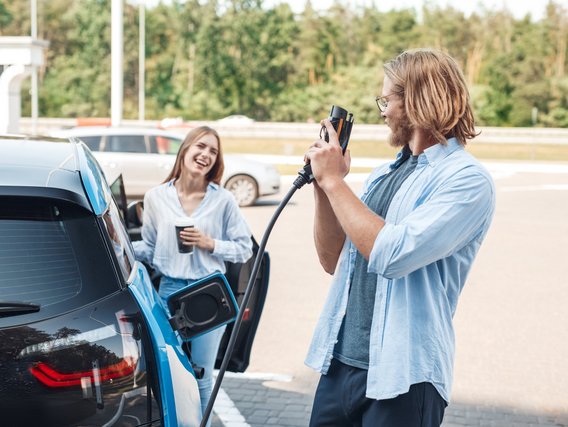
A woman stands at the car door and a man next to her with the charging cable for the electric car

Recharge your battery during the break

Overall, travelling by electric car offers great advantages:

  • Stopovers every two to three hours (250 to 300 kilometres) not only benefit the technology, but drivers and fellow travellers can also recharge their batteries at the same time.
  • The electric drive ensures a holiday right from the start and the moderate driving style, within the speed limits that apply in practically all countries anyway, also increases the range.
  • At a fast charging station, the battery can be charged to 80 per cent within 20 to 30 minutes.

At a normal charging station, however, e-car drivers need to allow much more time. Time in which children can let off steam and adults can have a picnic.

Charging electric car batteries with recuperation (= energy recovery)

If you drive into the mountains, you can recharge without stopping. This is because the battery is partially recharged after a long downhill ride.

The prerequisite for this is to drive with foresight and use the electric "engine brake" evenly.

In most vehicles, there is virtually no need to brake at all; the vehicle automatically switches to a higher recuperation mode when coasting for a long time, meaning that the energy is optimally recovered and stored.

Plan route with electric car

However, you should plan well for longer journeys. The number of charging stations at motorway service stations is increasing. Tank & Rast, the largest operator, has now installed charging points at every petrol station. But charging takes time. Good planning is therefore important.

The website of the Federal Network Agency has a register of charging points in Germany. An Excel list, which is updated regularly, can be downloaded from the agency's website. Alternatively, there is an interactive map: fast-charging points are marked with red dots, normal charging stations with blue dots. By clicking on the dots, information such as the operator, address and the respective technical equipment of the charging station is displayed.

The LEMNET website provides a comprehensive Europe-wide directory of charging stations, with more than 140,000 charging points at 45,000 locations to date. The site also offers a route planner. The search results are displayed on a Google Maps map, and users can download the route to their navigation device as a GPX file. The route can be customised precisely in the electric car route planner. To do this, users must enter their own vehicle model, battery capacity and plug type as well as the average energy consumption. The site uses this data to calculate suitable refuelling intervals. The calculations assume that you start with a fully charged battery.

Paying at charging stations when traveling with an electric car

Anyone travelling with an electric car should find out about international options from their mobility provider before setting off, as there is currently no standardised access and payment system. Sometimes you need a charging card, sometimes an app.

Currently, the online payment service PayPal or contactless payment via NFC and mobile phone work. Abroad, you can often pay directly at the charging station with a debit or credit card. Charging costs also vary greatly, from free to very expensive.

If you take out a contract with a mobility provider, you can save costs, but are dependent on roaming. Electricity is generally more expensive if you charge without pre-registration ("ad hoc").

Charging time is often billed, which can have a negative impact on costs for charging stations or vehicles with a low charging capacity. Ideally, you should therefore plan a longer journey with your electric car along fast-charging points to minimise waiting times.

Beware of the cost trap: Some electricity providers charge for the time spent standing at the charging point beyond the charging process in order to prevent charging points from being misused as car parks.
What you should know

Towing an electric car

  • There is currently no generally applicable regulation as to whether you can tow an electric car.
  • Each manufacturer has its own specifications.
  • It is essential that you follow the vehicle manufacturer's instructions to prevent damage to the battery, electronics and other important components.
  • If the electric car is towed improperly and damage is caused as a result, this may invalidate the manufacturer's warranty claims.
  • You can find out what applies to which vehicle model in the operating instructions.

  • If the wheels are turned during towing, the electric motor can generate uncontrolled current, which can damage the drive.
  • This is due to the fact that at least one axle with a motor generates energy in an electric car.
  • The induced voltage is generated by the rotary movement of the motor.
  • If the on-board system is not active, the control electronics of the electric car may be damaged if the electric motor produces current as a result of towing.

  • Check the manufacturer's specific instructions in the vehicle's operating instructions and follow the instructions for towing the electric car.
  • Ensure that towing is carried out in accordance with the manufacturer's instructions and taking safety precautions into account. This could mean, for example, that the vehicle must be put into neutral or towing mode.
  • However, this is only possible if the 12-volt on-board system still has power.
  • If the on-board battery is flat, this is not possible.
  • Use suitable towing devices that are specifically recommended for electric vehicles. Electric cars may have special towing requirements to prevent damage.
  • If possible, towing should be limited to short distances according to the manufacturer's instructions.

Note that these general steps may vary by manufacturer and model. It is important to follow the manufacturer's specific instructions in order to tow the electric car safely.

  • Ideally, electric cars should be transported on a special tow truck to prevent damage to the battery and electronics.
  • The same applies to vehicles with hybrid drives and combustion engines with automatic transmissions.

A towing company is normally liable for damage caused to your electric car during the towing process. This includes damage caused by

  • due to improper towing,
  • inadequate securing of the vehicle or
  • other negligence on the part of the towing company.

It is important that the towing company has appropriate insurance to be held liable in the event of damage to the vehicle. It is advisable to clarify the liability conditions in advance and ensure that the company has the necessary cover to settle any potential damage.

It is better to play it safe in any case and inform the towing service to load the electric car for transport. Let them know straight away that it is an electric car.

Kontakt

Wir freuen uns auf Ihre Anfrage!