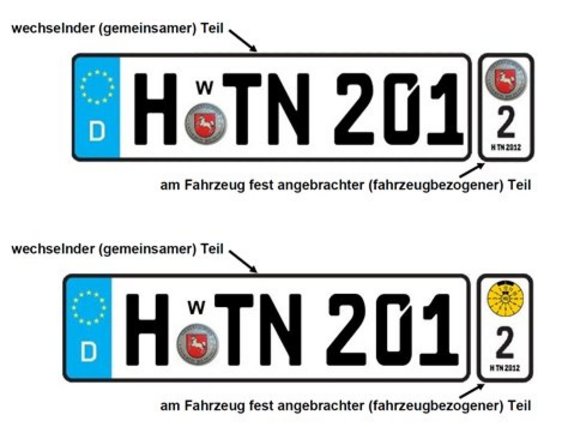
Here is an example of a second registered car (recognisable by the number "2" in the permanent part).
The lettering of the common licence plate part is shown in the lower section of the vehicle-related part. This means that the vehicle can be clearly identified even if the alternate part is not attached. A "1" (for the first vehicle) or a "2" (for the second vehicle) is embossed on the permanently attached part and, in the case of classic cars, an additional "H" after the number.
A prerequisite for the use of interchangeable licence plates is that both vehicles fall into the same vehicle category, e.g. two cars or two car trailers. The licence plates must be able to be attached to the vehicles with the same dimensions.
Interchangeable licence plates can be issued for the following vehicle categories:
- Motor vehicles for passenger transport with no more than eight seats in addition to the driver's seat (cars and motorhomes)
- Motorbikes and three-wheeled motor vehicles (trikes)
- four-wheeled motor vehicles up to 550 kg unladen weight (for electric vehicles without the weight of the batteries) and a maximum output of 15 kW and
- Trailers with a permissible total weight of up to 750 kg
A vehicle for which an interchangeable licence plate has been issued may only be operated or parked on public roads if the interchangeable licence plate is attached to it in full with both parts of the licence plate.
Interchangeable licence plates may not be used as seasonal licence plates, red licence plates, short-term licence plates or export licence plates.
As things stand at present, the registration of two vehicles on one interchangeable licence plate will not result in any tax relief.