Motorhome accessories
From bike racks to solar panels: the right accessories not only make your journey more comfortable, but also safer. We’ll show you what matters – and which extras make all the difference.
From bike racks to solar panels: the right accessories not only make your journey more comfortable, but also safer. We’ll show you what matters – and which extras make all the difference.
Anyone setting off on holiday in a motorhome will need all sorts of accessories for day-to-day travel. You need to think about vehicle accessories and essential travel items as early as when you buy or rent the vehicle.
Major mail-order companies have extensive catalogues that are well worth browsing through. Generally speaking, the range on offer is huge, ranging from wheel chocks to solar panels and roof air conditioning units, right through to cookware.
What you need and what items are useful depends on the type of motorhome and your own preferences.
You choose the accessories you need when you buy a motorhome. This makes sense, as retrofitting them later is far more complicated. These include items such as
already in the manufacturer’s accessories catalogue.
These accessories not only drive up the final price but also add extra weight. Motorhomes with a gross vehicle weight of 3.5 tonnes, in particular, generally have a low payload, so you should always keep an eye on the additional weight.
For rented motorhomes, accessories are limited to just a few items, such as a bike rack and the essential basic equipment.
The range of motorhomes is diverse, spanning everything from mini-campers and campervans to semi-integrated and fully integrated models, right through to luxurious motorhomes and exotic pick-ups with living quarters. All of them require a basic set of equipment to some extent.
This basic equipment includes:
The gas cylinder is undoubtedly an essential accessory. The gas cylinder compartment is sealed airtight from the interior and must not be used as storage space. A floor vent ensures that gas escapes to the outside in the event of a leak in the gas cylinder or pressure regulator.
As a rule, two 11-kilogram gas cylinders can be carried. As conventional steel cylinders are considerably heavier and therefore more cumbersome than aluminium cylinders, it is worth having them replaced. Anyone travelling during the cold season should have a safety gas pressure regulator fitted. This allows the gas heating to be operated whilst driving. In the event of an accident, the gas supply is cut off immediately.
Gas inspection G 607 – a legal requirement since June 2025
From June 2025, the gas inspection in accordance with DVGW Worksheet G 607 will be a legal requirement for motorhomes with permanently installed LPG systems and must be carried out regularly every two years.
Since June 2025, the gas inspection for motorhomes with liquefied petroleum gas systems has been a legal requirement. The inspection must be carried out every two years.
Here you will find detailed information on gas inspections for motorhomes – including the legal basis, deadlines and further explanations.
Safety involves not only driving carefully, but also having certain accessories. A fire extinguisher should be kept in an easily accessible place. Generally speaking, it is also a good idea to have a smoke detector in a central location, although this is not required by law.
A small gas detector warns of gas leaks, and anyone wishing to protect themselves against the unfortunately increasing number of burglaries and robberies should install a knockout gas detector.
Safety whilst driving is enhanced by the increasingly common use of driver assistance systems, such as
In any case, the vehicle should be fitted with a reversing camera. However, at the campsite, the passenger can also be a great help when manoeuvring into the pitch. To ensure that manoeuvring does not become a source of amusement for your camping neighbours, hand signals and verbal instructions should always be clear.
Often, the camper isn’t level because the ground is uneven. This can result in a restless night’s sleep. A quick fix is to use levelling chocks, which you drive onto at the required points.
A more convenient alternative is levelling jacks, which you lower as required and mustn’t forget to retract when setting off. True luxury is a fully automatic hydraulic levelling system. At the touch of a button, the motorhome is perfectly level.
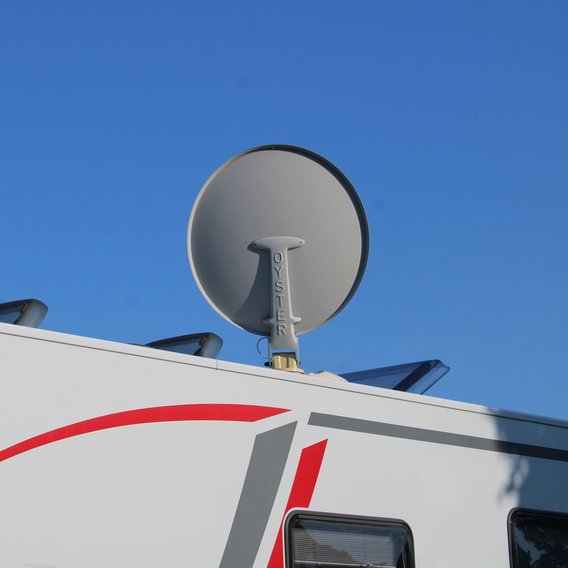
Anyone who doesn’t want to go without TV whilst on holiday will probably have already ordered a satellite system when booking their vehicle. As most campsites have Wi-Fi, you can also log in with your laptop and watch live streams or treat yourself to a film from the media library. Of course, you can also surf the internet and find out about your next destination or suitable campsites and parking spaces.
Another option is to install a router (including LTE and Wi-Fi antenna), which provides better internet access independently of the Wi-Fi network. If you do not connect to the 230-volt mains supply at the campsite or parking space, you will need sufficient power for your laptop, amongst other things.
In general, it is advisable to bring small voltage converters that can be plugged into the 12-volt socket. These convert the voltage and supply 230 volts. You must check the maximum power rating of the 12-volt socket. In many cases, the power is limited to 150 watts, so only a small mobile device (check for CE/EMC certification) can be used.
Power should be drawn from the on-board battery, as otherwise there is a risk of draining the starter battery, leaving it unable to start the engine.
If you want to save electricity in general, you can save a significant amount of power – particularly in older motorhomes – by replacing old light bulbs with LED bulbs.
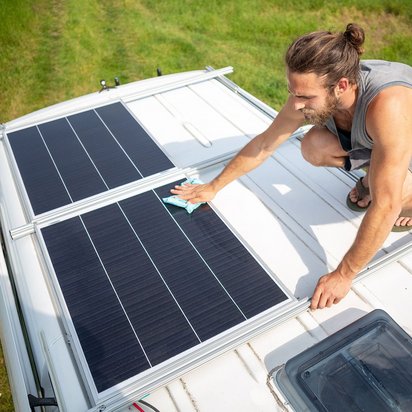
A solar system, which is usually mounted on the roof, ensures independence in terms of power supply. A charge controller must be installed between the solar panels and the on-board battery to prevent the battery from being overcharged and damaged.
One of the most useful accessories is, first and foremost, a bike rack. Once you’ve settled in at the campsite or parking area, you can explore the local area up close in an eco-friendly way. It gives your motorhome a break and is good for your health.
As a rule, on compact motorhomes, it is mounted on the rear wall of the vehicle. However, as the racks have to be secured above the rear lights, it takes a great deal of effort to manoeuvre the bikes into the rails, particularly with e-bikes.
It is therefore much easier to transport bikes on a rack attached to the tow bar. It is worth noting that, due to the overhang, a red-and-white warning sign must be fitted in countries such as Italy and Spain. On panel vans, the bike rack is mounted on the wing door. Generally, the overall length of the motorhome increases depending on the number of bikes being carried.
Those lucky enough to have a rear garage can secure and transport the bikes there. They stay clean and do not get in the way when parking or manoeuvring.
Another alternative is folding bikes, which can also be stowed in a panel van or motorhome with small storage compartments.
A safe motorhome should include at least:
A solar panel with a charge controller is recommended to ensure the service battery is self-sufficient. Inverters (e.g. 12 V → 230 V) should have a maximum power output of ~150 W and be CE/EMC-certified to protect the starter battery. Using LEDs instead of incandescent bulbs saves electricity and extends the service life.
Distribute your luggage evenly – place heavy items at the bottom or between the axles, and light items on top. Have your vehicle weighed if necessary. It is particularly important to fill the fresh water tank only as needed, so as not to exceed the maximum permissible weight.
Aluminium cylinders weigh only around 5.5 kg when empty, which is roughly half the weight of a steel cylinder – ideal for motorhomes with limited payload. However, aluminium cylinders are not approved for permanent installation and must be inspected or replaced every 10 years.
Steel cylinders are heavier (weighing approx. 11–12 kg when empty), but are inexpensive to hire or exchange and are suitable for permanent installation without the need for regular replacement.
A reversing camera significantly improves safety when manoeuvring by making the blind spot behind the vehicle visible and reducing the risk of accidents.
Experience shows that retrofit cameras are useful and, depending on the vehicle, technically feasible, even though they require wiring and should ideally be fitted by professionals.
Reversing cameras are not compulsory, but highly recommended – especially in tight parking situations or when reversing frequently.
Solar systems – whether permanently installed or portable – increase independence and enable several days of self-sufficient power supply for lighting and the fridge.
Disadvantages include high initial costs, dependence on weather and space, and limited output in shaded areas or poor light conditions.
Portable solar bags offer flexibility as they can be positioned independently of the motorhome – ideal for shaded parking spaces or when there is limited space on the roof.
For self-sufficient camping and long-term savings, solar systems are usually a worthwhile investment – modular, sustainable and flexible.