Skip to content

Guides and tips

Motorhome registration

Make your dream of owning a motorhome a reality: TÜV NORD guides you through the motorhome registration process step by step: from the minimum equipment requirements and permanently installed components right through to the official report required for motorhome registration.

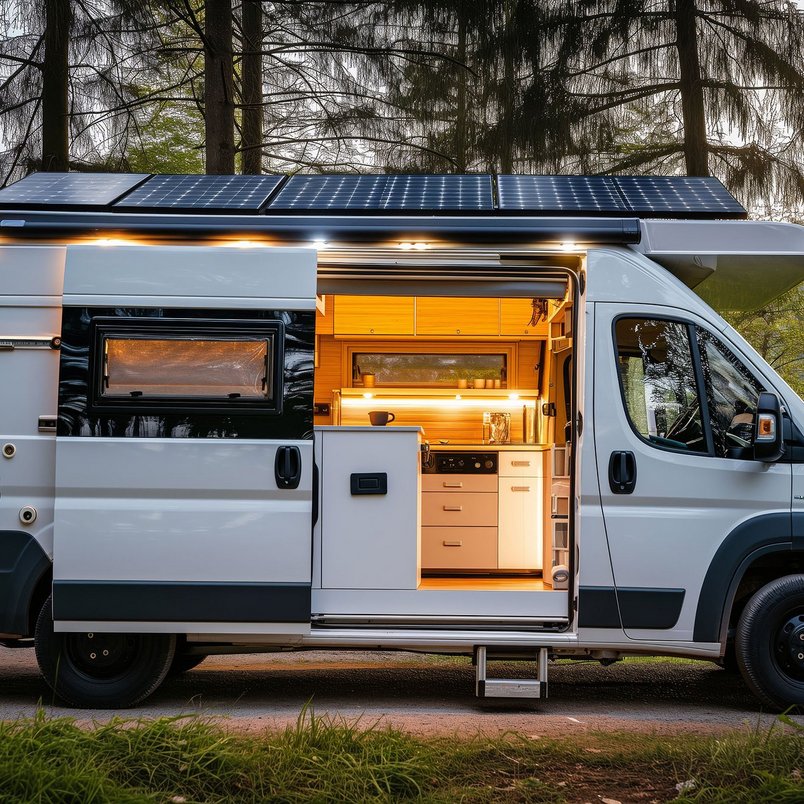
Zulassung als Wohnmobil mit allen Voraussetzungen

What counts as a motorhome: prerequisites & minimum requirements

Under the German Road Traffic Licensing Regulations (StVZO), TÜV Information Sheet 740 and the current vehicle class M (special-purpose vehicles), a vehicle is officially classified as a motorhome if it meets at least the following criteria:

Minimum equipment (according to StVZO & VdTÜV data sheet 740)

  • Seating area with a table: The table may be removable, foldable or stowable.
  • Sleeping area: A fixed sleeping surface or a fold-down seating area is sufficient.
  • Cooking facilities: Permanently fitted, suitable for the interior and with heat protection. May be fold-out or pull-out.
  • Storage space: Cupboards or shelves that securely store clothing, provisions or luggage – exceeding the standard of a car.

Cosy impression & living area

  • The interior must be primarily designed for living purposes and create a homely environment – including at least two side windows and ventilation in accordance with DIN EN 721.
  • Furniture edges must be rounded or rubber-coated to prevent the risk of injury. The floor covering must be non-slip and the materials used must be flame-retardant.

Safety & escape routes

  • Seats in the living area must comply with the requirements of Section 35a of the German Road Traffic Licensing Regulations (StVZO), including approved seatbelt mountings and test certificates (e.g. ABE, component certificates).
  • Two independent escape routes are required for each bench seat (e.g. doors, windows or hatches on different sides of the vehicle). Doors must be wider than 50 cm, at least 1 m high and open outwards from the inside.

Technical and installation-related specifications

  • Gas solutions: fixed installations with certified E-marking, where gas cylinders are safely housed and ventilated.
  • Electrical installation: 12/24 V or 230 V in accordance with VDE standards (e.g. DIN VDE 0100-721), approved components.

Assessment & authorisation

  • Following the conversion (involving permanently installed fittings), the existing type approval will lapse.
  • An officially recognised expert from TÜV NORD will issue you with a report in accordance with Section 19.2 of the Road Traffic Licensing Regulations (StVZO) and Information Sheet 740, on the basis of which the vehicle registration authority will make the new entry as a ‘Miscellaneous Motor Vehicle – Motorhome’.

How to convert for motorhome registration: step by step

Does your motorhome have sufficient structural integrity? All vehicle manufacturers have strict bodywork guidelines that are crucial for the stability of the bodywork and its attachment to the vehicle. If you remove or modify load-bearing body parts, the vehicle manufacturer may need to approve these changes separately.

Use materials that are flame-retardant for the interior fittings. They should also be shatter-resistant wherever possible. The assessment criteria are the guidelines for safety glass or comparable standards.

Seats - safe & approvable

  • Your seats must be fitted with type-approved seat belts and be permanently fixed in place – loose seats or those that can be removed without tools will not be accepted.
  • The maximum permitted number depends on the total weight and the permissible payload (Section 35a of the Road Traffic Licensing Regulations); we recommend seeking advice from our TÜV NORD experts at an early stage.

Access and emergency exits - convenient & safe

  • The lowest step height must not exceed 500 mm and must be non-slip.
  • Ideally, there should be a separate door to the living area on the right-hand side of the vehicle; in the case of double doors, the front door leaf must overlap.
  • Each seat must have two independent escape routes – e.g. via doors and windows on different sides of the vehicle; emergency exits must be at least 50 cm wide and 1 m high.

Heating - tested & professionally installed

  • Your auxiliary heating system must be type-approved and installed in accordance with the manufacturer’s instructions; the inspection sticker must remain legible at all times.
  • Experience shows that professional installation increases the likelihood of successful motorhome registration.

Electrics - safe & in accordance with regulations

  • The installation must comply with VDE/DIN standards – particularly in the case of 230 V systems.
  • Professional installation prevents fire risks caused by short circuits or overloading.

Furnishing the living area - practical & safe

  • Furniture such as cupboards and tables must be permanently fixed in place – the table may be fold-out.
  • Materials should be flame-retardant, edges should be rounded and cupboards should be lockable to prevent items from flying out in the event of an emergency braking manoeuvre.

Ventilation & fresh air supply - separate & effective

  • The living area and driver’s cab require an independent fresh air and exhaust air system – with no connection to the auxiliary heating, exhaust system or gas system.
  • Safety ventilation in accordance with DIN EN 721, with separate supply and exhaust air openings, is mandatory.

Outdoor installation - safe & injury-free

  • Spare wheels or accessories fitted to the outside must be secured with at least two independent fastenings.
  • Exposed sharp edges must be avoided – here too, protection against injury is paramount.
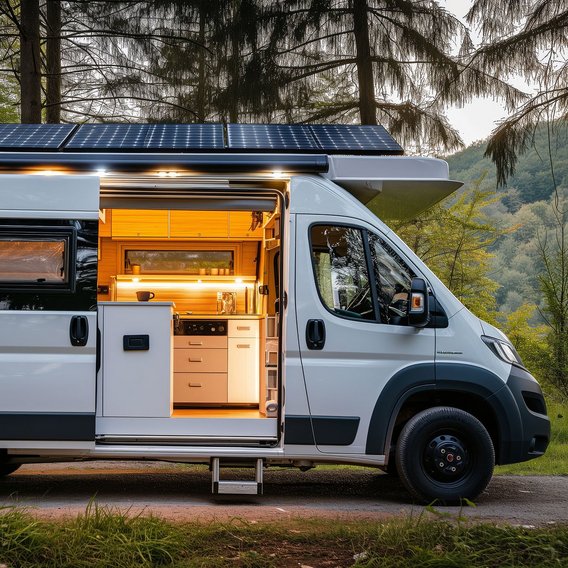
Camperausbau mit Solaranlage und moderner Innenausstattung
Practical experience rather than theory

Ulf & TÜV NORD: From van to motorhome

A real-life example: Ulf shows how he converted his van into a campervan – including MOT approval, fittings, interior layout and videos. Find out how you can get your campervan registered too.

Conversion & authorisation

1

Motorhome registration vs. lorries/cars

Depending on its conversion and intended use, a vehicle can be registered as a motorhome, a car or a lorry. According to the StVZO, a motorhome must have at least the following features permanently fitted: sleeping accommodation, seating, a table, a cooking area and sufficient storage space. Without such fittings, higher tax and insurance rates apply.

2

Type approval & bodywork approval

Any modification to the vehicle, particularly the fitting of additional components, may result in the general operating licence being revoked – unless an installation inspection or individual inspection has been carried out in accordance with Section 19 of the Road Traffic Licensing Regulations (StVZO). Have the individual inspection carried out by TÜV NORD. The registration certificate and the vehicle registration details will then be updated.

3

Tax & Insurance

A vehicle registered as a motorhome usually pays significantly lower tax, as this is based on gross vehicle weight and emissions class – not on CO₂ emissions, as is the case with passenger cars. Furthermore, motorhome insurance is often cheaper and offers special rates for contents and seasonal use.

4

Kitchen and water supply

Install a compact kitchen unit with cooking facilities, a sink and a fridge. For the water supply, you will need fresh water and waste water tanks, as well as a pump. Make sure you choose hygienic materials and opt for easy maintenance.

What you should know

Frequently asked questions about motorhome registration

In accordance with Section 19(2) of the Road Traffic Licensing Regulations (StVZO), the general operating licence expires if 

  • you change the type of vehicle (e.g. car → motorhome),
  • a hazard arises or
  • the noise or exhaust emissions deteriorate.

To reinstate it, an individual inspection by us is mandatory. You can conveniently have this carried out at one of our TÜV NORD centres. The vehicle can then be registered as a motorhome.

In particular, for vehicles weighing over 3.5 tonnes, registering as a lorry can be advantageous – as this often means a lower lorry tax rate applies. For vehicles under 3.5 tonnes, however, registering as a motorhome is usually cheaper.

  • Identity card or passport
  • Certificates of registration, Parts I and II
  • eVB number (insurance certificate)
  • Report on individual inspection in accordance with Section 19 of the Road Traffic Licensing Regulations (StVZO)
  • Proof of general inspection (HU)
  • COC/EC certificate of conformity (if applicable)
  • SEPA mandate for vehicle tax

The road tax for motorhomes is calculated based on the vehicle’s emissions and total weight, and is generally lower than for comparable passenger cars.

Anyone wishing to determine the exact amount of tax can calculate the vehicle tax directly online using the Federal Ministry of Finance’s calculator.

Discover exciting motorhome topics and helpful guides

From travel inspiration to practical tips on motorhomes: discover a wide range of topics to make your next trip even more relaxing and safe.
Camperausbau mit Solaranlage und moderner Innenausstattung

From a panel van to a camper van

Are you thinking of converting your van into a campervan? We’ll show you what you need to bear in mind when doing the conversion yourself – from planning to registration.
Go to the Camper Conversion Guide
Beladen eines Wohnmobils für eine Reise

Payload, axle load & weight at a glance

Overloading can result in a fine – we explain how to calculate the permissible payload and distribute the weight effectively.
More about motorhome payload
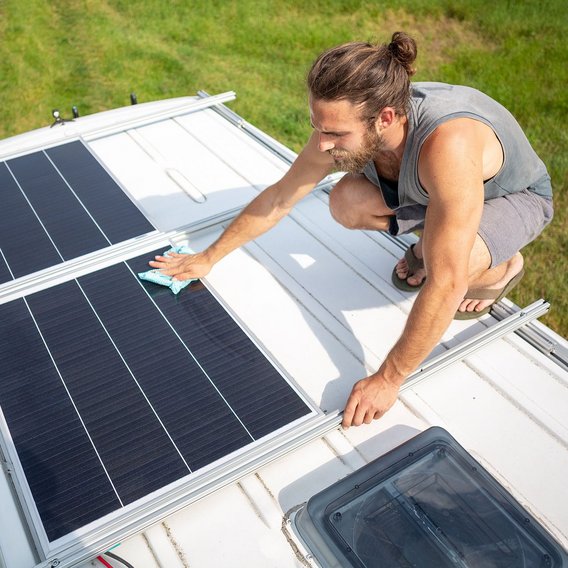
Reinigung von Solarpanelen auf einem Wohnmobil

Handy accessories for when you're on the go

From solar panels to awnings: which accessories are really worth having? Our recommendations for greater comfort and safety when travelling.
Tips on motorhome accessories

Contact

We look forward to your enquiry!

TÜV NORD Mobilität

Guide and tips