Guide and tips
Rising fuel prices and environmental awareness make fuel-saving driving more important than ever. TÜV NORD shows you how you can reduce consumption with small everyday measures and at the same time protect your engine, wallet and the environment. From the right driving style to regular maintenance and sensible loading.

The next stage of the CO₂ tax came into force in January 2024. It now amounts to 45 euros per tonne. This has increased the price of petrol and diesel by around three cents per litre.
The CO₂ tax is set to rise to 55 euros per tonne in 2025. And there is no end in sight. So it's worth asking: How can you save petrol? With these simple tips, you can significantly reduce your fuel consumption and protect the environment at the same time.
The equipment, care and maintenance of the vehicle also have a major influence on fuel consumption. Small adjustments can have a big impact. With a few simple changes to your vehicle, you can significantly reduce fuel consumption.
Regular testing of exhaust emissions and the use of low-friction oils are helpful measures for reducing fuel consumption.

In addition to a fuel-efficient driving style and vehicle optimisation, you should also make sure you choose a vehicle that consumes less fuel when buying a car.
Which car is best suited to you and your budget? In addition to the different fuel prices, you should also consider the purchase price and your annual mileage.
Before you buy a new diesel or petrol car, you should carefully weigh up the pros and cons. A diesel is often more expensive than a petrol engine. However, in comparison, it impresses with its low fuel consumption and more favourable fuel prices.
Conversely, with a petrol car you often benefit in terms of insurance and longer inspection intervals. You also have to retrofit some diesels with a soot filter in order to enter low emission zones.
Depending on the distances you travel and which model you drive, you should therefore consider: Are the lower fuel costs worth it compared to the other costs?
In general, it can be said that a third of the diesel vehicles available on the market today pay for themselves from a mileage of 10,000 to 15,000 km per year. It is worth comparing the diesels with each other.
TÜV NORD Mobilität offers you the following services when buying or selling a car TÜV NORD AutoKaufCheck. Together with you, our experienced experts will scrutinise the car and tick off a checklist with over 80 test points. This way you are well informed about the true condition of the vehicle.
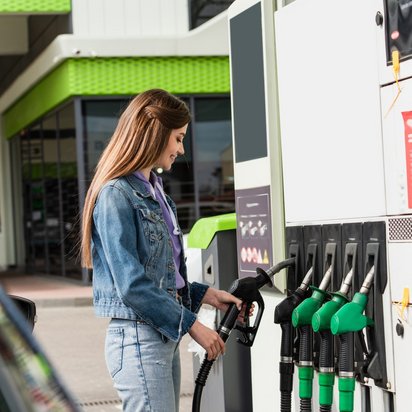
The higher the prices at the petrol pump, the more interesting the question: Is my car's fuel consumption above the norm?
TÜV NORD Mobilität has worked with the Institute for Vehicle Technology and Mobility (IFM for short), where we can determine the exact fuel consumption using state-of-the-art testing equipment.
Before the fuel consumption can be determined, we test the exact rolling and air resistance on the road.
We then transfer the characteristic values determined in the practical road test to the chassis dynamometer. This must simulate exactly the same resistance.
There is a direct correlation between CO₂ emissions and fuel consumption. Accordingly, we now measure the CO₂ emissions of your car on the chassis dynamometer. The fuel consumption can be calculated from the calorific value of the fuel.
This is how the test runs:
We differentiate between three parts in the test series:
Contrary to the manufacturer's claims, numerous tests have shown no effect whatsoever.
One time magnets are supposed to be wrapped around the petrol lines, the next time a mysterious gel is placed in the air filter. Manufacturers and advertisers are always coming up with new miracles to save fuel.
The sobering truth: independent tests have exposed the manufacturers' promises as mumbo-jumbo, with no proven effect. What is particularly annoying is that these products are sold at outrageously high prices. Car manufacturers also warn against these money-saving products.
In the event of damage, you may lose your warranty or goodwill claims.
TÜV NORD advises: Stay away from fuel-saving products.
Only when an EC federal authority recognises an organisation as an EC test laboratory is it permitted to prepare fuel consumption reports.
Our testing laboratory at the Institute for Vehicle Technology and Mobility (IFM) is accredited as a European testing laboratory in accordance with DIN EN ISO / IEC 17025 and DIN EN 45001 and carries out exhaust gas and fuel consumption measurements on cars, lorry engines and motorbikes.
Depending on your individual requirements, you can use the following tools to calculate your fuel consumption and plan your route efficiently (as of April 2024)