Guide and tips
Whether changing from summer to winter tyres or vice versa: changing tyres in good time ensures greater safety, better vehicle control and optimum driving characteristics. TÜV NORD Mobilität explains what you should pay attention to: from the tread depth to the right time and professional fitting.

Every year, many of you have to change your tyres in spring and autumn.
Summer tyres run optimally at outside temperatures between 10 °C and 40 °C. If the temperature regularly drops below 7 °C in autumn, the rubber of the fair-weather tyres hardens and the tyres have less grip. This is when you should replace your tyres at the latest.
Winter tyres are required by law if the weather conditions make it necessary. In practice, the rule of thumb "from O to O" has become established, i.e. to drive with winter tyres from October to Easter. If the temperatures deviate significantly from this rule, it makes sense to adjust the time of tyre change accordingly.
For both summer and winter tyres winter tyres have a minimum tread depth of 1.6 millimetres to be considered roadworthy. However, to ensure sufficient safety, it is advisable that your winter or all-season tyres do not fall below a value of 4 millimetres.
External factors such as heat or cold can cause material fatigue and thus shorten the service life of tyres. Therefore, always check the age of your tyres before changing them and replace them after six to eight years.
With the help of the four-digit DOT number on the tyre sidewall, you can quickly determine the age: It is surrounded by an oval circle and indicates the calendar week and the year of manufacture.
When replacing tyres, prevent the jack from collapsing or slipping away by ensuring that it is positioned on a level and firm surface.
Place it in the designated position, which can be recognised by a marking (see operating instructions), and do not tilt it so that you can jack up your car safely.
Imbalances in tyres can lead to uneven tread wear, with negative consequences for the handling and driving stability of the car. You need to take action at the latest when your steering wheel starts to wobble!
It is best to use the tyre change for regular, professional balancing. This will also increase the service life of your tyres.
If you change your tyres yourself, clean and inspect your tyres for damage before storing them, e.g.
Also remove stones from the tyre tread to ensure that the tyres are not further damaged during storage. Only if your tyres are intact can you drive safely and will also pass the next main inspection inspection.
Mark each wheel immediately after removal with chalk or a wax crayon so that you know where to reattach this tyre at the start of the season, e.g. "VR" for front right, etc.

Changing tyres
Use the wheel change to swap the positions of the tyres to ensure even tyre wear.
There are different procedures for this, depending on the drive of the vehicle of the vehicle:
If you have a front-wheel drive car, swap the front tyres on the same side to the rear, while the rear tyres must be offset diagonally to the front. The reverse is true for rear-wheel drive. For a car with four-wheel drive, the tyres always change position diagonally, i.e. from the front left to the rear right.
Tyres with directional tyres are an exception: You can recognise the direction of rotation on the tyre sidewall by the word "Rotation" or "Direction" and an arrow indicating the direction of rotation. You must always change such tyres without changing sides, i.e. from front left to rear left.
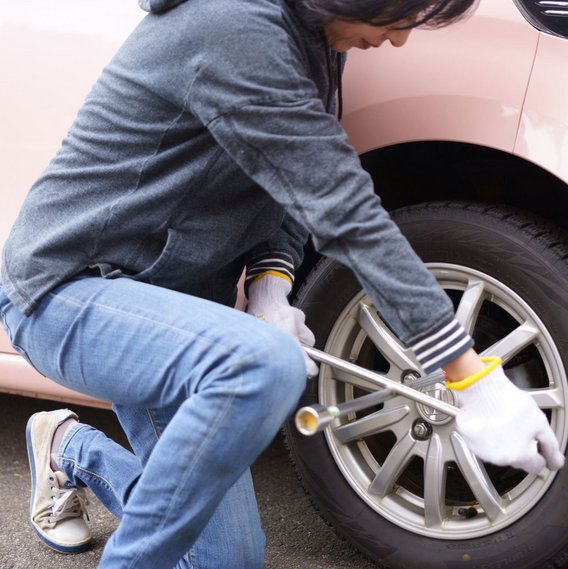
When fitting tyres, always ensure that the wheel bolts are tightened to the prescribed torque:
Always tighten the wheel nuts crosswise and repeat this after the first 50 to 100 kilometres.
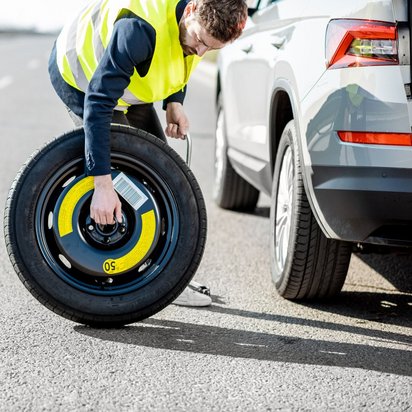
The air pressure should be adjusted after every tyre change. The correct tyre pressure not only improves handling and braking distance, but also reduces fuel consumption.
Tip: When storing tyres, increase the pressure by approx. 0.5 bar beforehand to compensate for the natural loss of pressure during the storage period.
Tyres like it cool, dry and dark. A cellar or garage are ideal.
According to the German Road Traffic Regulations (StVO), there is no age limit for tyres, with one exception: a maximum of six years applies to trailers with 100 km/h approval.
TÜV NORD Mobilität recommends that tyres over six years old should be regularly checked for cracks, tread and porosity and replaced if necessary. A gentle driving style, correct storage and regular tyre pressure checks will extend the service life of your tyres.
For a safe and smooth tyre change, you need
A tyre change at a garage usually costs from 20 euros (without storage). In addition, many garages offer professional tyre storage for an extra charge - convenient and safe.