Guides and tips
Vehicle lighting plays a crucial role in safety. Furthermore, manufacturers are increasingly using lighting systems as design features. Anyone wishing to customise their car’s lighting should bear a few things in mind.
Request light conversion now
To ensure that your vehicle’s lighting system is safe and effective, the following points are crucial:
Headlights are blinding me: why is that?
More and more vehicles are fitted with LED or xenon headlights. Unlike conventional halogen bulbs, however, these emit a rather cold light. Especially in the dark, these modern headlights can cause glare, even though the same glare limits apply.
The lighting system is designed to ensure that a vehicle remains clearly visible to all road users at all times, even in the dark.
The rule is as follows:
The full-beam headlights are usually fitted in the front headlights and widen the field of vision on poorly lit roads with no oncoming traffic.
Unlike daytime running lights or parking lights, dipped headlights provide ideal illumination of the road without dazzling oncoming traffic. At the same time, they ensure that you are visible to others. They must be switched on at the latest when visibility is less than 150 metres.
The marker light indicates the width of a vehicle in the dark, ensuring that sufficient distance is maintained when overtaking or when encountering oncoming traffic.
On wide vehicles, the marker lights serve as a supplement to the side marker lights.
As a passive signal light, the daytime running light makes cars and lorries more visible during the day. These are usually fitted to newer vehicles and switch on automatically when the vehicle starts moving, provided the dipped headlights are not activated.
The parking light is used to illuminate a parked vehicle within built-up areas.
The front reflectors are devices that reflect light from oncoming traffic, providing additional visibility in the dark.
The reversing light comes on when the vehicle is reversing.
Fog lights are used in fog, heavy snowfall or heavy rain.
Unlike dipped headlights, they spread the light flat across the road. You can either use them in addition to dipped headlights or switch to them when visibility is severely restricted.
Direction indicators are also commonly referred to as 'indicators' and are used to signal a change of direction.
Hazard warning lights are used to warn of danger, for example at the end of a traffic jam, in the event of an accident, or if a vehicle has broken down.
Side marker lights and side reflectors indicate the outline of a vehicle and are linked to the parking lights.
In Germany, they are required by law on all vehicles (except passenger cars) longer than six metres and on trailers. They ensure that the vehicle is more easily visible from the side in the dark.
The tail lights make it easier for other road users to spot a vehicle in poor visibility. They come on at the same time as the parking lights.
The brake light indicates that the vehicle is braking and warns following traffic. As a rule, two brake lights and an additional, raised brake light are required.
The rear fog light is a bright red, high-intensity auxiliary light that makes the vehicle visible in fog and is fitted to almost all modern vehicle models.
It may only be used when visibility is less than 50 metres – caused by fog.
Rear parking lights indicate that a vehicle is parked in built-up areas.
Rear reflectors are devices that make the vehicle visible to traffic behind and are fitted either at the rear or on the bumper. They ensure that the vehicle is visible to other road users when no other lights are on.
In addition, entry and exit lights may come on when the vehicle is stationary and a person wishes to get in or out, or when items are being loaded into the boot.
This light illuminates the ground around the vehicle.
Check your vehicle’s lights regularly. Headlights can become dull over time. You should therefore clean and polish them regularly and check that all lighting systems are working properly. This is particularly important when you take your vehicle for its annual roadworthiness test.
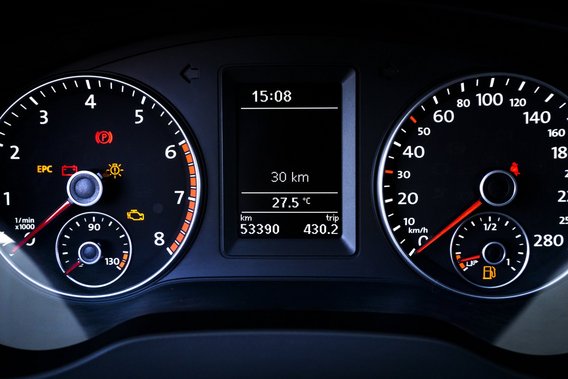
The rear fog light on the car is indicated by a separate symbol on the dashboard. The symbol usually shows a stylised headlamp with a line of small waves extending to the right to represent fog. When the rear fog light is switched on, this symbol lights up yellow on the dashboard. In addition, the rear fog light at the rear of the vehicle lights up red when it is switched on.
Please note that the use of the rear fog light is regulated by law and may only be used in poor visibility conditions when visibility is less than 50 metres. When visibility is 50 metres, the maximum speed limit is 50 km/h.

Hardly any other profession spends as much time on the road as lorry drivers – so Christmas enthusiasts may well be keen to have an atmospheric string of lights and a flashing LED Christmas tree.
However, the same rules apply as for cars: anything that shines whilst driving and may distract or irritate the driver or other road users is prohibited. Illuminated nameplates, externally mounted illuminated company signs or additional light strips are also off-limits.
Modifications can be made to a vehicle’s lighting system to improve its appearance, visibility or performance.
This may include the fitting of LED lights, xenon headlights, fog lights or other special lighting elements to achieve a personalised look. However, not everything that looks good is legal. Furthermore, unauthorised lights constitute a significant fault during the annual roadworthiness test.
Please note that when making changes to vehicle lighting, local laws and regulations regarding vehicle lighting must be complied with to ensure road safety. (see section on legal regulations)
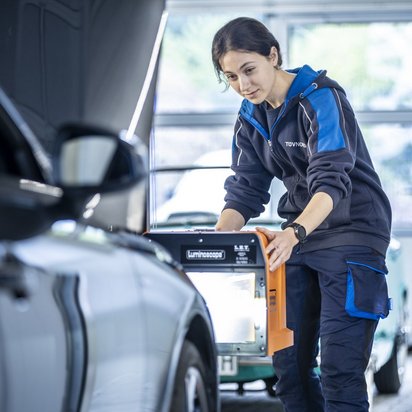
According to the StVZO, anything not expressly mentioned in Section 49a et seq. is prohibited. Consequently, the following modifications are not permitted:
It looks spectacular, is easy to fit and can be ordered online – yet underbody lighting is prohibited. But why aren’t lights allowed under the car? The light can distract other road users and thus poses a safety hazard. If you’re caught using it on public roads, you’ll face a fine, receive a penalty point in Flensburg and, in some circumstances, your vehicle registration may be revoked. Underbody lighting is also prohibited, even with an additional switch.
Car ambient lighting refers to a special type of lighting designed to illuminate the interior of the vehicle in order to create a pleasant atmosphere. This lighting is often located in various places within the vehicle’s interior, such as along the door panels, in the footwell, on the dashboard or in other areas.
Ambient lighting can be adjusted to different colours and brightness levels and helps to create a comfortable and appealing environment in the car. Installation of this interior lighting is subject to compliance with the provisions of the StVZO. The installation of ambient lighting should always be carried out by a specialist workshop.
What legal requirements must be taken into account for interior lighting:
Ambient lighting must be installed in accordance with Sections 49a and 30 of the Road Traffic Licensing Regulations (StVZO) and ECE R48 for lighting installations.
LED interior lighting in cars is only permitted if it can be switched off whilst driving and does not emit light to the outside. All lights fitted inside the vehicle must not impair the driver’s vision or dazzle other road users.
In addition, car accessories such as vehicle indicators and white rear-facing lights are not permitted.
The law requires that all lighting equipment must be in working order at all times.
Vehicle lighting systems (= LTE) comprise the various lighting components used for illumination and signalling on vehicles. These systems serve to improve the visibility of the vehicle and to signal to other road users.
Lighting equipment includes:
The installation of vehicle lighting is governed by both national regulations under Sections 49a–54 of the StVZO and harmonised EU regulations or ECE (Economic Commission for Europe) regulations:
How can I tell if a lighting fixture is approved?
Lighting equipment must be type-approved. You can recognise this by the relevant approval mark, which consists of the approval number and the symbol of the approval authority.
Example 1: E4 The country code 4 indicates that this component was approved in the Netherlands. The E refers to an ECE regulation.
Example 2: e 1 The component was approved in Germany on the basis of an EU directive (indicated by the country code ‘1’).
All lighting equipment fitted to the vehicle must be in working order. Road traffic regulations make no distinction between lights used when stationary and those used whilst driving.
If unauthorised lighting equipment is used, the vehicle’s general operating permit (ABE) will be revoked and you may face a fine.
Furthermore, your third-party liability insurance cover may be at risk. In the event of an accident, the insurance company may refuse to pay out or assert claims for recourse if the accident is attributable to the vehicle modifications.
During the annual roadworthiness test, cars fitted with unauthorised lamps, lights, headlights or modifications to the lighting equipment that cannot be approved are generally classified as having a significant defect. In this case, the roadworthiness certificate will be refused.
A parts certificate (TGA) is usually supplied with safety-critical tuning parts. The installation must be inspected and approved. If the result is positive, the experts issue a certificate which can be used to have the modification entered in the vehicle documents at the registration office. Parts certificates are valid without restriction until 19 June 2028. Thereafter, individual approvals can be carried out using these certificates.
From June 2028, component type approval will replace the component certificate. Whether a modification approval is required can be determined from the TTG approval documents; there is no universal rule regarding the necessity of such approval. TÜV NORD is already issuing TTGs.
If the description states ‘ABE’, no additional approval is usually required. However, tuning enthusiasts must strictly adhere to the instructions set out in the approval certificate. These include, for example:
Anyone who fails to comply risks losing the car’s roadworthiness certificate. Furthermore, you must always have the ABE certificate to hand, just like your vehicle documents, and be able to produce it during a roadside check.
With an ABG certificate, approval of modifications is not usually required, unless explicitly requested. However, components supplied with an ABG certificate are generally intended for specific vehicle models only, so it is advisable to check carefully before purchasing.
This certificate is equivalent to an ABE certificate, but also confirms that the tuning part complies with EU regulations. These items do not usually need to be approved separately, but the documents should always be kept to hand with the vehicle documents.
Whether it’s ABE, ABG or ECE – caution is always advised when tuning parts interact with one another: for example, when a sports steering wheel is fitted alongside a set of new wheels. In such cases, individual approval is required. This is also necessary if a bespoke, one-off part is fitted.
Whether you’re switching to LED retrofits, fitting additional headlights or updating your vehicle’s lighting design: don’t take any risks at your next MOT test. Our experts will review your plans in advance.