Guides and tips
Winter tyres
Get your vehicle ready for winter – with certified winter tyres and tips from TÜV NORD, you’ll stay safe on the road even when temperatures drop below 7°C.
Reliably measure tread depth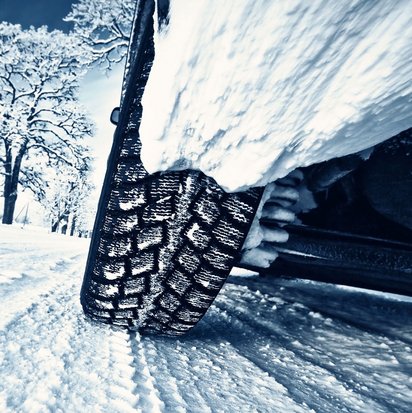
Guides and tips
Get your vehicle ready for winter – with certified winter tyres and tips from TÜV NORD, you’ll stay safe on the road even when temperatures drop below 7°C.
Reliably measure tread depthWhen temperatures drop below 7°C, the rubber compound in summer tyres hardens and grip decreases significantly – which is why it is advisable to switch to winter tyres by this point at the latest.
Winter tyres should also have a minimum tread depth of 4 mm – even though the legal minimum is only 1.6 mm – in order to noticeably reduce braking distances on wet, snowy or slushy roads.
In Germany, winter tyres are mandatory in certain conditions: in wintry conditions such as black ice, snow or slush, you may only drive on tyres that are reliably suitable for winter use – since 1 October 2024, these must bear the Alpine symbol, which older M+S tyres no longer meet.
In addition, tyres with a speed rating lower than that of your vehicle require a clear speed sticker to ensure operational safety.
Time and again, people turn up at TÜV NORD in winter with summer tyres. In Germany, however, there is a situational requirement for winter tyres. This means that in the event of black ice, snow-covered roads, slush, or icy or frosty conditions, a motor vehicle may only be driven with tyres marked on the sidewall with the ‘Alpine symbol’ (a mountain pictogram with a snowflake).
Tyres that meet this requirement are referred to below as winter tyres. During a transitional period until 30 September 2024, winter tyres manufactured before 2018 and marked ‘M+S’, ‘M&S’ or ‘M.S.’ without the ‘Alpine symbol’ were permitted to continue being used in winter conditions.
Since October 2024, winter and all-season tyres bearing the “M+S”, “M&S” or “M.S.” marking without the additional “Alpine symbol” are no longer permitted in winter conditions
Winter tyres are not mandatory on motorcycles or Class L vehicles (motorcycles, trikes and quads). However, if they are used, the M+S marking is sufficient to indicate they are winter tyres. The snowflake symbol is not available for these tyres.
A fine of €40 is payable for any breach, as well as one penalty point on your driving record in Flensburg.
It is not just snow and ice that make winter tyres necessary. When temperatures drop below 7 degrees Celsius, the grip of summer tyres decreases. Braking distances become longer and the vehicle skids more easily. In such circumstances, even ESP and ABS are of no use.
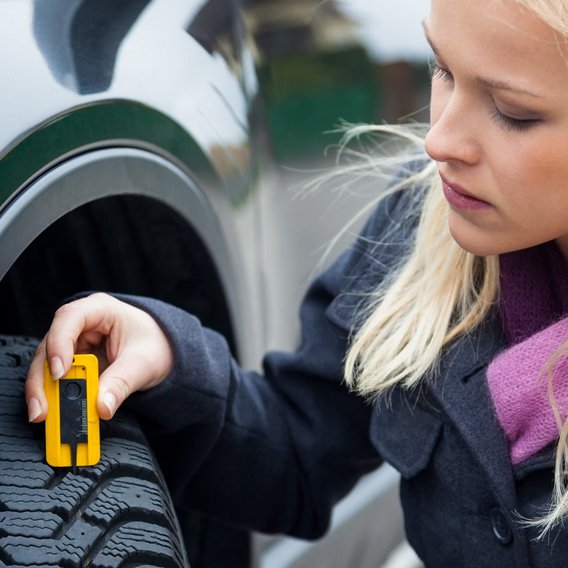
The law stipulates a minimum tread depth of 1.6 millimetres. However, in winter we recommend that you have at least 4 millimetres of tread on your tyres for better grip, or that you replace your tyres after 10 years at the latest!
When average temperatures drop below 7 degrees Celsius, it is high time for a tyre change. This is because winter tyres offer better grip not only in wintry road conditions, but also at temperatures below the 7-degree mark. This is due to the tyres’ grip properties. In cold weather, the rubber of summer tyres hardens and no longer provides sufficient grip on the road. Although all-season tyres are generally better suited to winter than summer tyres, they are only a compromise when compared to winter tyres. Anyone who relies on their vehicle daily in winter or is planning a long journey should therefore definitely use winter tyres.
Under the law, the driver of a car is responsible for complying with the winter tyre requirement in Germany, not the registered owner listed on the vehicle registration document. Consequently, if a hire car is not fitted with winter tyres, it is the driver who is liable, not the hire car company. There is no legal entitlement to the provision of a car suitable for winter conditions. You should therefore always check before setting off in a hire car that winter tyres are fitted and that the tread depth is correct – for your own safety too!
Anyone driving on winter tyres must display a winter tyre sticker in their car showing the maximum permitted speed. Alternatively, the driver can be notified of the maximum permitted speed via an automatic display in the vehicle. This applies at least whenever the winter tyres are approved for a lower maximum speed than the car is capable of. Otherwise, you risk a fine of €20 if stopped by the police. The sticker is usually applied by the tyre fitting centre when the tyres are fitted.
Our TÜV NORD experts frequently identify the absence of the sticker or display during the annual general inspection. This is a defect that has been classified as a ‘significant defect’ since 1 July 2012 and results in the vehicle having to be re-presented for inspection. Therefore, when fitting winter tyres, please ensure the sticker is present or obtain one free of charge from your local TÜV NORD centre. This will enhance your safety, protect you from potential fines issued by the police and, where applicable, save you from having to bring your vehicle back for the MOT test.
Winter holidaymakers travelling abroad without suitable tyres risk losing their comprehensive insurance cover by failing to comply with the winter tyre requirement. Furthermore, in some places it can prove very costly if you are driving without winter tyres.
Always check the applicable regulations in the relevant country before you travel.
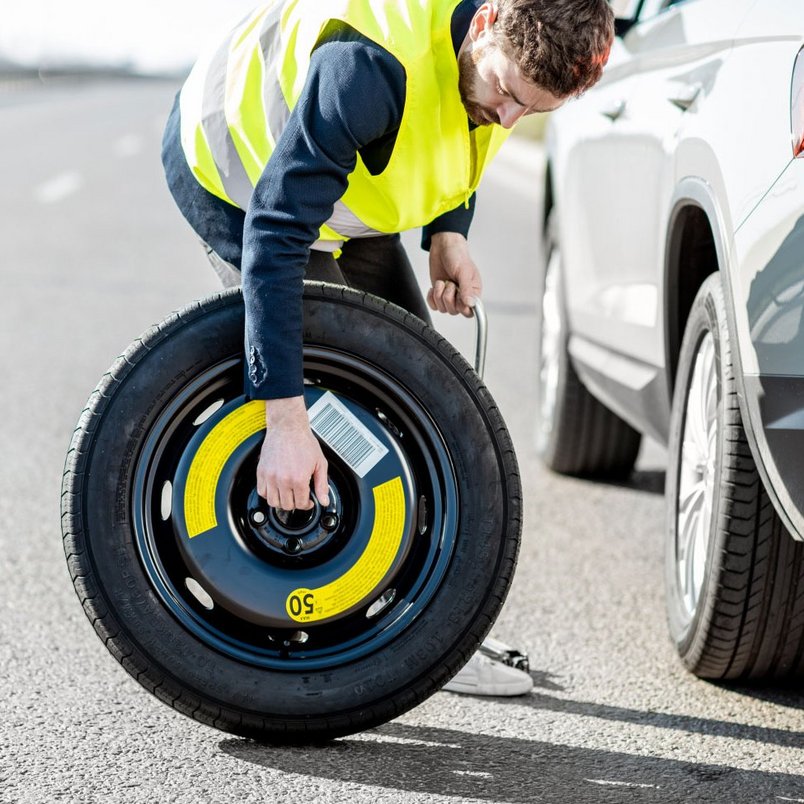
Many motorists fit their own tyres to save money. Our TÜV NORD experts explain what you absolutely must bear in mind when changing your tyres to ensure your car gets through the winter safely.
In Germany, there is no general requirement to use winter tyres – the so-called “situational requirement for winter tyres” applies only in winter road conditions such as black ice, snow, slush or icy patches (Section 2(3a) of the Road Traffic Regulations (StVO))
From 1 October 2024, only winter tyres bearing the Alpine symbol may be used. The old M+S symbol is now only valid for tyres manufactured before 1 January 2018. Failure to comply may result in fines (from €60) and penalty points in Flensburg
You can check the tread depth using a tread depth gauge or a 1-euro coin: if the gold ring disappears completely, there is still enough tread left.
All-weather tyres bearing the M+S or Alpine symbol are generally permitted. However, specialist winter tyres offer significantly better performance on ice and snow – they are safer than all-season tyres, particularly in regions where cold weather and snow are common.
A single millimetre can make a difference of metres in braking distance. Use our simple expert tip to check the condition of your tyres yourself in seconds – and find out when the law comes into play.