Vehicle data
Car checks in just a few minutes
How TÜV NORD Onboard Car Diagnosis is making car sales safer.
Vehicle data
How TÜV NORD Onboard Car Diagnosis is making car sales safer.
12 March 2026
Anyone who buys or takes possession of a car in part exchange will want to know that everything is in order under the bonnet. The experts at TÜV NORD Mobilität have developed a diagnostic tool that provides quick and comprehensive information about the condition of a vehicle and ensures greater transparency and safety on other levels.
It’s so easy and convenient: just quickly pair your smartphone with the car via Bluetooth, and you can use apps to make calls, navigate and listen to podcasts and playlists on the streaming service of your choice even while driving. But what only a few people know is that all this personal data is also stored in the car itself. Once you sell your car or return a leased vehicle, telephone lists and navigation destinations can still be accessed and misused – as can stored means of payment or even garage door codes – with all the associated consequences for previous owners and for car dealers or leasing companies. This is because they are obliged to remove personal data completely in compliance with the GDPR before resale. “Otherwise, they run the risk of fines of 50,000 euros per vehicle in the EU, and as high as 250,000 francs in Switzerland,” says Christoph Elmerhaus, Account Manager at TÜV NORD Mobilität.
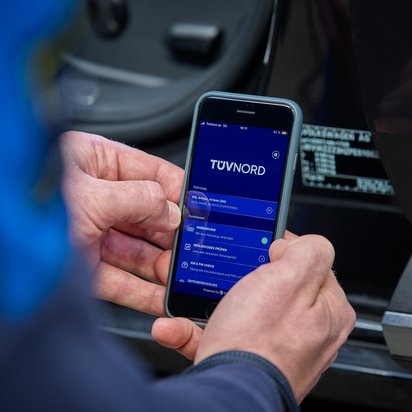
It is precisely for such cases that the vehicle diagnostics expert and his colleagues have developed TÜV NORD Onboard Car Diagnosis. The matchbox-sized diagnostic tool is connected to the OBD socket in the car, which can be used to read out various vehicle data. Once connected, it sets to work, cleaning up privacy-relevant information within minutes.

But this is far from exhausting the possibilities of the tool. It can also read error codes and engine data via the OBD interface, allowing problems and defects in the electronic control units that control the engine, brakes and airbags to be detected at an early stage. Dealers and private buyers alike are thus not exposed to the risk of taking on the burden of expensive repairs along with their new car. “After all, remedying electronic defects is now as expensive as fixing mechanical ones,” Mr. Elmerhaus points out.
The tool can also track down potential manipulations of the odometer reading: Intelligent algorithms identify discrepancies that may be indicative of manipulation. The tool also checks whether the vehicle identification number (VIN) matches the manufacturer’s data. This can be used to determine whether a VIN has been manipulated or forged – indicating that the car has been stolen.

Mr. Elmerhaus and his colleagues aim to add further functions to their multifunctional tool for vehicle diagnostics. The most recent major upgrade has already been integrated. The tool can now also determine the health status of the batteries of used EVs or plug-in hybrids and then issue a battery certificate that will state how much the battery capacity has decreased from new and how much residual capacity and range the battery still has. The health check takes just three minutes, is carried out on the stationary vehicle and meets the Europe-wide standards of the CARA consortium for vehicle take-backs, residual value determination and remarketing. This creates transparency and trust – and removes the biggest uncertainty factor that still makes many people shy away from buying a used electric car.
This is an article from #explore. #explore is a digital journey of discovery into a world that is rapidly changing. Increasing connectivity, innovative technologies, and all-encompassing digitalization are creating new things and turning the familiar upside down. However, this also brings dangers and risks: #explore shows a safe path through the connected world.