Noise protection
Making charging quieter
How to plan and test the sound insulation of battery storage systems.
Noise protection
How to plan and test the sound insulation of battery storage systems.
18 December 2025
Battery storage systems are an essential element of the energy transition. But like any other industrial installation, they make a certain amount of noise. To help clear obstacles on the path to approval, experts like Felix Erbe from TÜV NORD check whether these XXL batteries meet the legal requirements for noise protection.
#explore: Mr. Erbe, where are battery storage systems usually built?
Felix Erbe: It varies. Smaller systems are installed in industrial estates, municipal utilities build them as buffer storage next to existing power plants, and industrial companies install them on their factory premises to enable them to use the electricity generated by their rooftop PV systems during night shifts. Very large storage systems get built near substations far outside built-up areas. But even here, there may be isolated houses or farms whose inhabitants must be protected from noise pollution.
What kinds of noise do battery storage systems emit?
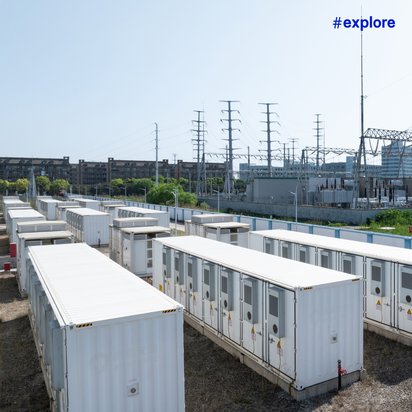
Battery storage systems are usually housed in constructions that look a lot like classic shipping containers. The main source of noise is the fans used to cool the batteries during charging and discharging. The noise output level of a battery container averages out at around 90 decibels. If you were to stand one metre away from the container, about 70 dB would reach your ears, which corresponds to the noise made by a vacuum cleaner. So, a single container isn’t particularly noisy, but issues can arise if you have 300 battery containers in an installation. On top of that, you also get the electrical hum made by the various transformers and the inverter which converts the alternating current from the grid into direct current for storage in the battery. For larger systems, you also need grid connection transformers. Since the main source of noise from these four-metre-high installations is relatively high up, it will spread easily throughout the surrounding area, a factor which planners must take into account when they’re considering their noise protection measures.
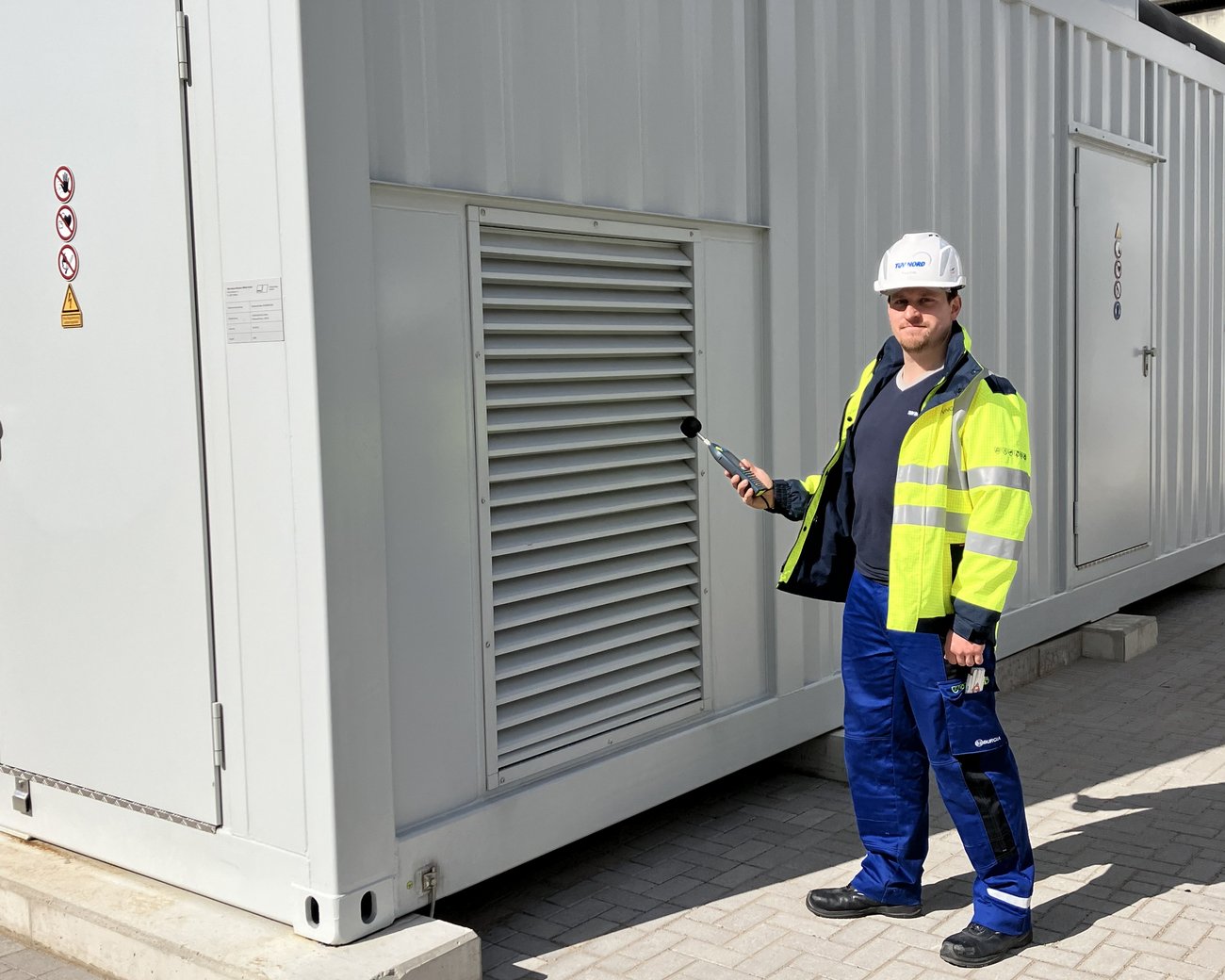
Felix Erbe is an expert in noise and vibration technology at TÜV NORD Umweltschutz. He regularly checks whether battery storage systems fulfil the legal requirements for noise protection.
What do you have to consider in your planning to prevent things from getting too noisy for the neighbours?
There are different options. Most battery containers have a noisy side – the one where the fan sits. So, if all the buildings potentially affected by noise are located in the south, all the fans can be installed on the north side, resulting in a significant noise shielding effect. You can also use silencer kits that are set to the frequency of the fans, meaning that they cancel out individual noises that are particularly irritating. And then you also have classic shielding measures like noise barriers or earth ramparts. But these can’t be too far away from the individual battery containers, or the sound may jump over the barrier. So, the noise barriers must be placed close to the containers, and, if necessary, the plans must allow for additional barriers between rows of containers to ensure there’s sufficient sound insulation.

Where do you as noise protection experts fit into the approval process?
We usually get brought in before the actual approval process; the first thing we do is to carry out a preliminary investigation. We check whether the system is basically feasible in terms of noise protection at the planned site and with the planned layout and which noise protection measures are going to be necessary. For storage systems planned outside settlements, a development plan is first drawn up by the relevant local authority. In this context, we define the specifications for sound insulation that must be considered during construction: What will the system’s maximum noise output be? On which side of the containers should the fans be installed? Which guideline values must be undercut by how much if we’re going to consider previous noise pollution from existing sources on the site, for example.

What happens next?
Once the development plan is in place and it’s time for the actual approval procedure, we prepare an expert opinion for the noise forecast. Based on the final layout of the system and all the components that are to be used in it, we use a special simulation program to calculate the noise propagation and whether the guideline values are going to be complied with for all the houses in the vicinity. This simulation model takes into account the location and height of the planned installation and its noise sources, the planned noise protection measures and the topography of the site, as this also has an impact on noise propagation.
If our report gives the green light and all the other requirements – like fire protection, for instance – are also met, the authority will issue the building permit. Once the storage system has been commissioned, an acceptance measurement is carried out to ensure that the predicted values aren’t exceeded. If they are, the operators will have to make further improvements, for example by erecting more noise barriers. To be on the safe side, however, we always look at the worst-case scenario in our forecasts, by which I mean the highest possible theoretical noise level. After all, if the system stays below the guideline value in this extreme situation, it will in all other cases anyway. For example, in this calculation, we assume that the battery storage system fans will run under full load day and night. In fact, however, this will only be the case at peak times: when there’s a lot of available electricity in the grid or on particularly hot summer days. This means that the real noise pollution tends to be lower than predicted.
This is an article from #explore. #explore is a digital journey of discovery into a world that is rapidly changing. Increasing connectivity, innovative technologies, and all-encompassing digitalization are creating new things and turning the familiar upside down. However, this also brings dangers and risks: #explore shows a safe path through the connected world.