Hydrogen
Perennial favourite
How to test hydrogen engines and where they are needed.
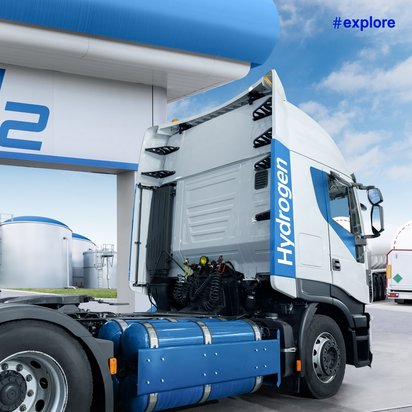
Hydrogen
How to test hydrogen engines and where they are needed.
15 January 2026
When we talk about hydrogen in lorries, we actually always mean fuel cells that convert this volatile gas into electricity, which in turn drives an electric motor. But hydrogen can also be combusted directly. TÜV NORD expert Stephan Nentwig explains how H2 engines differ from their conventional combustion counterparts, how they are tested and for what purposes they can be used.
#explore: Mr. Nentwig, how do hydrogen engines differ from their conventional combustion counterparts?
The differences aren’t actually all that major. In principle, we’re talking about a typical combustion engine in which the fuel-air mixture is ignited by a spark plug. However, it uses what’s known as a lean concept, i.e. using excess air, in which respect it’s similar to diesel. But since hydrogen is very volatile and is stored under significantly higher pressure than natural gas, for example, the H2 engine places special demands on the engine’s peripherals, such as the injection and engine management systems. Here you have to be very careful to ensure that no unburned hydrogen gets into the exhaust, where it might accidentally ignite, but there are technical solutions to this issue.
You have already carried out type approval tests for hydrogen engines. What were their specific features?
The main challenge was that hydrogen combustion engines have not yet been definitively mapped in the EU regulations for the approval of lorry engines: Like fuel cell drives, these don’t give rise to CO2 emissions as such. In the combustion process, however, the combustion air produces nitrogen oxides, and other exhaust components come from the engine oil, for example. This means that you have to ensure they comply with the legal limits and that the exhaust gas scrubbing systems work reliably. However, the test procedures defined for diesel engines in the EU can’t be applied to H2 combustion engines in all respects. Which is why, in close coordination with the approval authorities, we consulted other international regulations from the UNECE legal system with the aim of adapting these procedures to the requirements of the hydrogen engine. This allowed it to be approved in the context of an exemption from the rules. This has provided us with the basis for further type approval tests of hydrogen engines.

Stephan Nentwig is team leader in the Powertrain/Emissions – Engine Dyno division at TÜV NORD Mobility’s Institute for Vehicle Technology and Mobility (IFM) in Essen. The automotive engineer deals with the homologation and type approval of commercial vehicles for road, rail and inland waterways.
Is it possible to work with the established exhaust gas scrubbing processes in the case of the H2 engine, or is retrofitting required here?
This is one of the advantages of the hydrogen engine: You can indeed use the tried-and-tested systems from diesel engines and even leave out certain components. Since hydrogen, unlike fossil fuels, doesn’t contain carbon, no soot, which accounts for the lion’s share of particulate matter in diesel, is produced during combustion. This means that you don’t need to install particulate filters in H2 combustion engines. These also produce significantly less nitrogen oxides than diesel, which is why the legal limits for these air pollutants are are way higher than is needed, by about 90 percent.
Does the H2 combustion engine also have disadvantages compared to batteries or fuel cells, for example?
One disadvantage is lower efficiency. With the hydrogen engine, as with all other combustion engines, much of the energy contained in the fuel is lost through waste heat. So, the H2 engine achieves an efficiency score of 35 to 45 percent at best. This puts it behind the fuel cell, which manages a score of 50 to 60 percent – until it’s converted into kinetic energy at the wheels. In the case of battery-electric drives, the figure is as high as 80 percent, making them more efficient than any other drive. Efficiency and, with it, fuel costs are particularly relevant in the commercial vehicle sector. In heavy goods transport, these constitute the largest item after personnel costs, meaning that they are crucial when it comes to running haulage businesses economically.
Even given these reservations, where are hydrogen engines still needed?
They’re needed, on the one hand, in regions where there isn’t yet any charging infrastructure, and on the other, for applications where a lot of energy is required on a permanent basis – for example, in heavy goods vehicles that have to move large loads over long periods of time. This is especially the case in Scandinavia, where lorries weighing up to 60 tons are permitted, or with Australian “road trains”, which can weigh more than 100 tons. If you want to move loads like these, you won’t get very far even with large 600-kilowatt-hour batteries like those currently being installed in electric lorries. The same applies to off-road applications, i.e. in agriculture and construction. Take, for example, mining excavators, combine harvesters or forage harvesters, which sometimes require outputs of 300 kilowatts for several hours at a time until the fields have been cleared, which would drain even big batteries. While fuel cells can basically be used to move heavy-duty transports and the corresponding vehicles are also being developed, the H2 engine comes into its own especially in the off-road sector.

In what way?
Combustion engines are very robust. Unlike fuel cells, they’re insensitive to shocks, dust, very high or low ambient temperatures and also to the impurities that you get in hydrogen. While impurity levels in the hydrogen used in fuel cells may not exceed 0.03 percent, an H2 engine will run smoothly even with higher impurities. It would therefore be possible to run these engines on cheaper green hydrogen, which would reduce operating costs. Moreover, hydrogen engines don’t require the use of expensive precious metals – except in the catalytic converter. Last but not least, the manufacturers have garnered over 100 years of experience with combustion engines, meaning that the production processes are established and tested, eliminating the need to develop them first. In principle, H2 combustion engines could be produced quickly in large quantities to drive decarbonisation.
In your view, which climate-friendly drives will be used in heavy goods transport in the future?
In regional and distribution transport, the battery-electric drive will dominate because the daily mileage is less and vehicles can be charged in the depot using low-cost electricity. It’s for this reason that food logistics companies, for example, are finding electric lorries cheaper to operate than diesel, even though the vehicles are more expensive to buy.
And in long-distance transport?
Here there’ll be a mixed picture. Electric lorries will be used for easy routes and well-planned trips. When it comes to moving heavy loads over long distances, however, hydrogen will be used – in either internal combustion or fuel cell formats. This will, of course, depend on the sufficient availability of green hydrogen. Another good option for this area might be electric lorries with a range extender, i.e. a small combustion engine that can be used to generate extra power for additional range. Off road, we’re more likely to see the use of hydrogen engines. But for this to happen, as with fuel cell vehicles, green hydrogen will have to be able to compete with conventional fuels in terms of price. This isn’t yet the case. But if hydrogen were to be produced at scale in sunny countries and transported to Germany, prices would fall significantly, while diesel and petrol are going to gradually get more expensive over the coming years due to CO2 certificate trading. Until that happens, however, further financial incentives will be needed from policymakers to persuade logistics companies to switch to climate-friendly drives.
And yet, alongside the climate-friendly drives I mentioned above, diesel will also stay in the mix in long-distance transport for a longer period until a sufficiently well-developed refuelling and charging infrastructure can be established along the European highway network.

This is an article from #explore. #explore is a digital journey of discovery into a world that is rapidly changing. Increasing connectivity, innovative technologies, and all-encompassing digitalization are creating new things and turning the familiar upside down. However, this also brings dangers and risks: #explore shows a safe path through the connected world.