Guide and tips
Whether summer, winter or all-season tyres: If you want to buy new tyres, you are faced with a wide range of options. Our guide will help you choose the right tyres for your vehicle and your driving habits. We explain what you should look out for when buying tyres, give tips on correct storage and provide information on legal requirements.

To the layman, all tyres look the same. How can you tell a good tyre from a bad one when there is so much choice?
Test reports from car magazines and automobile clubs provide a good overview. These tyre tests are usually based on a comprehensive catalogue of criteria and the tyre label serves as a further guide.

Since 2012, car tyres must be marked with a label in the tyre trade and therefore also when sold. The type approval for tyres in accordance with ECE R 117 is based on three pillars and defines
energy efficiency.
There is a similar rating system for these three criteria as there is for electrical appliances and their energy efficiency class.
The tyre label is intended to enable buyers to compare different tyre models in terms of the three criteria listed.
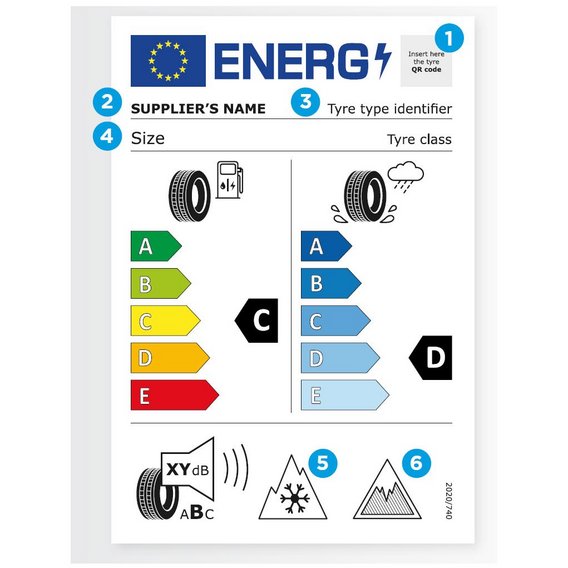
A new EU regulation, which applies to car, truck and bus tyres that come onto the market after 1 May 2021, has introduced a new standard label that provides additional information for winter and all-season tyres on
contains. Individual tyre data can be downloaded via a QR code on the tyre label.
The "old" tyre label still applies to tyres that were placed on the market before 1 May 2021.
You can find out what the information on the tyre label means in detail and how the tyres differ in the three criteria in this Flyer of the BRV Bundesverband Reifenhandel und Vulkaniseur-Handwerk e. V.
1 = QR code (link to the product database)
2 = Trade name/supplier
3 = Type identification of the tyre
4 = Tyre size, load index, speed index, tyre class
5 = Snow grip pictogram
6 = Ice grip pictogram
When buying tyres, more than just the right size counts: the EU tyre label provides important information on fuel efficiency, wet grip, noise development as well as ice and snow grip. These labels help you to choose the right tyres for your vehicle, your driving behaviour and your environment. Find out here how the individual criteria are assessed and what they mean for your safety and driving comfort.
The fuel consumption depends on the rolling resistance. Thus from
The rolling resistance of tyres is divided into classes A to E, where class A = highest efficiency and class E = lowest efficiency.
However, it is difficult to make a comprehensive purchase decision based solely on the tyre label. Buyers should not only look at the label, but also at the composition of a tyre.
If you imagine a tyre as an atomic model, the rubber molecules are the atoms. For a long time, the connecting element between the molecules was carbon black. But carbon black is inflexible, so the rubber does all the work. As a result, the tyre heats up quickly and wears out faster.
For about ten years now, the use of silica instead of carbon black has become increasingly popular in tyre development. Silica is silicic acid and ensures a flexible bond between the rubber molecules, which now heat up more slowly and last longer.
It is easy to tell whether tyres contain silica, as manufacturers advertise their products heavily. But silica alone does not make a good tyre.
It is not advisable to use up outdated winter tyres in the warmer months of the year, as this has a significant negative impact on driving safety in terms of braking distances and cornering grip. And if you drive close to the tread limit with winter tyres, you increase your susceptibility to aquaplaning on wet roads.
For many, all-season tyres seem to be an option to summer and winter tyres. But is this really a good choice? On the one hand, a tyre should have the lowest possible rolling resistance and therefore low fuel consumption, but on the other hand, it should enable a short braking distance in winter. This balancing act cannot be achieved without restrictions.
The assumed cost advantage is also a fallacy. Whether you drive the whole year with one set of tyres or only half a year with two sets, the result is roughly the same in terms of wear and costs. A second set of tyres pays for itself relatively quickly.
However, if you include an active tyre pressure system with sensors on each valve in this calculation, the cost per tyre is between 20 and 50 euros. With two sets of tyres, this can really add up, especially as the sensors have to be re-tuned every time the wheels are changed.
You also have to factor in the cost of changing the wheels and storing them if you can't do it yourself or don't have space for the second set of wheels.
A lot of the disadvantages of all-season tyres from earlier years have disappeared. For example, current all-season tyres are also approved for higher speeds. Up to 300 km/h are possible in some sizes.
However, all-season tyres are not an alternative for everyone. Particularly under extremely seasonal conditions, such as very wintry road conditions or on hot summer days, they are only a compromise and are inferior to regular winter or summer tyres.
However, it is no longer possible to speak in general terms of "the" all-season tyre. Some brands are geared more towards winter tyres with good snow performance, others more towards summer tyres, which make few concessions even in warm temperatures. Specialist dealers can provide advice here.
As a general rule, all-season tyres are generally worthwhile for drivers who drive little and leave the vehicle parked in icy conditions.
If, on the other hand, you drive a lot and over long distances and also have a powerful vehicle, you should opt for summer tyres in summer and winter tyres in winter.
A tread depth of 1.6 millimetres is mandatory. This is the legal minimum tread depth. However, TÜV NORD recommends replacing tyres with a tread depth of 4 millimetres or more, as tyre grip decreases significantly in the wet.
If you don't have a tyre tread gauge to hand, you can easily make do with a 1 euro coin. The edge is exactly three millimetres. If the gold rim disappears in the tyre tread, everything is fine. If the gold edge of the 1 euro coin is still visible, there is less than 3 millimetres of tread on your tyre. Incidentally, the measurement is taken in the groove of the tyre, not on the small bumps in the tyre. These are the so-called wear indicators, also known as TWI = Tread Wear Indicator. If these are no longer visible, it is high time for a tyre change.
No, in Germany there is no obligation to fit winter tyres on your vehicle.
However, there is a situational winter tyre obligation, i.e. if winter road conditions prevail, i.e. black ice, snow, icy conditions, then you may only drive with winter tyres.
The rule of thumb isfrom Easterto October. At Easter, the winter tyres are replaced by summer tyres and then in October from summer tyres to winter tyres.
Only tyres marked with the "Alpine symbol" (mountain pictogram with snowflake) on the tyre sidewall are considered tyres for winter conditions on cars and trucks and their trailers. Tyres that meet this requirement are referred to below as winter tyres. In a transitional period until 30.9.2024, winter tyres produced before 2018 with the "M+S", "M&S", "M.S." marking without the "Alpine symbol" may continue to be used in winter conditions.
Since October 2024, winter and all-season tyres with the "M+S", "M&S", "M.S." marking without the additional "Alpine symbol" are no longer permitted in winter conditions. No winter tyres are prescribed for motorbikes or vehicles in category L (motorbikes, trikes and quads). If these are nevertheless used, the M+S marking is sufficient as winter tyres. The snowflake symbol is not available for these tyres.
You will find the right tyre size for your vehicle in the following documents: