H2 readiness for gas and steam power plants (GUD power plants)
Hydrogen is considered a central pillar of the energy transition and an important driver of decarbonisation. The energy carrier, ideally in its green form, has the potential for a further revolution in the energy sector. Hydrogen will play an important role in the energy mix, bridging the gap between generation, storage and distribution through to seamless supply and driving forward the necessary sector coupling. So whether as a storage medium for energy, or in the supply of electricity and heat, or as a fuel for clean mobility - hydrogen has great potential as an energy carrier. In the field of reconversion to electricity, hydrogen is also a "no-regret" application. This means that the use of H2 makes economic, ecological and social sense in many applications, with or without the consequences of climate change. The economic aspect in particular has recently become increasingly important due to the rising costs of fossil fuels.
In the Climate Act, the European Union has committed to being climate-neutral by 2050 at the latest. The German government has already set 2045 as the target for Germany. In order to realise this, the energy supply must also be reassessed. A successful energy transition requires a combination of security of supply, affordability and environmental compatibility with innovative and sustainable climate protection. Hydrogen can, must and will replace the predominant natural gas in many places. With regard to the above-mentioned time horizon, this also means that power plants built in the near future must be capable of climate-neutral operation, i.e. suitable for hydrogen, for example. If these are fuelled with H2 or a mixture of H2 and natural gas, new questions arise, particularly with regard to safety precautions and the technical conditions. TÜV NORD uses a specially developed H2-ready assessment scheme to assess the hydrogen suitability of combined cycle power plants. The starting point here is the concept phase of the construction or expansion of a CCGT power plant.
Combined cycle gas and steam turbine (CCGT) power plants will make an important contribution to the upcoming transformation and the fulfilment of climate targets. In addition to a high level of efficiency and the relatively easy conversion to hydrogen, they have another advantage: energy supplies with a short start-up time, as with CCGTs, allow supply gaps to be filled quickly. This is because the increasing proportion of renewable energies means more and more fluctuations in output due to the inconsistent availability of light and wind. In a climate-neutral energy supply, H2-fuelled CCGT power plants can therefore be used for reconversion to electricity on a larger scale. To this end, newly constructed plants must be H2-ready, which according to the underlying scheme means that they can be operated with 100% hydrogen.
With TÜV NORD's assessment scheme for new and existing gas and steam power plants, plants and systems can be assessed from the early planning phase on a project and customer-specific basis in three H2 readiness levels. Whether on behalf of operators, manufacturers, insurers or OEMs. In this procedure, the assessment limits can be planned individually, are component-related and provide an independent orientation and assessment aid for the future security of the power plant concept. In addition, long-term planning with an average service life of around 35 years protects operations from unplanned downtimes and premature decommissioning. "H2-ready" in the plant construction of a CCGT power plant makes the operation competitive and future-proof on the way to climate neutrality.
But what is meant by H2-readiness in this assessment scheme? In the TÜV NORD assessment scheme, H2-ready to use refers to suitability for use with hydrogen as the sole fuel in CCGT components or systems. This means that H2 replaces natural gas in the actual combustion process.
Other properties result in different technical requirements for components and systems, which are categorised and addressed with the help of the assessment scheme. The H2-ready to adjust stage means that components must be modified or replaced for operation with hydrogen. Conversion is generally feasible here.
Unfit for H2, on the other hand, is the assessment if the replacement or modification of parts and components required for use with hydrogen is not possible. The categorisation can be carried out on a modular basis for individual components or subsystems, up to the assessment of an entire CCGT power plant. H2 readiness can therefore be categorised into 3 levels: Operation with H2 immediately possible (1), operation possible after conversion (2) and conversion impossible or not reasonable (3).
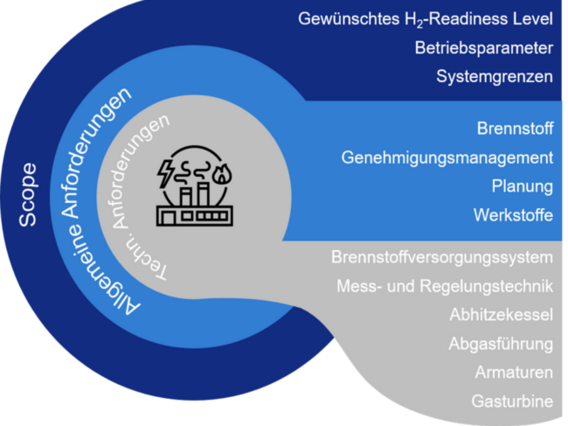
The assessment scheme can be understood as the basis for the "roadmap" for the construction of a new or the conversion of an existing CCGT power plant. It can be customised to meet actual requirements. The assessment scheme is divided into four steps, starting with the target definition with a requirements matrix, through overarching requirements (e.g. fuel, authorisation management, planning, materials), technical requirements (e.g. fuel supply system, gas turbine, waste heat boiler, valves, measurement and control technology) to the final assessment. The assessment is carried out on the basis of existing technical regulations, norms and standards, where applicable and available.
The results at the end of the process allow the upcoming measures on the way to H2 readiness to be categorised. The results offer a number of advantages for the client: The results mean neutral proof of the technical feasibility of the (sub)projects. They pave the way for climate-neutral operation of their plant on the basis of future-proofing the system. In addition, the results serve as orientation in a dynamic environment of a rapidly and constantly changing energy landscape.