Skip to content

Audit and expert opinion

Carriage test

The carriage inspection at TÜV NORD ensures the roadworthiness of horse-drawn vehicles. An annual inspection is required by law for commercial vehicles, while a regular inspection every three years is recommended for private vehicles. After a successful inspection, the vehicles receive an FN sticker.
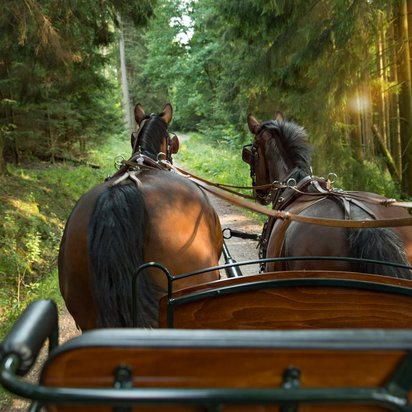
Pferdekutsche auf einem Waldweg

Safe on the road on the coach box

Horse-drawn vehicles used for the commercial transport of passengers or goods must undergo an annual technical safety inspection by officially recognised experts or test engineers. Such an inspection is also advisable for privately used horse-drawn vehicles - i.e. carriages or covered wagons - to ensure that the vehicle is roadworthy and complies with regulations. Here you can find out what you need to know as the owner of a carriage or covered wagon.

When is a carriage test required?

  • According to Section 31 StVZO, the owner is responsible for the operation of the vehicle. In addition, drivers are responsible for ensuring that their vehicle is in the prescribed condition in accordance with Section 23 StVO. This also applies to horse-drawn vehicles.
  • Horse-drawn vehicles used for the commercial transport of passengers or goods must undergo a technical safety inspection every 12 months.
  • Such an inspection is based on the guidelines for the construction and operation of horse-drawn vehicles, which were issued in co-operation with the TÜV Association and the German Equestrian Federation (FN).
  • For every vehicle that complies with the guidelines and has been inspected by an authorised expert, the relevant inspection body issues an FN carriage pass and marks the vehicle with a sticker bearing the FN emblem as a cross-organisational feature.

What is an FN vehicle registration document?

Every horse-drawn vehicle is accompanied by the FN carriage pass, which contains the following:

  • the technical data
  • dimensional sketches
  • Photos of the vehicle
  • Documentation of the initial acceptance/inspection
  • Documentation of the periodic inspections

In addition, it must be noted in the FN vehicle pass whether the vehicle is authorised for commercial passenger transport.

How is the carriage test documented?

  • The successful inspection is documented with an inspection report
  • The test is also documented in the carriage passport
  • If your carriage or covered wagon passes the test, it will receive the FN badge (FN = German Equestrian Federation)
  • This visibly documents the technical safety of the carriage or covered wagon
  • If defects are found on the vehicle, a re-inspection may be necessary (depending on the degree of the defect)
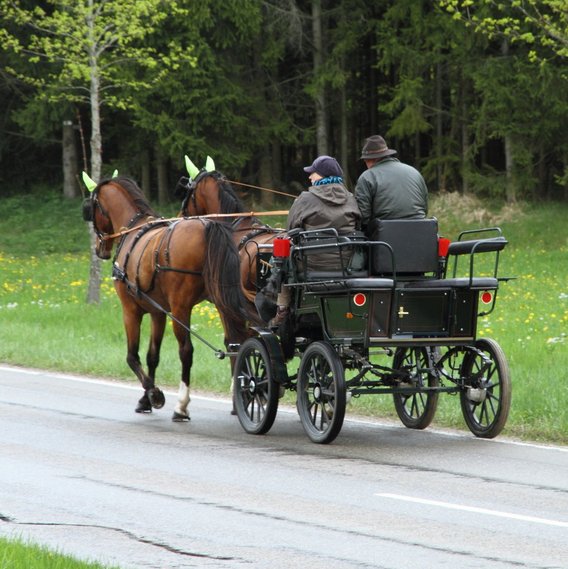
Pferdekutsche auf einer Landstraße

How often do you have to take the carriage test?

  • For horse-drawn vehicles in commercial passenger or goods transport, the carriage inspection must be carried out as required, but at least once a year
  • In the private sector, a carriage inspection is recommended at least every 3 years
  • In addition, regular maintenance (at least once a year) is essential, as even vehicles that are not used very often can suffer "static damage"

What is checked during the carriage inspection?

  • Lighting
  • Brakes
  • Chassis and axles
  • Wheels and tyres
  • Vehicle superstructure
  • Driver and passenger seats
  • Equipment

Who is authorised to carry out a carriage inspection?

  • Only officially recognised experts or test engineers may carry out the technical safety inspection.
  • Carriages and covered wagons are only tested at TÜV NORD Mobilität by additionally trained and certified carriage experts

How can I prepare my vehicle for the carriage test?

How can I prepare my motorhome or caravan for the gas inspection?

To prepare your carriage or covered wagon for the carriage test, you should check the following points in advance:

  • Lighting equipment
  • Service and parking brake
  • Axles, wheels, tyres and suspensions
  • Steering, steering stop
  • Chassis, body and hood
  • Access steps, seats and holding devices
  • Additional equipment

What you should know

Frequently asked questions about the carriage test

If your carriage or covered wagon is being inspected for the first time, please contact one of our TÜV NORD carriage experts in good time or simply use our contact form to do so

He or she will explain to you what the test schedule looks like

The inspection usually takes place at your premises

Initial inspection: depending on effort, approx. 120 € basic price

Repeat inspection: currently € 62 (as of Oct. 2022)

Depending on the scope, size and equipment of the vehicle, the test takes around 30 minutes.

Call us on the free service telephone number 0800 80 70 600, fill in the form or send us an e-mail directly to verkehr@tuev-nord.de.

We will then forward your enquiry to the TÜV NORD expert in your region.

There is currently no legal obligation to do so

According to § 31 StVZO, the person driving must be suitable for driving a combination

This includes their professional qualification

However, the suitability does not require the driver to be in possession of a driving licence for motor vehicles or to acquire the FN driving badge class 3 or 4

Exception: providers of commercial carriage rides in Lower Saxony


TÜV NORD tip:
However, by acquiring the FN driving badge, you as the driver can prove your suitability if this becomes necessary in court, for example after an accident.

In the case of covered wagons and all carriages with insufficient all-round visibility for the driver or if the body obscures the driver, clearly visible, symmetrically mounted, yellow, type-approved, electrically operated flashing lights must be fitted as direction indicators on both sides of the carriage at the front, sides and rear for reasons of road safety; these lights must be operated from the driver's seat and can also be switched on as hazard warning lights.

For all other vehicles, it is sufficient to use an indicator trowel at least 500 mm long with a round red/white sign and a diameter of approx. 200 mm to indicate a change of direction.

If a vehicle does not have electrically operated direction indicators, the necessary direction indicators must be given manually by the driver or passenger using the indicator trowel.

As this can be difficult for other road users to recognise on covered wagons, electrically operated direction indicators are essential for road safety.

Contact

We look forward to your inquiry!