Sustainability certification for hydrogen and its derivatives
TÜV NORD, as a knowledge-based service provider, supports the analysis and preparation of auditable evidence to demonstrate compliance with certification criteria – ranging from electricity sourcing and operational data to GHG accounting and traceability along the supply chain.
Get in touch with us
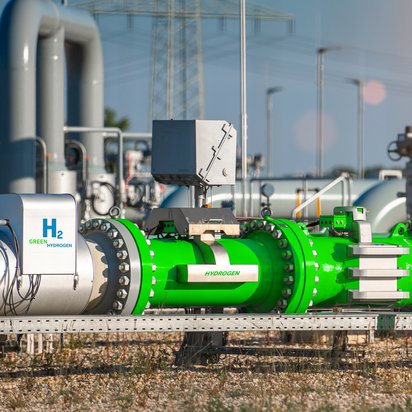

Renewable fuels of non-biological origin (RFNBOs) are a key building block of the energy transition. They enable renewable electricity to be converted into hydrogen and synthetic fuels derived from it, thereby supporting the decarbonization of applications that cannot be directly electrified or can only be electrified with difficulty. As a result, RFNBOs are becoming relevant across a wide range of sectors – from industrial processes and parts of the mobility sector to flexibility and storage options within the energy system.
With the growing importance of RFNBOs, the requirements for proofs of sustainability are also increasing. What matters is not only that the required data and documentation are available, but also that they are consistent across all process steps and structured in a way that is auditable. This includes electricity sourcing and its allocation, operational and measurement data, consistent GHG accounting, and transparent documentation along the supply and offtake chain via Points of Sustainability (PoS) and their registration in national and European databases.
Robust and reliable documentation therefore builds trust among project partners and offtakers and reduces risks at critical interfaces – particularly where multiple actors and systems interact.

In energy-intensive basic materials industries, hydrogen is a key lever for decarbonization—for example in steel production, where it can replace fossil-based reducing agents. At the same time, electrolysis forms the technological foundation for producing (green) hydrogen. For this reason, production logic, data quality, and verification mechanisms should be considered from an early stage. TÜV NORD addresses these topics across the entire value chain—from production to industrial applications.
Green Steel through Hydrogen: Decarbonizing the Steel Industry in Focus (#explore)
Electrolysis: How Water Becomes Hydrogen – Fundamentals and Context
Hydrogen: Testing, Safety, and Certification Across the Entire Value Chain

In the mobility sector, synthetic fuels such as e-fuels are gaining importance—particularly for applications that cannot be fully electrified directly. As a result, transparent production pathways, clear emissions accounting, and verifiable documentation are becoming increasingly important. At the same time, safe and compliant infrastructure—such as refueling stations and fuel storage facilities—is a key prerequisite for scalable market deployment.
Learn more about e-fuels in our knowledge article (#explore)

As the share of volatile renewable generation increases, so does the need for flexibility within the energy system. Hydrogen can serve as a storage and balancing option, thereby contributing to system stability—particularly when combined with energy storage solutions and effective load management. Accordingly, robust concepts for storage, safe operation, and verifiable documentation of relevant parameters along the value chain are essential.
Green Flexibility in the Energy System – Fundamentals and Practical Examples (#explore)
Hydrogen Storage – Technologies, Applications, and Testing Services
Hydrogen as an Energy Storage Medium – Integrating Renewable Energy and System Benefits

Transport and trading structures will be decisive for the market ramp-up of hydrogen and its derivatives. Hydrogen networks and pipelines provide the foundation for large-scale transport, while import chains often involve carrier substances such as ammonia, methanol, or LOHC. At transfer points along the supply chain, clearly defined responsibilities, consistent traceability, and transparent documentation are particularly critical to ensure trust in sustainability verification.
Hydrogen Pipelines and Hydrogen Networks: Planning and Operating Transport Infrastructure Safely
Hydrogen: Testing, Safety, and Certification Across the Entire Value Chain
Ideally before the operational ramp-up (pre-FEED / FEED), or prior to the first significant supply or offtake agreement—so that documentation, data flows, and responsibilities are established in an audit-ready manner from the outset.
Typical documentation includes electricity procurement records and guarantees of origin, metering and operational data, process descriptions, mass-balance logic and parameters, as well as evidence supporting supply chain traceability.
At a minimum, the following elements should be covered:
We support, test, and certify sector-coupled energy systems in accordance with all relevant VDE, IEC, DIN, and ISO standards.
Whether power-to-X plants, hydrogen systems, or hybrid energy systems, we support you from feasibility analysis and grid connection assessments through to safety and conformity verification.
Our interdisciplinary expert teams combine experience in electrical engineering, process engineering, the hydrogen economy, and digitalization. In this way, we assess complex sector-coupling systems safely, efficiently, and in full compliance with applicable standards and regulations.
With TÜV NORD, you secure technical quality, regulatory certainty, and trust—for the successful implementation of sector-coupled systems in the energy system of the future.