Driving licence and vehicle
Anyone wishing to drive into an environmental zone usually needs a valid emissions sticker. This indicates how many pollutants a vehicle emits and determines whether entry is permitted. On this page, you can find out what types of stickers are available, how to apply for them, and who is exempt.
Order your environmental badge now
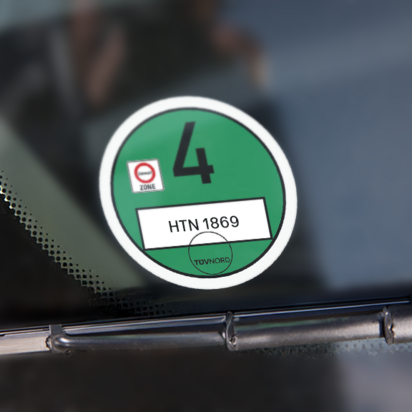
To improve air quality in cities, many German local authorities have introduced so-called low-emission zones. Anyone wishing to drive in these zones must have a valid emissions sticker, also known as a particulate matter sticker. This indicates how many pollutants a vehicle emits and therefore determines whether or not you are permitted to drive your car into certain areas.
Low-emission zones are now in place in numerous towns and cities across Germany. Only vehicles that meet a specific emissions standard and can demonstrate this with the appropriate emissions sticker are permitted to drive in these zones. The regulations are designed to protect public health and ensure compliance with European air quality targets.
Vehicles without a valid sticker risk a fine, regardless of how low their emissions actually are.
Due to frequent and regular exceedances of the EU air quality limits for particulate matter and nitrogen dioxide, numerous cities have established low-emission zones. The following applies to these zones: access is permitted only with an emissions sticker.
You will find the relevant traffic signs on the access roads. These show the environmental stickers that allow you to drive in the zone. In Hanover, only cars with yellow and green environmental stickers are permitted to enter. Some cities even restrict access exclusively to vehicles with a green sticker.
Under the law, there are numerous exceptions. For example, classic cars with H-number plates do not require a particulate matter sticker.
Further exemptions apply to
Tip: You can find an up-to-date overview of low-emission zones on the Federal Environment Agency’s website, for example.
The colour of the emissions sticker depends on your vehicle’s emissions category. This is based on the emissions class, fuel type and date of first registration.
Display the emissions sticker inside your car where it is clearly visible. The best place is the lower part of the windscreen on the passenger side.
Depending on its emissions, your car will be issued with a green, yellow or red sticker. Vehicles with high emissions, such as petrol cars without a regulated catalytic converter, will not be issued with an emissions sticker. Virtually all petrol cars, as well as vehicles powered by LPG, natural gas or ethanol with a regulated catalytic converter, will be issued with a green sticker, allowing them to drive freely.
The allocation of a sticker depends on:
Many motorhomes, classic cars with H-licence plates and imported vehicles can also receive a sticker under certain conditions.
You can easily obtain the environmental sticker from your local TÜV NORD centre or conveniently online.
Here’s how it works:
Important: The sticker is linked to the vehicle. It remains valid if the vehicle changes ownership. However, if the windscreen is replaced, a new sticker must be issued.
Driving without a sticker or special permit is an administrative offence. A fine of €80 may be imposed. Since 1 May 2014, no points have been awarded on the Flensburg register for this offence.
The stickers are used to identify vehicles that are permitted to enter the low-emission zones.
If you are caught driving in the low-emission zone without the correct sticker, you will be liable for a fine of €80. Since 1 May 2014, this offence no longer results in points being added to your driving record in Flensburg.
Yes, for the low-emission zones currently being planned; however, there could also be temporary low-emission zones.
Natural sources of particulate matter include, for example, Saharan dust, microorganisms and their fragments, pollen, forest fires, volcanic eruptions and similar phenomena. However, a significant proportion is produced by human activity: industry, private households, road traffic and power stations are just some of the sources of particulate matter.
Natural sources of particulate matter include, for example, Saharan dust, microorganisms and their fragments, pollen, forest fires, volcanic eruptions and similar phenomena. However, a large proportion is produced by humans: industry, private households, road traffic and power stations are just some of the sources of particulate matter.
Depending on their emission class, vehicles are issued with either a red, yellow or green sticker. The relevant sticker is determined by the emission code number, which is recorded in your vehicle documents. Diesel vehicles fitted with a retrofitted particulate filter are issued with a certificate.
Vehicles without an internal combustion engine (e.g. electric motors, fuel cells) belong to emission group 4 (green). They also require a sticker to be allowed to enter an environmental zone.
“XY-OM 531” is a fictitious registration number. It is intended to illustrate that the vehicle’s registration number must be entered in the white box on the particulate matter sticker. Without this entry, the sticker is invalid. The sticker is only valid for the vehicle bearing the same registration number as that stated on the sticker. The entry is made by the garage or the registration office. The sticker will not be issued without this entry.
You can, for example, order the environmental stickers conveniently online. Simply fill in the order form and purchase the environmental sticker online. Alternatively, you can visit your nearest TÜV-NORD branch. All you need is your vehicle registration document; you do not need to bring the car itself. That is why you can also order the sticker conveniently online.
At TÜV NORD centres, an emissions sticker costs just €6 (for vehicles with German number plates); for vehicles with foreign number plates, we may charge an additional fee to cover any necessary research.
If you order the environmental sticker online, we will post it to you and charge €14.90 (including postage and handling), or €19.90 for vehicles not registered in Germany.
The sticker is valid indefinitely. However, you will need a new sticker if you re-register your vehicle and the registration number changes, as the number on the sticker must match the registration number. The stickers are valid nationwide in all low-emission zones.
The emissions sticker must be displayed in a clearly visible position inside the vehicle. We recommend placing it in the lower part of the windscreen on the passenger side. If the text on the emissions sticker is no longer legible, it must be replaced. The sticker is invalid if it is not clearly legible. This can usually result in warnings or fines.
Order your emissions sticker from the comfort of your own home. Simply send us your application by post or email. We can help you determine which type of emissions sticker you need.
Only four-wheeled vehicles require a sticker. Most quads and trikes are classified as ‘motorcycles’ and are therefore exempt from the regulation. They remain free to drive. The same applies to vehicles registered as agricultural or forestry tractors. However, quads and trikes registered as passenger cars are affected by the regulation.
Driving without a sticker or a special permit is an administrative offence. This carries a fine of €80. Since 1 May 2014, no points have been added to the Flensburg register for this offence.
Passenger cars fitted with a first-generation catalytic converter (Annex XXIII of the Road Traffic Licensing Regulations) with emission code numbers 01, 02 and 77 (retrofitted) are also issued with a green sticker. Classic cars are permitted to drive in the low-emission zone even without a sticker or a special permit.
You will still be able to enter Germany without a sticker in future. The only areas you will not be able to enter are the low-emission zones.
You can easily order the environmental stickers online. Simply fill in the order form in either German or English.
Vehicles registered abroad also require an emissions sticker. The classification of foreign vehicles into emission groups, and thus their allocation to a specific sticker, is governed by the Road Signage Regulations. Otherwise, the allocation is based on the year of the vehicle’s first registration. The road signs marking the entrance to an environmental zone are part of the general road signage applicable to everyone. This means that foreign nationals must also comply with these rules when driving their vehicles.
Upgrading from Euro 1 to Euro 2 halves the tax. Retrofitting is therefore well worth considering.
The driving ban in the low-emission zone generally affects petrol cars without a regulated catalytic converter or older diesel cars.
Changing your vehicle or retrofitting it can certainly be worthwhile. Today, there are also used cars with petrol engines and regulated catalytic converters that emit very little nitrogen oxide and almost no particulates. Furthermore, for many older diesel vehicles meeting the Euro 1 emissions standard, there is the option of upgrading to the Euro 2 standard. This not only grants you the red sticker to drive in the low-emission zone. Depending on the engine capacity, the road tax is also reduced by €100 or more per year.
Another alternative is public transport. You must decide for yourself whether the costs are reasonable, as ultimately it is also a political issue.
Would you like an emissions sticker for your vehicle? At TÜV NORD, you can:
Online order:
Simply enter your details online, submit the form, and you’re done.
We will check your documents, determine the correct sticker and send it to you by post, including a printed registration number, not handwritten.
Cost:
€14.90 (incl. VAT & postage) for vehicles registered in Germany
€19.90 for foreign vehicles
Or simply visit a TÜV NORD centre near you; we’ll be happy to advise you.