Guide and tips
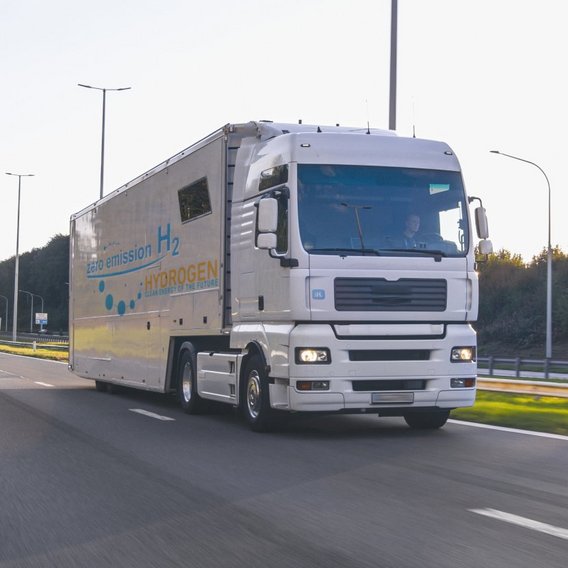
Hydrogen is not only the most abundant element in the universe. The processing of hydrogen is also seen as one of the key technologies for the future and is already being used in various sectors of the economy. In mobility, for example.

Hydrogen is not only contained in almost all compounds of organic chemistry, but is also present in considerable quantities on earth, as it is a component of water.
With the symbol H, the element is in first place in the periodic table and occurs almost exclusively in gaseous, bound form. As a secondary energy, the colourless and odourless gas requires additional energy, known as primary energy, in order to be produced.
We introduce you to the alternative drive fuel in more detail: How does a hydrogen car work and how safe is it? What are the advantages and disadvantages of a hydrogen fuel cell car compared to other fuels? Where does the future of the hydrogen car lie?
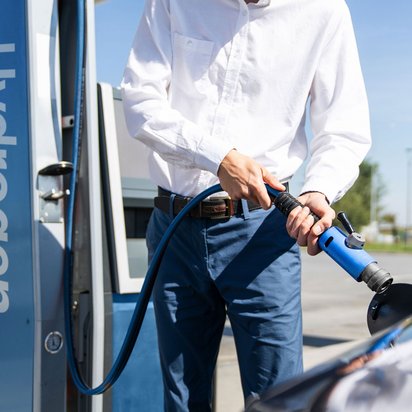
If you want to drive a hydrogen car to neighbouring countries, you need to plan your route according to the European H2 filling stations.
Unlike diesel or petrol vehicles, vehicles with fuel cell technology do not emit particulate matter, nitrogen oxides or CO2 during operation. The only waste product is water (vapour). This makes them locally emission-free.
They can also be produced using any source of electricity, which is an advantage when producing green hydrogen. What's more, water and hydrogen can also be used as an intermediate storage medium for renewable energy generators, which can compensate for possible bottlenecks in the power supply with renewable energies.
Advantages of hydrogen cars:
One disadvantage is the high energy consumption in the production of hydrogen. Added to this is the lack of refuelling station infrastructure in Germany and abroad, which makes good route planning essential.
The choice of models is also still limited and offers hardly any variety. In addition, the purchase of an electric vehicle - whether battery or hydrogen-powered - is very expensive.
Disadvantages of hydrogen cars:

In contrast to other fuels, the combustion of hydrogen does not produce any pollutants that could be released into the atmosphere.
Compared to battery-powered vehicles, hydrogen cars have an important advantage in the commercial vehicle segment, as a particularly high level of performance is required here.
In order to reach this level, immensely large batteries would have to be installed in the battery-powered variant. These are not only material-intensive, but also a significant cost driver when purchasing the vehicle. In order to store the same amount of energy as two full tanks of 700 bar hydrogen with battery cells, the batteries would take up many times the volume and mass of the hydrogen tanks. The additional weight would also have a negative impact on the range and payload, especially for lorries. In terms of range, hydrogen cars are in no way inferior to conventional combustion and diesel vehicles.
In the passenger car segment, the hydrogen fuel cell vehicle competes with both the classic combustion engine and the up-and-coming battery electric mobility. The latter has significant advantages in terms of model diversity and price appeal. A rapid race to catch up in terms of registration figures is considered impossible.
In the commercial vehicle segment and for electric buses, vehicles with fuel cells could catch up in the coming years, as the requirements profile for the vehicle in terms of
better suited. In addition to its use in fuel cells, hydrogen can also be used as an energy carrier in combustion engines.
The future of the two alternative fuels depends on various factors.
These include, among others
The planning of new hydrogen vehicles by well-known manufacturers shows that hydrogen has future potential in the motor vehicle segment. In order to achieve the climate targets, both hydrogen and the battery will be needed to become less dependent on fossil fuels. The origin and the production and distribution routes of the respective energy source should also not be neglected here.
The automotive world is changing rapidly: alongside classic petrol and diesel drives, alternative drives are becoming increasingly important. Whether electric, fuel cell, hybrid or gas-powered vehicles: they all offer different advantages for the environment, efficiency and driving comfort. Discover the different drive types and find out which one best suits your needs.
The electric motor is probably one of the best-known alternative forms of drive.
Driven by an electric machine, the motor draws the necessary energy from a battery. energy from a batterywhich can be recharged at a special charging station.
The resulting operating costs are significantly lower than for a car with an internal combustion engine. In addition, there are no nitrogen oxides, less particulate matter and CO² emissions.
The fuel cell car contains a hydrogen tank, a fuel cell and a small battery that kicks in whenever a little more energy is needed. As fuel cell vehicles are basically electric cars, they are an emission-free and quiet alternative to combustion engines.
Another advantage: hydrogen is probably the most abundant element and an almost infinite resource.
The hybrid is equipped with an electric and fossil-fuelled engine. In a series hybrid car, the combustion system is only responsible for generating electricity and serves as a small power station.
The parallel hybrid is different. Here, both engines work simultaneously. Why is this an advantage? It's simple: in city traffic you can drive purely electrically, on longer journeys the combustion engine takes over and at full power both work in parallel.
Hybrid technology has proven itself and, thanks to the additional electric motor, emits fewer greenhouse gases than pure diesel or petrol vehicles.
The plug-in hybrid vehicle differs from the hybrid primarily in terms of charging options.
The plug-in hybrid can be charged via a power grid - an option that is not available for hybrid cars. Depending on the model, the electric range is also greater than that of a hybrid.
With a vehicle fuelled by LPG, fuel costs can be reduced by half. LPG is a liquefied mixture of propane and butane and is cheaper than petrol. Converting to LPG can pay off, especially for frequent drivers and cars with high fuel consumption.
Also good to know: LPG and natural gas have tax advantages. The tax rates are much more favourable than for petrol and diesel.
Natural gas is a combustible, organic raw material and is much more environmentally friendly to burn than petrol or diesel.
In Germany, there is H-gas and L-gas, which differ in their methane content. As this is higher in H-gas, vehicles of this type consume less and also have a greater range.
Interesting fact: natural gas is refuelled in kilograms and not litres.
The efficiency of an appliance indicates what proportion of the energy supplied is converted into useful energy. What about the efficiency of alternative drives? We have taken a closer look at the efficiency of the three most common power systems.
An electric motor converts around 80 % of the energy supplied to it into motion and, conversely, only releases 20 % of the energy into the environment. Of course, losses that occur when charging the battery must also be taken into account. Nevertheless, an electric vehicle achieves an efficiency of around 65% and is therefore much more efficient than a car with a conventional combustion engine. By way of comparison, the efficiency of a diesel engine is around 45%, while that of a petrol engine is around 30-35% under optimum conditions.
A fuel cell alone achieves an efficiency of 83 %, but when installed in a vehicle, losses must be expected. An efficiency of 50 % can be assumed here. This not very precise efficiency is due to the fact that the fuel cell is an energy converter that converts hydrogen into electricity.
If one considers the complete sequence of processes, from the production of hydrogen to the conversion into electrical energy, an efficiency of only around 30 % remains. In terms of efficiency, the fuel cell is therefore barely better than vehicles that run on diesel or petrol.
A hybrid vehicle also has a significantly better efficiency than a car equipped solely with an internal combustion engine. The overall efficiency is always optimised by the choice and distribution of the two drive systems. Depending on what is most efficient, hybrid cars switch between the drives or run simultaneously with an electric motor and combustion engine.
You can find out more about the efficiency of alternative drive types at Efficiency of electric cars.
Although hydrogen is highly flammable, it will never explode without a trigger and ignition source. It also mixes quickly with the ambient air. There is therefore no cause for concern with hydrogen fuel cell cars. As hydrogen is stored in separate, pressurised tanks, hydrogen and oxygen do not get in each other's way.
Numerous crash tests have shown that a total loss is required to damage the hydrogen tank and release hydrogen.
The range of hydrogen cars depends primarily on the tank capacity. In contrast to combustion vehicles, consumption and tank capacity are not specified in litres but in kilograms.
Some models achieve a range of over 600 kilometres and are comparable to petrol or diesel vehicles in this area. Battery-powered electric vehicles have to have a large battery storage system to cover similar distances.
The hydrogen refuelling station network is currently still patchy, but they do exist - H2 refuelling stations and mobile stations. There are currently just over 100 public hydrogen refuelling stations available across Germany (as of April 2022).
Which hydrogen cars are available? The range of hydrogen cars is currently very limited.
The first "standard" fuel cell vehicles on the European market are
There was the GLC F-Cell from Mercedes, but this has since been withdrawn from the market.
As hydrogen is only found in compounds with other substances such as natural gas, crude oil or water, it must be separated using energy. There are various energy-intensive processes for producing hydrogen:
Depending on whether hydrogen is to be stored in gaseous or liquid form, there are various storage options:
Although hydrogen is colourless and odourless, colours still play an important role. They determine whether and how sustainably hydrogen is produced. A basic distinction is made between four colour categories:
Grey hydrogen
Turquoise hydrogen
Blue hydrogen
Green hydrogen
Unfortunately, only two per cent of hydrogen demand is currently covered by renewable energies; the remaining 98 per cent is produced from hydrocarbons such as natural gas, crude oil or coal.
Production in particular therefore currently contradicts the claim of environmental sustainability.