Skip to content

Guide and tips

Securing loads in the car

Even in everyday car transport, unsecured loads can quickly become a hazard. Even emergency braking can exert enormous forces that can turn even light objects into dangerous projectiles. TÜV NORD shows you how to secure your load correctly - with practical tips for the boot, roof and interior.

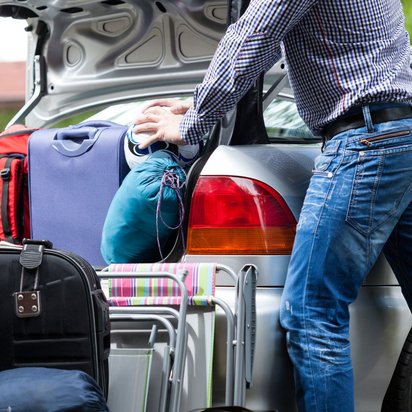
Beladen eines Autos mit Gepäck für eine Reise

Proper load securing in the trunk

Summertime is travelling time. Luggage piles up in and on top of the car. But in the event of a collision, a harmless toy can become a dangerous projectile. There's suddenly no stopping the roof rack either.

We give you tips on what you should bear in mind when loading your car:

  • Distribute the load evenly. One-sided loading impairs driving behaviour
  • Caution: Always pack heavy items of luggage right at the bottom. The lower the vehicle's centre of gravity, the better the road holding.
  • Do not place anything on the parcel shelf. Even light objects can become dangerous projectiles on impact.
  • Push the luggage close to the back of the rear seats so that it cannot slip.
  • The load should be secured in all directions of movement, especially in the direction of travel.
Use lashing straps and safety belts

  • Secure your luggage with lashing straps. You can secure objects in the rear seat using the seat belts.
  • Do you have sufficiently stable restraining devices?
  • Caution: Simple grids that are clamped between the roof and the loading area can hardly withstand the forces of a collision.

Maximum permissible roof load

Roof luggage is sometimes a somewhat windy affair. And at 100 km/h, a hurricane is already tugging at it.

  • The luggage on your roof should offer as little surface area as possible for the wind to attack. It is best to use roof boxes.
  • In the event of a collision at approx. 30 km/h, simple universal carriers often tear out, causing the entire system to crash.
  • The maximum permissible roof load, including the carrier systems used, is approx. 50-100 kg. You will find precise information in the operating instructions for your car. You must comply with the maximum permissible total weight of the vehicle (number 15 in the vehicle licence). This value must not be exceeded!
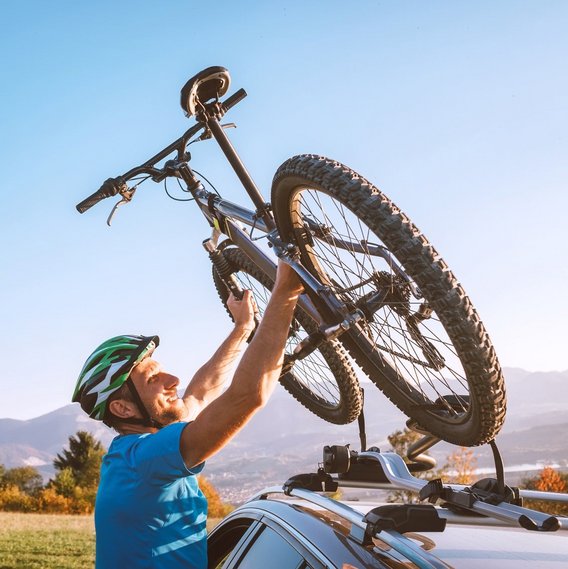
Fahrrad wird auf Autodachträger montiert

Bike rack for the car

  • If possible, you should transport bicycles at the rear of the vehicle. Universal rear carriers are already available relatively cheaply. Caution: Otherwise, minor scratches and dents are an occasional side effect.
  • Customised rear models are a paint-friendly option, although they are correspondingly more expensive.
  • If you have a towbar, you can also transport your bikes safely with a so-called towbar carrier.
  • Observe the permissible drawbar load. You must also not exceed the permissible rear axle load (number 16 in the vehicle licence).
  • Many TÜV NORD stations have vehicle scales where you can check the weight.

General tips for loading the vehicle

  • Stow the warning triangle, high-visibility waistcoats and first aid kit within easy reach. This will save you having to clear out the boot in the event of an emergency stop.
  • Plan sufficient breaks with exercise for longer journeys.
  • Never leave animals alone in the car during longer breaks. In summer temperatures and direct sunlight, the car can quickly turn into an oven.
  • Don't forget your travel documents, ID cards and vaccination booklet.
  • Every time you stop, check that your load and load carrier are still secure. Tighten the fastening screws if necessary. If you need tools for this, you should stow them within easy reach.
  • Bicycle accessories such as an air pump, water bottle and pannier do not belong on the bicycle during transport, but in the boot.

Contact

We look forward to receiving your inquiry!