Skip to content

Guides and tips

Traffic jam or slow-moving traffic

Traffic jams cost time, fray your nerves and sometimes even cost money. Our TÜV NORD traffic jam guide helps you to better understand traffic jams and avoid them sensibly. You’ll learn how traffic jams form, what to bear in mind when traffic is slow-moving, and what steps you can take to reach your destination with less stress.
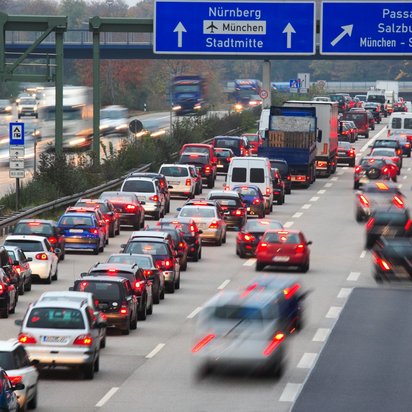
Stau auf einer Autobahn mit Verkehrsschildern nach Nürnberg und München

What to do in a traffic jam on the highway

Traffic jams are a daily nuisance for many motorists. Roadworks, heavy traffic or accidents can quickly bring traffic to a standstill. The result: long waiting times, mounting stress and an increased risk of accidents. Traffic jams are a real test of patience, particularly during the holiday season or on commuter routes. However, by understanding the causes and reacting appropriately, you can help ensure your own safety and improve the flow of traffic.

The 4 most important tips for avoiding traffic jams

1

Keep a safe distance

Keep a safe distance and avoid the so-called ‘butterfly effect’: if you follow too closely and the vehicle in front slows down, this can lead to sudden braking. This triggers a chain reaction among the vehicles behind, which are then forced to brake as well.

2

Stay in lane

Although “lane hopping” is popular, it can cause unnecessary traffic jams: frequent lane changes and overtaking manoeuvres often force other drivers to brake, triggering the familiar domino effect. You should therefore stay in your chosen lane as much as possible and only overtake if you are not obstructing anyone in the process.

3

Use the zip method

Use the zip-merge method, not the 'V' formation: only merge into the lane narrowing just before the obstruction, using the zip-merge method, and adjust your speed to match that of the traffic in the adjacent lane. Merging too early may be well-intentioned, but it is wrong as it disrupts the flow of traffic.

4

Avoid rush hour

Road capacity is limited. If possible, plan your journey outside peak hours. Also consider when you set off – travelling at night, early in the morning or during the week can be good alternatives.

Here's what to do in a traffic jam:

  • Keep an emergency lane clear
  • Administer first aid if you come across an accident and first aid has not yet been administered
  • Drive past quickly if help is already being provided
  • Follow the instructions of the police and emergency services; do not obstruct them
  • Do not take photographs of the accident scene

How is an emergency lane formed?

As soon as a traffic jam forms – in other words, as soon as traffic starts to slow down – drivers must form an emergency corridor. The emergency corridor is always formed between the left-hand lane and the lane next to it, regardless of how many lanes there are. Cars in the left-hand lane must move as far as possible to the left-hand edge of the carriageway, whilst all others must move as far to the right as possible within their own lane. The hard shoulder must not be used.

If the emergency corridor is not wide enough for emergency vehicles, such as in narrow roadworks, vehicles must line up in a staggered formation with increased distance from the vehicle in front. This allows emergency services to weave their way to the scene of the accident.

Penalties for driving in an emergency corridor: If you obstruct the passage of emergency vehicles or drive in the emergency corridor yourself, you face severe penalties. A fine of between 200 and 320 euros, two points on your licence in Flensburg and a one-month driving ban.

Increased risk of accidents at the end of traffic jams

Traffic jams frequently lead to fatal rear-end collisions, particularly involving lorries. Many drivers have this nightmare scenario in mind and therefore change lanes very abruptly – often without warning – from the right-hand to the left-hand lane.

However, it is safer to brake gently as soon as the end of the traffic jam comes into view and switch on your hazard warning lights in good time to warn the traffic behind you.

Always keep a safe distance from the vehicle in front of you – this way, you can still react in an emergency and pull over onto the hard shoulder if you see that the vehicle behind you is not braking in time.

It is best to keep an eye on the traffic behind you in your rear-view mirror until it has also come to a standstill behind you.

Heavy fines for rubberneckers

  • Onlookers at accident scenes who hinder the work of emergency services, often even photographing or filming the victims and then posting the footage online – a problem that is growing in scale.
  • A legislative amendment has now been introduced to tackle this issue even more effectively. There are hefty penalties for onlookers, and the legislation makes it clear: gawking is not a trivial offence, but is indeed classified as a criminal offence.
  • This applies in particular to taking photographs or filming injured people or those killed in accidents. Offenders face a prison sentence of up to two years or a fine. Failure to render assistance is also a criminal offence and can be punished with a prison sentence of up to one year or a fine.

Good to know

Frequently asked questions about traffic jams

Of course, one option is to leave the motorway when there’s a traffic jam, simply to bypass it. However, you can assume that other drivers will also consider this option. That’s why diversions and alternative routes are usually just as congested, unless you’re among the first vehicles to react to the new traffic situation.

So sometimes it is better to put up with a half-hour wait than to risk losing even more time on a congested diversion.

And however tempting it may be when stuck in a traffic jam – you are not allowed to drive on the hard shoulder. Unless, that is, signs explicitly permit the use of the hard shoulder.

Anyone who nevertheless swerves onto the hard shoulder to reach a service area or motorway exit more quickly risks a fine of 75 euros and a penalty point.

  • Stopping on the hard shoulder of the motorway is also prohibited. Offences are punishable by a fine of 30 euros.
  • Anyone who parks their vehicle on the hard shoulder must pay a fine of 70 euros and will receive one penalty point. 

According to the Highway Code, you are not permitted to leave your vehicle, even in the event of a traffic jam on the motorway.

The only exception is if you are securing the scene of an accident or setting up a warning triangle because your vehicle has broken down.

Otherwise, a violation is punishable by a fine of ten euros. However, if traffic comes to a standstill for a long time due to a full road closure, the police will probably turn a blind eye if you step out briefly to stretch your legs. You should, however, never stray far from your vehicle in case traffic starts moving again.

Overtaking on the right on the motorway is permitted if traffic in the left-hand lane has come to a standstill or is travelling at a maximum speed of 60 km/h.

If traffic is stationary, you may pass on the right at a maximum speed of 20 km/h.

If vehicles in the left-hand lane are also moving, you may overtake on the right at a speed no more than 20 km/h faster than them. This means that when overtaking on the right, you are not permitted to drive faster than 80 km/h. However, many drivers are unaware of this. Anyone driving faster than permitted risks a fine of 100 euros and a penalty point.

And however tempting it may be to head for the exit just a few metres back – driving in reverse or making a U-turn on the motorway is strictly prohibited, even in a traffic jam.

These dangerous manoeuvres are punishable by a fine of up to 200 euros, two penalty points and a one-month driving ban. Naturally, these penalties do not apply if the police expressly instruct you to turn around, for example to clear the motorway in the event of a total closure.

Many motorists find themselves envying motorcyclists during a traffic jam, as they can simply weave their way through the stationary vehicles and carry on.

However, this behaviour is not permitted.

Weaving between stationary vehicles is punishable by a fine of 100 euros and one penalty point.

Even in a traffic jam, it is prohibited to use a mobile phone without a hands-free kit whilst the engine is still running.

Anyone who makes a phone call whilst the engine is running faces a fine of between €100 and €200, two penalty points and a driving ban.

More topics related to travel and mobility

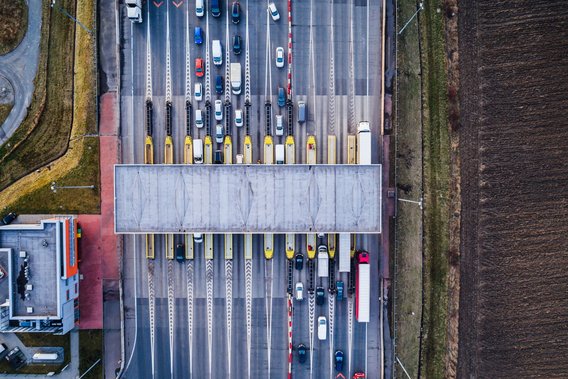
Luftaufnahme einer stark befahrenen Mautstation

Tolls in Europe

Anyone travelling abroad by car should find out in good time about any tolls that may apply. In many European countries, there are charges for using motorways, bridges or tunnels. On this page, you will find an overview of toll regulations in popular travel destinations.
Find out more about tolls in Europe
Beladen eines Autos mit Gepäck für eine Reise

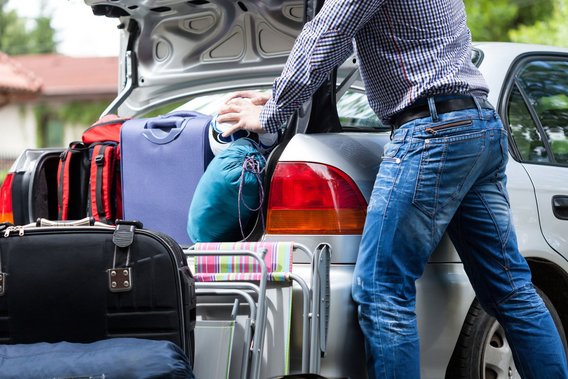
Securing loads in the car

Even during everyday journeys in a car, unsecured loads can quickly become a hazard. Even during an emergency stop, enormous forces are generated that can turn even light objects into dangerous projectiles. TÜV NORD shows you how to secure your load properly – with practical tips.
Find out more about securing loads in your car
Familie mit Gepäck vor einem Wohnmobil auf einer Wiese

Rent a motorhome

Hire a motorhome and set off on your journey. Discover practical tips on hiring and important safety information. Our checklist and answers to frequently asked questions make planning a breeze. The TÜV NORD motorhome guide is your go-to resource for finding the perfect motorhome.
Find out more about motorhome hire

Contact

We look forward to receiving your inquiry!