Space
Back to the Moon
The role ALTER’s professionals are playing in the Artemis programme.
Space
The role ALTER’s professionals are playing in the Artemis programme.
26 March 2026
It has been half a century since humans last left their mark on the moon. In 2027, astronauts are to set foot on the lunar surface once again. The experts from ALTER, a subsidiary of the TÜV NORD GROUP, are playing a key role in this ambitious space programme, which is intended to establish the moon as a springboard for future Mars missions.
The date: 14th December 1972. The scene: Taurus-Littrow, a region in the Mare Serenitatis lunar sea. It’s 5:40 a.m. coordinated universal time. “As we leave the moon and Taurus-Littrow, we leave as we came,” says Eugene Cernan, “and, God willing, we shall return, with peace and hope for all mankind.” With these words, the commander of the Apollo 17 mission climbs the ladder and disappears into the lunar module.
Cernan, who has just died, is still the last person to have set foot on the surface of the Earth’s satellite – but he will not remain the last forever. Having originally sent the sun god Apollo, NASA is now despatching his twin sister, goddess of hunting, the forest and the moon: Artemis. This is the name NASA has given to its second ambitious moon landing programme, which consists of several missions, in which ESA and other space agencies will also be involved. One of the goals is to establish a presence on the moon and thus to lay the foundation for future Mars missions.
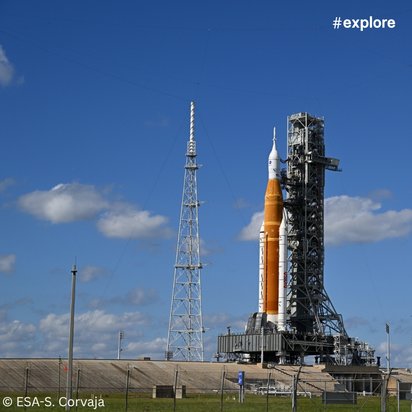
In April 2026, the Orion spacecraft is scheduled to begin its approximately 370,000-kilometre journey to the moon with one female and three male astronauts on board. In Seville, Spain, the employees of ALTER, a subsidiary of the TÜV NORD GROUP, will then gather in front of large screens. “As with all the programmes we’ve been involved in, we’ll pause for a few minutes to celebrate the success of this mission,” says Manuel Morales. “And what we’ve achieved as a team.” The component and product assurance engineer has been working at ALTER for more than 20 years, but, as far as he’s concerned, the Artemis programme is something special: “It’s the moon,” says Mr. Morales. “And we’re talking about taking people there again after more than half a century! It’s a childhood dream come true for many scientists.”

However, humans won’t set foot on the moon again until 2027: in 2026, on the first manned flight, the four-person crew will first orbit the moon and test the Orion spacecraft’s systems. The spacecraft consists of two main parts: the US crew module, also known as the Multi-Purpose Crew Vehicle (MPCV), and a cylindrical supply and propulsion module called the European Service Module (ESM). This is where the main engine for the flight to the moon is housed.
The role of ALTER’s experts included the procurement and testing of electronic and electromechanical parts for the ESM. The module contains more than 20,000 parts and components and twelve kilometres of cable. It measures four by four metres and will weigh around 13 tons at the point of launch. The module will carry the fuel and supply the crew with energy, water and oxygen for several weeks. At the end of each mission, it will separate from the spacecraft and burn up in the Earth’s atmosphere. NASA has ordered six of these ESMs from its European partners.
ALTER has been involved in space missions for more than 30 years, in particular in European Space Agency (ESA) missions. In their development of the ESM service module, the European space engineers drew on their experience with the Automatic Transfer Vehicle (ATV), an unmanned and automated space freighter that delivered supplies to the International Space Station (ISS) between 2008 and 2015. At that time, as now, experts from ALTER were responsible for procuring and testing the components that were installed in the five ATVs.
Despite all this previous experience, working on Artemis was different. The challenge was not only the sheer number of components, each of which had to be put to the test, and the large number of tests. All quality requirements also had to be met under very exacting conditions. “The complexity of the equipment, especially when it came to testing new technologies, was a real challenge,” Mr. Morales says. This was a mammoth task that was only achieved thanks to a strong team performance. “We’ve been working here on the future of space exploration and now understand the medium-term requirements for this type of mission,” says the engineer. “After a busy day, it was great to realise that we’d done something that will be passed on to future generations.”

After all, Artemis is just a bridge to the future: As part of the programme, a permanent base camp is to be established on the moon. ALTER has already evaluated high-performance LEDs for the robots to be charged with this task. “We carried out some very interesting laboratory tests with lunar regolith,” says Mr. Morales. This is the dusty, sharp-edged and crumbly layer of rock that covers the surface of the moon and can pose risks to humans and technology alike.
With the Lunar Gateway, a space station in lunar orbit that will serve both for research and as a “transfer station” between space shuttles and the lunar surface, the idea behind Artemis is to prepare for humanity's next big step: the first manned flight to Mars. ALTER has already left its mark on the Red Planet too – at least in the form of the robots whose components were tested by the experts.
One of these robots, the Perseverance rover, has been crisscrossing the Martian surface since 2021. At the beginning of this year, it discovered an ancient rocky landscape that might yield proof of ancient life on the now desolate planet. However, it will take closer examination on Earth for any certainty to arise. But getting the collected samples back to Earth is currently still a financial and technical challenge.
This is all the truer for a manned flight to the Red Planet, which NASA is aiming for in the 2030s. It will first be necessary, for example, to develop the life support systems needed to supply travellers to Mars with oxygen and water during the long flight and the technical procedures to protect them from the Red Planet’s deadly radiation. In general, there’s still a lot to learn about Mars first, says Mr. Morales, dampening exaggerated expectations of an early launch. “Before we send humans there, let’s stick to using robots to understand how the planet works.”
This is an article from #explore. #explore is a digital journey of discovery into a world that is rapidly changing. Increasing connectivity, innovative technologies, and all-encompassing digitalization are creating new things and turning the familiar upside down. However, this also brings dangers and risks: #explore shows a safe path through the connected world.