Skip to content

Audit and expert opinion

Gas testing for caravans and mobile homes

Whether heating, cooker or refrigerator - in motorhomes or caravans, liquid gas ensures comfort when travelling. To ensure that you are always worry-free when travelling, your gas system should be checked regularly. Our certified test engineers carry out the test in accordance with DVGW worksheet G 607, document the proper condition and give you peace of mind on every journey.
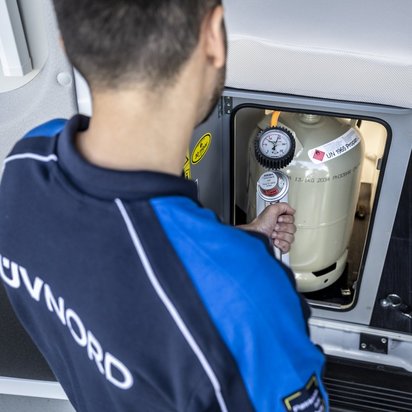
Ein Mann mit einem TÜV NORD T-shirt prüft die Gasanlage in einem Wohnmobil

Regulations for gas testing in caravans and motorhomes

  • Since 19 June 2025, a uniform, statutory inspection obligation has been in force: all leisure vehicles with a permanently installed LPG system - i.e. motorhomes, caravans and caravans - must provide proof of a valid gas test in accordance with DVGW worksheet G 607.
  • The gas test is a separate test, independent of the main inspection (HU). It is carried out by recognised test engineers and documented in the test report and in the gas test booklet ("yellow booklet").
  • The inspection period is 24 months: the LPG system must be inspected again every two years at the latest. In addition, an inspection is required before initial commissioning and after modifications requiring inspection or before recommissioning.
  • The gas system may not be operated without a valid test certificate. Anyone who exceeds the deadlines is committing an administrative offence; fines of between 15 and 60 euros are currently imposed depending on how long the deadline is exceeded.


ℹ️ Note: If you already have a valid gas test in accordance with DVGW G 607, the next repeat test is based on the date documented in the certificate (maximum 24 months). If there is not yet a valid gas test, you should carry out the initial test as soon as possible to avoid a ban on using the gas system and possible fines.

What is checked during a gas inspection?

The gas test involves a pressure test of the gas system, the pipes and all connected appliances and technical components. In addition, all components with a replacement obligation of ten years are checked. This includes gas regulators, gas hoses, stopcocks and all installed gas cylinders.

The following items, among others, are checked on the basis of a defined test plan:

  • Mounting of the gas cylinders
  • Ventilation opening in the gas box
  • Check that there are no electrical devices in the gas box
  • Tightness of the gas system
  • Safety valves
  • Functionality of the gas system
  • Age of connection hose and pressure reducer
  • Function of the individual gas appliances and safety valves, i.e. are all flames burning, do the valves switch off, etc.?
  • Exhaust pipes

Travel safely with a certified gas system – Video on gas testing for motorhomes and caravans

In this video, you will learn everything you need to know about gas testing for motorhomes and caravans - explained in a clear and practical way. We explain why the gas test is so important for your safety, how often it should be carried out and which legal requirements apply.

Our TÜV NORD experts will guide you step by step through the testing process: They will show you how a gas system is tested professionally and in accordance with the recognised standard, what is taken into account and how you can optimally prepare yourself for the appointment. This way, you know exactly what to expect and how to operate your system safely and in compliance with regulations.

How can you best prepare for the gas inspection?

To ensure that your camping vehicle passes the test, follow these tips for preparing for the gas test:

  • Bring the inspection certificate for the periodic inspection with you to the inspection (= yellow inspection book).
  • Make sure that the gas cylinder is connected and filled.
  • Check that all appliances connected to the gas system are working.
  • Charge the battery so that all appliances connected to the gas system can be ignited and tested for functionality (not necessary for piezo igniters).
  • In the case of a new installation, bring the certificates of all new gas appliances with you to have them entered in the inspection logbook.
  • Also check that the pressure reducer and connection hose are not older than 10 years. The test is subject to the European standard EN 1949 and EN 12864/13786. 12864/13786, according to which pressure regulators and non-fixed connection lines must be replaced no later than 10 years after manufacture, regardless of their condition.

What happens if the gas test is not passed?

  • The result of the G607 gas test has no influence on the issuing of the HU sticker.
  • It should be noted that parts of the gas system (e.g. the heater) are tested as part of the main inspection. If defects are found in these components, the vehicle will not pass the general inspection.
  • If a defect is found that is likely to jeopardise the operation of the gas system, the vehicle owner will be informed of this in writing under "Remarks" in the inspection certificate.
  • In this case, you may not operate the gas system.
  • If you cannot prove that you have passed the gas test and an accident occurs, gross negligence can be assumed. In this case, all insurance cover is cancelled.
  • For insurance reasons, campsite operators may also refuse entry to camping vehicles without a valid gas test.
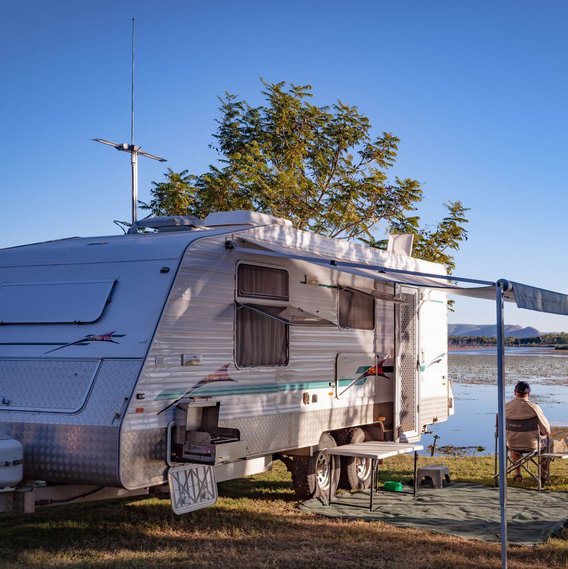
Two people are sitting by a lake under a blue sky. A caravan is also parked in the meadow.

What should you pay attention to when handling gas systems?

Always play it safe! This applies in particular to the gas cylinder. In our safety tips below, we have summarised what you should bear in mind when handling the gas system in your motorhome and caravan:

Don't let just anyone use the gas

  • Always have your LPG system installed or converted by specialists.
  • The system must be checked before it is used for the first time. Our specialists have the relevant expertise, are familiar with potential hazards and will give you the safety you need.
  • Always position gas cylinders vertically. Please ensure that the cylinder cabinets close tightly. As gas is heavier than air, there must be an unclosable ventilation opening of at least 100 cm² in or directly above the floor so that any escaping gas can escape.

The most important rules for regulators

  • Use caravan regulators with a safety valve. Other regulators cannot withstand the stresses and strains.
  • Connect the regulators by hand. This allows you to feel whether the thread is gripping properly. Please do not use spanners, pliers or similar tools.
  • If temperatures drop below +5 degrees Celsius, use a de-icing system for the regulators, such as Eis-Ex. Special winter-proof hoses are available for winter campers.

Do not let anything burn when cooking

  • Caution, risk of suffocation: open the roof hatch or a window. All these appliances consume oxygen. Odourless carbon monoxide can also escape. Therefore, never use these kitchen appliances as a "heater".
  • When switching on gas appliances where the operating handle is pressed for ignition, make sure that it springs back automatically after being pressed.

Expose exhaust gases to fresh air

  • The flue pipes of the gas heater must rise slightly along their entire length. Stable installation is important. Use flue pipe supports if necessary.
  • The flue pipe must be tightly and firmly connected to the heating system and the chimney and must not show any signs of damage.
  • Replace older flue pipes with stainless steel pipes.

The air principle of safe living

  • Make sure that the safety vents in the caravan are open.
  • If there are no safety vents - which is often the case with motorhomes - ensure that there is sufficient air in other ways.

The operating instructions: Here's how it works

  • Read the operating instructions for the appliances carefully.
  • If the instructions are missing, it is best to order them directly from the manufacturer.
  • It is best to stick the operating instructions in a clearly visible place near the appliance.

Save time and travel

Were you planning to visit us anyway for a general inspection or one of the many other TÜV NORD services? Then have the gas system checked at the same time. It couldn't be easier or quicker.

What you should know

Frequently asked questions about gas testing

Camping vehicles with a liquid gas system are subject by law to the so-called "gas test G 607". This is a safety test in which an expert puts the gas system through its paces.

The following guidelines form the legal basis for this:

  • Technical regulations for liquefied petroleum gas (TRF)
  • EC Directives 2001/56EG and 2004/78EG
  • DIN EN 1949
  • DVGW worksheet G 607

A test in accordance with DVGW data sheet G607 is required for leisure vehicles.

Recreational vehicles include

  • Motorhomes
  • caravans
  • Mobile homes
  • Permanent camping units

To ensure that the LPG system in your caravan or motorhome is safe to operate, it must undergo a special inspection. Faults or defects in LPG systems in caravans or motorhomes endanger human life and property. Anyone travelling with an untested gas system may be at risk of poisoning and explosion.

The leak test (tightness test) is part of the G 607 gas test:

  • The gas cylinder is closed and the valve is turned off
  • The leak tester or pressure pump is connected to the supply hose to the gas system and a pressure of 150 mbar is pumped into the line
  • After five minutes, check whether the display shows 150 mbar
  • After a further five minutes, the pressure is compared again
  • The pressure may drop by a maximum of 10 millibars
  • If the pressure deviation is higher, there is probably a leak somewhere
  • Worn components and hoses are replaced
  • If the pressure gauge has not changed, the gas system is tight
  • The supply hose is then reattached to the gas cylinder
  • The screw connection is checked with a leak detector: If bubbles form in the sprayed liquid, gas is escaping from the valve

The gas system test for motorhomes and caravans costs €74.10 at TÜV NORD (as of January 2026).

You should never carry out the gas test on the caravan yourself! Firstly, there is a high risk of injury, and secondly, a simple check of the gas system does not replace the regular, prescribed G 607 gas test.

G 607 gas tests may only be carried out by persons who have the necessary expertise.

  • The first gas test in accordance with DVGW Code of Practice G 607 "LPG systems in vehicles" must always be carried out by an expert before the gas system is put into operation for the first time.
  • For new vehicles, this is usually carried out by the manufacturer.
  • The gas test is then carried out by TÜV NORD experts at regular intervals of two years.
  • If you replace, repair or install new gas appliances such as cookers or heaters, a new gas test is required.

  • If no defects are found during the test, your caravan or motorhome has passed the G607 gas test.
  • After a successful inspection, the process is documented in the inspection certificate for the periodic inspection.
  • If the gas system is free of defects, a new gas test sticker will also be affixed to the vehicle to document compliance with the regulations at the time of the test and the year and month when the next periodic test is due.

  • In general, you can have the G 607 gas test carried out wherever you have your main inspection carried out.
  • Many caravan and motorhome dealers as well as specialised workshops and testing companies - such as TÜV NORD - offer gas tests.
  • Regular gas tests are also carried out at campsites.
  • There are also mobile service providers who carry out the test on site.

Initial and repeat tests to verify the compliance of liquefied petroleum gas systems in accordance with DIN EN 1949 / DVGW Code of Practice G 607 may only be carried out by persons who have successfully completed a training course for testing gas systems for residential purposes and therefore have the necessary expertise.

Contact

We look forward to your inquiry!