Guide and tips
Indicator lights
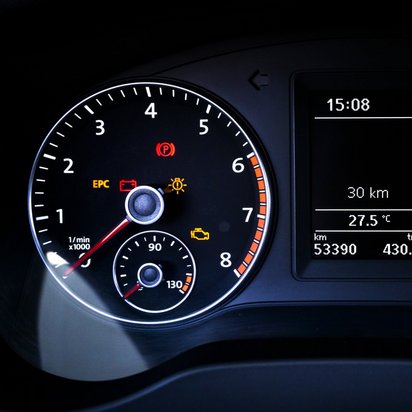
The indicator lights in the car signal to us in different colours that something is wrong. The most important indicator lights and warning lights and their meaning.
Guide and tips
The indicator lights in the car signal to us in different colours that something is wrong. The most important indicator lights and warning lights and their meaning.
Do you always know immediately what your electronic alarm system is signalling? It is not always immediately clear how serious the fault is. Some error messages require immediate action and a visit to a workshop, otherwise there is a risk of serious damage to the vehicle.
Generally speaking:
Yellow and red indicate problems and functional failures. It is highly advisable to stop the car immediately if a "red light" comes on. Green symbols indicate the function or readiness of systems that can be switched on and off, such as cruise control or lane departure warning. White symbols indicate, for example, the start-stop system or the parking aid.
The blue colour is reserved for the high beam. This colour scheme is standardised. As far as the symbols are concerned, however, some car manufacturers may use different colours to those shown in the following illustrations.
This light indicates that the battery is no longer being charged by the alternator (generator). There may be several reasons for this: The V-belt is broken or the alternator, battery or regulator are defective. You should take the vehicle out of service immediately, as the coolant pump is often also driven by the V-belt and cooling therefore fails.
If this symbol lights up, there can be two reasons for this. Either the parking brake is still applied - which is often accompanied by an acoustic signal - or the brake fluid reservoir contains too little brake fluid or is empty. In this case, you should stop immediately and contact a specialist workshop.
This symbol indicates that the brake pad has reached its wear limit. Have the pads replaced at a specialised workshop.
The oil can signals that the oil pressure is too low - a can with wavy lines underneath prompts you to check the oil level. Switch off the engine and wait a few minutes to measure the oil level on the dipstick. Top up the oil if necessary and visit a workshop.
The coolant temperature is too high. Switch off the engine immediately and allow it to cool down. Then check the coolant level. Before topping up the water or coolant, be sure to read the operating instructions on how to open the tank safely. As the tank is pressurised, there is a risk of scalding! If the symbol remains illuminated despite sufficient coolant, the vehicle must be checked in the workshop.
There is a fault in the engine electronics or in the exhaust system. This may result in reduced performance and increased environmental pollution. Contact a workshop immediately!
Airbags or belt tensioners can deploy unintentionally or fail in the event of an accident. Have the restraint system checked at a specialised workshop.
If this symbol lights up, the ABS has failed due to a fault. ESP, brake assist, electronic brake force distribution and the tyre pressure monitoring system will also no longer function properly. Contact a specialist workshop immediately.
If this indicator light flashes, the Electronic Stability Programme or traction control is working. If the symbol lights up continuously, the ESP is switched off. If the ESP cannot be switched on again, consult a specialist workshop.
Illuminates if the tyre pressure is too low or if there is a system fault. The system uses the ABS sensors to compare the rolling circumference of all four wheels with a target value. Check the air pressure of the affected tyre immediately.