Guide and tips
Anyone looking for a reliable used car will find the TÜV report a valuable decision-making aid. The analysis is based on the results of millions of main inspections and shows which vehicle models have defects particularly frequently or rarely.

The new TÜV report is an absolute must for anyone thinking of buying a used car or selling their "second-hand" car. It provides objective information on whether a particular car will become a workshop car over time or whether it will run smoothly for years. For the latest guide, our TÜV experts analysed all main inspections between June 2024 and June 2025.
The TÜV report is available for just 5.90 euros at any TÜV NORD centre as well as in newsagents.
The latest results of the TÜV NORD main inspections show that the quality of many vehicles remains stable: The quality of many vehicles remains stable, but there is still room for improvement In the period from June 2024 to June 2025, numerous cars were tested at over 250 TÜV NORD stations and in more than 10,000 partner workshops. The evaluation shows key trends in vehicle safety and defect distribution.
The unbiased look at the defect rates of the TÜV experts is once again proof of the effectiveness of the independent and neutral main inspectionwhich is usually due every two years and for which vehicles with defects are sent to the repair centres. This encourages drivers to invest in keeping their cars in good technical condition - to the benefit of general road safety.
Germany's motorists continue to be travelling in vehicles that are predominantly technically safe - even if the number of defects has risen slightly. 59.4 per cent of all vehicles tested at TÜV NORD stations stations received the sticker without any complaints, which is 0.8 percentage points less than in the previous year. 25.2 per cent of the vehicles had such significant defects that they had to be repaired before the new sticker could be issued.
A clear trend in this year's TÜV report: the frequency of defects increases noticeably with age. Vehicles that are ten years old or older show an above-average number of safety-relevant defects - particularly in brakes, axle suspension and lighting. The average age of the vehicles presented at the TÜV NORD centres was 10.8 years. The increasing average age of the car population has a direct impact on road safety. The proportion of vehicles with significant defects increases significantly with each additional year: for three-year-old cars the proportion is around 6 per cent, for ten-year-old vehicles it is already 23 per cent and for vehicles over twelve years old it is even around 28 per cent.
The main causes are material fatigue, worn components and electronic ageing. Plastic and rubber components lose their elasticity, cables and plug connections become susceptible to corrosion, brake lines can leak and malfunctions in ABS and ESP systems occur more frequently in older vehicles. In addition, many owners of older vehicles are less willing to maintain their vehicles: regular inspections are postponed more frequently for cost reasons, spare parts are more expensive or more difficult to obtain. This increases the risk of sudden breakdowns - for example due to defective lighting, brakes or engine controls
The independent and neutral main inspection is and remains a central pillar of road safety. It ensures that vehicles with technical defects are recognised and returned to the workshops. This mechanism plays a key role in ensuring that motorists regularly invest in the good technical condition of their vehicles - for the protection of all road users.
"The vehicle population in Germany is older than ever before. We can also see this trend in the defect statistics," explains Hartmut Abeln, Managing Director of TÜV NORD Mobilität and member of the Group Management Board of the TÜV NORD GROUP. "Older vehicles can be technically reliable if they are regularly serviced and professionally maintained. However, with increasing mileage, the load and wear on safety-relevant components naturally increase. A sense of responsibility on the part of vehicle owners is therefore crucial. Those who take inspections and maintenance work seriously make an active contribution to road safety and sustainability - and at the same time ensure that their car remains reliable for longer."
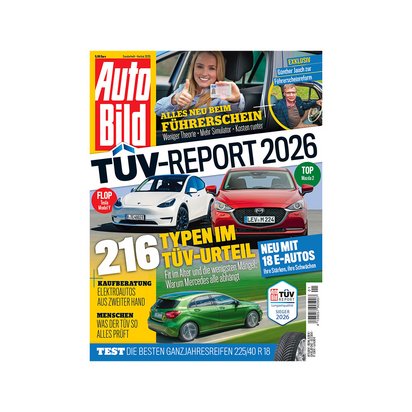
In the overall ranking, the Mazda 2 impresses with the lowest defect rates of all age categories, taking first place in the TÜV Report 2026, followed by the B-Class from Mercedes-Benz and the VW T-Roc. Electric vehicles are particularly strong this year: models such as the Fiat 500E, the BMW i3 and the Mini Cooper SE are among the top 25 most reliable vehicles. Bringing up the rear in this year's evaluation is the Tesla Model Y, which has the highest defect rate in the age group comparison.