Guides and tips
Whether it’s a city bike, mountain bike or e-bike: TÜV NORD is here to help with a practical spring check-up that ensures your bike is fit for everyday use and road safety. With our comprehensive checklist – covering everything from the frame, tyres, brakes, chain and lights right through to the e-bike battery – you can keep track of all the important points.
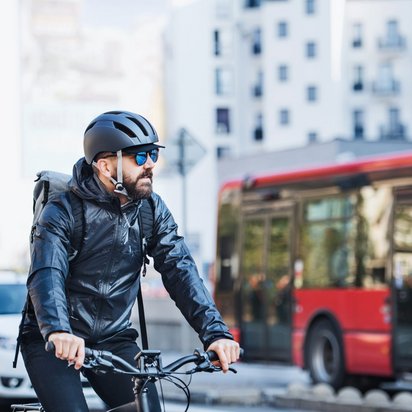
Cycling is becoming increasingly popular in Germany: in 2023, there were 84 million bicycles, 11 million of which were e-bikes. For the first time, more e-bikes (53 per cent) were sold than conventional bicycles (47 per cent). Sales in 2023: 1.9 million bicycles vs. 2.1 million e-bikes.
All types of bicycle were in demand: e-bikes, city bikes, mountain bikes and children’s bikes. Turnover stood at 7.06 billion euros (2022: 7.36 billion euros).
(Source: ZIV Zweirad-Industrie-Verband e.V.)
Bicycles are a practical means of transport and can be an alternative to cars or public transport.
Not every bicycle has the same maintenance and road safety requirements. Whilst the focus with city bikes is primarily on lights, brakes and suitability for everyday use, with mountain bikes it is particularly important to check the tyre tread, suspension and components subject to heavy wear.
For city and trekking bikes, the following points in particular should be checked regularly:
As city bikes are often used on a daily basis, signs of wear and tear tend to develop gradually.
Mountain bikes and gravel bikes are often used on uneven terrain. As a result, the frame, suspension fork, brakes and tyres are subjected to greater stresses.
The following are particularly important:
After off-road rides, dirt and moisture should be thoroughly removed.
E-bikes have additional electrical components that should be checked regularly.
These include:
Defective or damaged batteries should not be used any further.
When it comes to children’s bikes, safety is a top priority. Parents should check the following regularly:
Children’s bikes should also be adjusted regularly to suit the child’s height.
There are many simple checks that cyclists can carry out themselves. These include, for example:
However, a DIY bike check is no substitute for a professional inspection.
Specialist workshops have the specialist tools and experience required to reliably check safety-critical components. Particularly with modern e-bikes or high-quality bicycles, signs of wear, material fatigue or damage can be difficult for laypeople to spot.
A specialist workshop should check the bicycle in particular for:
With e-bikes in particular, faults in electrical components can pose safety risks.
To ensure that bicycles can be used safely in road traffic, certain key safety requirements must be met. These are based, amongst other things, on the provisions of the Road Traffic Licensing Regulations (StVZO).
Safety-compliant equipment includes, amongst other things:
Particularly in the dark and in poor visibility, working lights play a crucial role in road safety. In discussions about StVZO-compliant bicycle lights, reference is often made to approved lights bearing a test mark.
In Germany, there is currently no legal requirement for cyclists to wear a helmet. Nevertheless, wearing a cycling helmet is strongly recommended to reduce the risk of serious head injuries in the event of a fall or accident.
Children, in particular, should always wear a properly fitting bicycle helmet when cycling.
Lights and reflectors ensure that cyclists are seen in good time in the dark, in the rain or in poor visibility.
Therefore, the following components should be checked regularly:
Dirty or damaged reflectors lose much of their effectiveness and should be cleaned or replaced.
For e-bikes, it is also advisable to check:
Damaged cables or moisture on electrical components can compromise safety.
Check the bike frame and fork for cracks, other damage or warping. If any of these issues are found, they must be replaced immediately!
Due to their complex internal workings, suspension forks are a job for a specialist. If oil leaks from oil-damped bicycle suspension forks, the seals should be replaced.
If the bike tyres do not rotate smoothly or are wobbly, it is advisable to visit a specialist shop. In most cases, the problem can be fixed using a spoke wrench. If the bike rim is bent, it will need to be replaced.
Also check the bearing play: to do this, hold the rim between your thumb and forefinger and move the wheel back and forth. If it feels wobbly, adjust the axle bearing.
Bicycle chains are subject to heavy wear and tear. At the very latest when the chain starts to grind or squeak, it needs to be cleaned and re-lubricated. First, apply a generous amount of oil to the chain and then wipe it down thoroughly with a cloth.
Once the chain is clean, apply lubricant to it again. Check the condition of your chain: if it is only resting on the tips of the sprockets, it needs to be replaced.
You should check the length of your bike chain at regular intervals. Specialist bike shops stock special measuring gauges for this purpose. Due to the strain caused by the drivetrain and gear changes, every bike chain stretches over time. Consequently, the teeth on the sprockets and chainrings become worn down. If you wait too long to replace a worn-out bike chain, the tooth profiles will no longer mesh properly with a new chain: it will skip under load!
However, if you regularly check the bike chain for elongation and replace it when the gauge indicates it’s time, you can delay the need to replace other, more expensive drivetrain components. A regularly maintained bike chain can last up to 3,000 kilometres.
To ensure your bike stops quickly, it is absolutely essential to check the braking system:
If the tread or pattern on your bike tyres is worn down, or if the sidewalls are brittle or cracked, treat yourself to a new set of tyres.
The narrower the tyre, the higher the air pressure: a road tyre should have a minimum air pressure of 3.5 bar, whilst a racing bike tyre can have up to 9 bar. You’ll find details of the recommended air pressure on the sidewall of the tyre.
Check that your bicycle’s lights and dynamo are working properly and make sure that the cables are not rubbing against anything. If the bicycle light does not work despite the wiring being in good condition, the dynamo is usually faulty. Replace any faulty reflectors.
Battery-powered lights, on the other hand, are very low-maintenance. Check the batteries or rechargeable cells. If they have already leaked, be sure to dispose of the light and batteries as hazardous waste. Battery fluid is highly corrosive and very dangerous. If the batteries are still in good condition, recharge them to be on the safe side.
For e-bikes with lights powered by the battery, pay particular attention to the cables between the light unit and the battery. Do they show any signs of damage, have they become damp, or is there rust on key connection points?
Alongside the motor, batteries are the heart of every e-bike or pedelec. They ensure hours of riding enjoyment – or great frustration – when the battery runs flat. For this reason, you should take particular care of your battery.
If an e-bike battery has not been charged for a long time, it may have discharged. You must therefore plug it into the mains before using it for the first time. If the e-bike battery is getting on a bit and the range is becoming increasingly limited, it may be worth getting a replacement battery. This is particularly true if you are planning longer rides.
Although no-name bikes are often cheaper to buy, they can cause problems when repairs are needed. When buying a bike, it is therefore worth investing in a well-established manufacturer and ensuring you have a local repair shop so that you can be sure of getting hold of spare parts.
When buying a scooter, you shouldn’t just focus on its appearance. Everyone’s body shape is different, and not every model will suit you.
Before buying, you should try out models from different manufacturers and take a test ride. Ensuring that a motorised two-wheeler is ergonomically suited to you not only guarantees a comfortable ride, but is also a fundamental aspect of safety.
Anyone considering buying a retro model or even a classic car should be cautious. As mopeds are not required to undergo a general inspection (HU), a significant number of motorised two-wheelers on the road have forged documents. Before deciding to buy, you should seek advice from an association or club.
Although only a helmet is compulsory, anything that makes sense on a motorbike also makes sense on a scooter. Many scooters now reach speeds of over 100 km/h, so protective clothing is more than just sensible – in the worst-case scenario, it can save lives.
You can already find good-quality, second-hand scooters at affordable prices in the low four-figure range. As there are generally no road tax or MOT costs involved, not only is getting started in the world of scooter riding relatively inexpensive, but so is the day-to-day running of the vehicle.