Urban mobility
Comeback for the bicycle
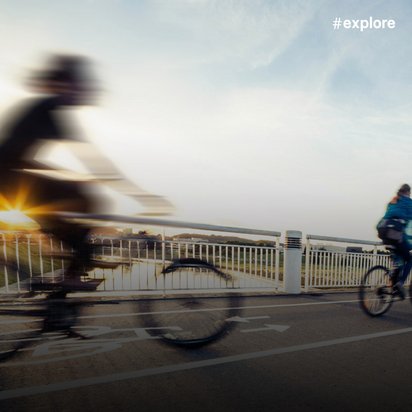
200 years after its invention, the bicycle is gaining popularity. #explore explains what progress is being made by cycling in Germany.
Urban mobility
200 years after its invention, the bicycle is gaining popularity. #explore explains what progress is being made by cycling in Germany.
28 June 2018
The numbers speak for themselves – altogether, German households own around 78 million bicycles. Cycling is becoming ever more popular with users themselves, but also with politicians ... who are increasingly viewing the bicycle as a proven solution to the problems of high traffic volumes and environmental pollution. But whilst well-known cycling cities such as Amsterdam and Copenhagen have been promoting cycling intensively for years, mobility researchers warn that Germany still has to catch up.
In Utrecht, the Netherlands, rush-hour traffic rolls quietly along on two wheels: people of all ages, from bankers in suits to students in hoodies, cycle harmoniously towards their destinations. Cars are in the minority in the Netherlands’ third-largest city, with a population of 340,000. 60 per cent of all journeys in Utrecht city centre are made by bike, whilst the figure for the wider region stands at 40 per cent. Up to 150,000 cyclists use the well-designed cycle paths every day, which are consistently separated from the carriageway for cars along the main roads. This means that children, older people and occasional cyclists can also get around the city safely. Special bridges and underpasses also ensure that cyclists can make swift progress. Those travelling at the right pace can ride through the city on the ‘green wave’. And at the main station, bikes can be securely stored – free of charge for the first 24 hours – in a dedicated car park with 4,500 spaces. It is currently being expanded and, once completed, is set to accommodate as many as 12,500 bikes. This facility has catapulted Utrecht to second place in the ranking of the world’s most cycle-friendly cities – just behind the cycling mecca of Copenhagen.
Although German cities are still a long way from the situation in Denmark or the Netherlands, the popularity of the bicycle is growing here too, 200 years after its invention – amongst the general public and in politics alike. Commuters cycle to work, and cargo bikes for transporting children, bowling skittles or shopping are, at least in the cities, no longer a rare sight. It is not just among students that the bicycle is increasingly replacing the car as a status symbol. And more and more local authorities and cities, as well as regional governments, are making the promotion of cycling a priority in order to tackle traffic and emissions problems. From a transport policy perspective, this is obvious, as bicycles produce neither emissions nor noise, thereby protecting not only the environment but also people’s health and peace of mind. What’s more, the bicycle takes up considerably less space – and that is a precious commodity in densely built-up cities plagued by traffic jams. “The bicycle is the most space-efficient mode of transport we have,” emphasises transport scientist Martin Randelhoff. The mobility expert calculates that a single car parking space can accommodate eight to ten bicycles. “And in free-flowing traffic, a road of the same width can carry 14,000 people per hour in each direction, rather than 2,000.”
The bicycle is the most space-saving means of transport that we have.
Martin Randelhoff
traffic specialist
An enormous relief for jammed-up traffic routes – and a way of gaining space which can then be used for more street playgrounds and green areas. This improves residents’ quality of life and also improves the climate in towns and cities. “More permeable ground coverings mean, for example, that heavy rain drains away better and that the microclimate – in other words the temperature in towns and cities – can be better regulated”, explains Randelhoff.
Cyclists are not only helping the environment and improving their own health. “I can be much more flexible with my bike and also get closer to my destination that if I travel by car”, says Randelhoff. And a study has found that 40 to 50 per cent of all journeys which are taken by car in big cities are shorter than five kilometres. It is just as fast to cover a distance like that by bike as by any other means of transport ... because there is no wasted time spent going to the bus stop or finding the car and it is usually possible to ride right up to the door rather than spend many minutes searching for a parking space near home and blocking the traffic in the process.
But bicycles could also become the most-used mode of transport even on longer journeys. Fast cycle highways such as the partially open RS1 between Duisburg and Hamm are intended to bring commuters to their destinations rapidly and safely, far away from motor vehicle traffic ... whether by means of pure muscle power or with the electrically-powered support provided by the extremely popular e-bikes. After its completion, according to a feasibility study the new cycle highway through the Ruhr region could result in up to 52,000 fewer car journeys per day and 400,000 fewer kilometres travelled by car, which would also save 16,600 tonnes of CO2 each year. This will also be facilitated by the increasing popularity of e-bikes, as they also make it possible for cyclists who are not particularly fit to cover distances of 15 kilometres or more without excessive effort or anxiety about loss of drive power. As the average commuter has a journey of 16.8 kilometres, the e-bike can offer a real alternative here, and direct linking of the fast cycleways to local and long-distance rail transport should also make it easier for those who have longer journeys to change over to the train. And the more people who travel into town by bike, the better the traffic flow and the fewer battles for the limited parking space available. Ever more State governments are starting to like this idea. In Baden-Württemberg alone, ten such fast cycle highways are to be built by 2025.
The cost of the 101-kilometre long RS1 amounts to 184 million euros – with around half of this going towards bridges and underpasses to guide cyclists past vehicle traffic without the need for crossroads. This may at first sound like a large sum, but it is in fact very little compared with the costs of building a conventional motorway. Motorways cost between 6 and 20 million euros per kilometre, and can even swallow up as much as 163 million euros.
In fact, the investment in cycle highways should even save money, as they potentially reduce damage resulting from accidents, absences through sickness and operating costs for mobility. The authors of the feasibility study calculate that in the best case scenario, the RSI should bring in five times as much as it costs to build in terms of the overall economy. And incidentally, it will open up new mobility options for people who do not have cars.
Researchers from the University of Lund also come to the conclusion that cycling saves money – and not only to the benefit of the individual road user. According to their calculations, each kilometre by car costs the driver and society 0.50 euros. This is six times as much as a bicycle, which costs 0.08 euros per kilometre. If the costs to society alone are considered, a kilometre by car costs 0.15 euros, whereas bicycles create a profit of 0.16 euros. Society benefits from this in the form of the positive impact on health, air quality and quality of life, among others.
But the best cycle highway is not much use if the network of cycle paths in towns and cities is not satisfactory. Here, there is still a great deal to be done, according to Martin Randelhoff. “The cycling infrastructure in German towns is often obsolete and mostly piecemeal”, says Martin. Cycle paths that end suddenly at a bollard or meet motor vehicle traffic flow, or which turn into a series of humpbacks because of the roots of bordering trees and in winter are not cleared at all or are cleared very late, are more the rule than the exception in many places. During the cycle climate test of the German Cyclist’s Association ( Allgemeiner Deutscher Fahrrad-Club (Bundesverband) e.V.- ADFC) for 2016, 539 German towns were awarded an average grade of 3.8. Even the best cycling locations and cities such as Münster, Karlsruhe and Freiburg could not achieve more than 3 in terms of grade.
The greatest problem is that our infrastructure does not really extend a true welcome to users.
Martin Randelhoff
traffic specialist
“The greatest problem is that our infrastructure does not really extend a true welcome to users – because it is piecemeal or seldom of a quality which promotes a subjective feeling of safety for the different user groups”, says Randelhoff. Inside towns, cycle paths should be at least two metres wide, and where they are used intensively, three metres would be ideal. “So that it is also possible to ride with a cargo bike or a trailer and overtake or be overtaken”, as Randelhoff points out. Every child carrier bike causes a jam on the current cycle paths, which are at most one and a half metres wide. And wider cycle paths would also help goods transportation: in Berlin, some courier services have been participating in a joint project since the end of May 2018 in order to establish if cargo bikes can replace traditional vans.
The ADFC is demanding more space, more money, more priority and more planners for cycle traffic. Per capita investment of 30 euros per year is needed, as has been standard for a considerable time in Amsterdam, Copenhagen and Utrecht. “Almost everywhere in Germany, we invest considerably less than five euros and paint narrow strips onto existing roads”, reports ADFC national chief executive Burkhard Stork. And Martin Randelhoff thinks that in order to ensure greater safety for cyclists, illegal parking on cycle paths should also be punished more severely. “There is no point in building a cycling infrastructure that is not usable and is even dangerous because cyclists have to swerve into the flow of motor vehicles.” The traffic expert therefore argues for higher fines at the Federal State level and a greater obligation to tow away illegally parked vehicles.
Berlin was one of the least successful contenders in the cycle climate test: Germany’s capital city landed at position 36 with a grade of 4.34 – only Cologne, Mönchengladbach and Wiesbaden came lower on the list. But now, Berlin has earned praise for improvement. Driven forward by the “Bicycle Referendum” initiative, Berlin was the first city in Germany to create a cycle traffic Act. In addition to 100,000 parking spaces and 100 kilometres of cycle highway, the main roads should also be provided with separate paths for cyclists which are separated from roads used by motor vehicles, as has been the case in Copenhagen for years now. Hazardous junctions and crossroads are to be redesigned, and cycle stations and indoor cycle parks are to be built at railway stations. And cyclists are to receive priority over individual motorised transport on a priority network consisting of routes that are particularly important for cyclists. The possibility of synchronised traffic lights for cyclists is also to be considered.
By 2025, the city wants to increase the proportion of cycle traffic from its current 13 per cent: up to 30 per cent in the low-emission zone, and up to 20 per cent in the whole of Berlin. Copenhagen and Amsterdam are already aiming at a 50 per cent rate for cycle traffic, whilst the German cycle city Freiburg is aiming at 40 per cent. However, Berlin is gradually catching up with the premier league of cycle-friendly European cities in terms of investment per head. The intention is to invest 50 million euros annually in cycling over the next four years ... in other words, 14 euros for each resident of Berlin. In 2015 it was only 15 million euros. And for each part of the city there will be two members of staff who will only be concerned with cycle traffic, to ensure that the funds are in fact spent – which did not always happen in the past because of low manpower. “The draft legislation covers the needs of cycling very well in all respects”, says mobility expert Randelhoff. “But it is important that the plans are truly made reality. Because the best goals in the world are worth nothing if they are not put into practice.”
This is an article from #explore. #explore is a digital journey of discovery into a world that is rapidly changing. Increasing connectivity, innovative technologies, and all-encompassing digitalization are creating new things and turning the familiar upside down. However, this also brings dangers and risks: #explore shows a safe path through the connected world.