Skip to content

Technical monitoring

From DÜV to TÜV

From the industrial revolution to the digital revolution: The history of TÜV NORD is closely intertwined with the developments of the past 150 years.
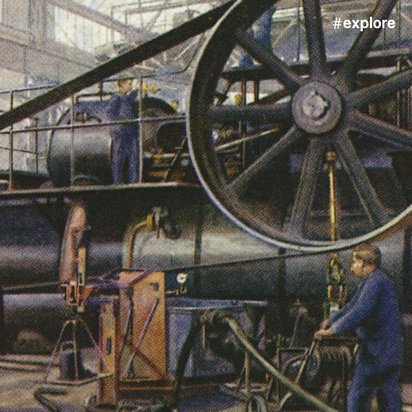
Historische Industrieszene aus der Frühzeit der Industrialisierung, die eine große Dampfmaschine mit markanten Schwungrädern zeigt. Mehrere Arbeiter und ein Mann in formeller Kleidung (vermutlich ein Ingenieur oder Aufseher) stehen um die Maschinenanlage herum in einer Fabrikhalle mit hoher Decke und industriellem Aufbau.WiederholenClaude kann Fehler machen. Bitte überprüfen Sie die Antworten.

8. September 2016

From the industrial revolution to the digital revolution: The story of TÜV NORD is closely linked with the developments of the past 150 years. What used to be a collection of small steam boiler monitoring associations has now become an international group.


Explosions and Risks

It all started with a blast. In 1855, a steam boiler exploded in a factory in Hanover. Many workers died on the spot, and others were badly injured. Devastating accidents like these were not uncommon in the era of the Industrial Revolution. According to early statistics, in the years 1877 to 1890 there were more than 200 steam boiler explosions in the German Empire alone which left nearly 200 people dead and over 100 seriously injured. Alongside inadequate maintenance and construction defects, the most common cause of the terrible accidents was simply a lack of water. A water level that was too low also triggered the boiler explosion on 27 November 1977 in Bitterfeld - to date the last steam boiler explosion ever recorded in Germany. There was very little water in the boiler of the steam locomotive, and the last remaining water spilled out onto overheated parts of the heating surface when the engine was braking and stopping. The water evaporated in a split second, the roof of the firebox was ripped open - and the sudden depressurisation caused the boiler to explode.


Grafische Zeitleiste mit dem Jahr „1765“ als hervorgehobener Abschnitt und dem Text „Erfindung der Niederdruck‑Dampfmaschine durch James Watt“. Darunter steht eine stilisierte Illustration einer frühen Dampfmaschine sowie Markierungen weiterer Jahre auf der Zeitleiste.
Grafische Zeitleiste mit dem Jahr „1835“ als hervorgehobener Abschnitt und der Beschriftung „Erste deutsche Eisenbahn“. Darunter befindet sich eine stilisierte Darstellung einer frühen Dampflok, gefolgt von weiteren Jahresmarkierungen.
Grafische Zeitleiste mit dem Jahr „1857“ als hervorgehobener Abschnitt und der Beschriftung „Erstes Dampfschiff aus Stahl“. Darunter ist eine stilisierte Darstellung eines mehrmastigen Dampfschiffs mit seitlichem Schaufelrad zu sehen, gefolgt von weiteren Jahresmarkierungen.
Grafische Zeitleiste mit dem Jahr „1873“ als hervorgehobener Abschnitt und dem Text „Gründung des DÜV in Hannover“. Darunter steht eine stilisierte Illustration einer frühen Dampfmaschine mit zwei großen Rädern und seitlicher Steuerstange; weitere Jahresmarkierungen folgen rechts.
Grafische Zeitleiste mit dem Jahr „1883“ als hervorgehobener Abschnitt und dem Text „Verordnung über das gewerbsmäßige Verkaufen und Feilhalten von Petroleum – Vorläufer der Verordnung über brennbare Flüssigkeiten (VbF)“. Darunter befindet sich eine stilisierte Illustration eines dreirädrigen Motorfahrzeugs, gefolgt von weiteren Jahresmarkierungen.
Grafische Zeitleiste mit dem Jahr „1900“ als hervorgehobener Abschnitt und dem Text „28 Vereine mit 273 Ingenieuren überwachen im gesamten Deutschen Reich 89.000 Dampfkessel“. Darunter befindet sich eine stilisierte Illustration eines historischen Waggons oder Triebwagens, gefolgt von weiteren Jahresmarkierungen.
Grafische Zeitleiste mit dem Jahr „1910“ als hervorgehobener Abschnitt und dem Text zur erstmaligen Nennung „amtlich anerkannter Sachverständiger für den Kraftfahrzeugverkehr“ in der „Verordnung über den Verkehr mit Kraftfahrzeugen“. Darunter stehen stilisierte Figuren neben den Buchstaben „TÜV“, gefolgt von weiteren Jahresmarkierungen.
Grafische Zeitleiste mit dem Jahr „1939“ als hervorgehobener Abschnitt und dem Text „Beginn der Eigenüberwachung von Kraftfahrzeugen“. Darunter ist eine stilisierte Illustration eines Gesetzbuches mit der Aufschrift „StVG“ und einer angedeuteten Straßenmarkierung abgebildet, gefolgt von weiteren Jahresmarkierungen.
Grafische Zeitleiste mit dem Jahr „1957“ als hervorgehobener Abschnitt und dem Text „Einführung der ‚Verkehrssünderkartei‘ beim Kraftfahrt‑Bundesamt in Flensburg“. Darunter ist eine stilisierte Karteikarte mit Namen, Ort und Eintragungsdetails abgebildet, gefolgt von weiteren Jahresmarkierungen.
Grafische Zeitleiste mit dem Jahr „1975“ als hervorgehobener Abschnitt und dem Text „Kooperationsvertrag zwischen den Vereinen in Hamburg und Hannover“. Darunter befindet sich ein rundes TÜV‑NORD‑Logo mit der Aufschrift „ISO 9001“, gefolgt von weiteren Jahresmarkierungen.
Grafische Zeitleiste mit dem Jahr „1987“ als hervorgehobener Abschnitt und dem Text „Gründung der Gesellschaft Technische Schulungen Nord – Erste Programme ‚TÜV‑Akademie‘ für externe Teilnehmer“. Darunter befindet sich eine stilisierte Illustration eines Förderturms, gefolgt von weiteren Jahresmarkierungen.
Grafische Zeitleiste mit dem Jahr „2010“ als hervorgehobener Abschnitt und dem Text „Erste Prüfaufträge für Windenergieanlagen in Nord‑ und Ostsee“. Darunter befindet sich eine stilisierte Illustration einer Offshore‑Windenergieanlage, gefolgt von weiteren Jahresmarkierungen.
Grafische Zeitleiste mit dem Jahr „2011“ als hervorgehobener Abschnitt und dem Text „TÜV NORD erwirbt die ALTER TECHNOLOGY Group und prüft im neuen Geschäftsbereich Aerospace Bauteile von Satelliten“. Darunter befindet sich eine stilisierte Illustration einer Leiterplatte, gefolgt von weiteren Jahresmarkierungen.
Grafische Zeitleiste mit dem Jahr „2012“ als hervorgehobenen Abschnitt und dem Text „TÜV NORD setzt neue Zeichen für die Energieversorgung der Zukunft, Elektromobilität, IT‑Sicherheit und Nachhaltigkeit“. Darunter befindet sich eine stilisierte Illustration eines Elektroautos mit Ladekabel, gefolgt von weiteren Jahresmarkierungen.
Grafische Zeitleiste mit dem Jahr „ab 2015“ als hervorgehobenem Abschnitt und dem Text „Digitalisierung gewinnt an Bedeutung – TÜV NORD GROUP prüft erste Industrie 4.0‑Anwendungen“. Darunter befinden sich stilisierte Symbole für eine Datenwolke, ein Tablet und einen Industrie‑Roboterarm, gefolgt von weiteren Jahresmarkierungen.

The Birth of TÜV

To provide better protection for the workers, steam boiler operators clubbed together in Hamburg in 1869 to found the Norddeutscher Verein zur Überwachung von Dampfkesseln (DÜV). From that date on, on the basis of a voluntary commitment, the North German association and other “DÜVs” took to monitoring the operational safety of boilers - and the number of accidents underwent a rapid decline. By the turn of the 20th century, 28 associations with 273 engineers were monitoring 89,000 steam boilers throughout the German Empire. From that time on, the monitoring associations kept pace with the technical and social developments - never losing sight of the core idea of making people and their environment safer. The state gradually transferred other safety-related tasks, such as the inspection of electrical installations, lifts and motor vehicles, to the DÜV, which in 1938 was renamed the TÜV (Technischer Überwachungsverein).

A wish to make the world safer is embedded in our DNA.

Dirk Stenkamp

Member of the Board of Management of the TÜV NORD GROUP

Safety in the Digital Age

Today, almost 150 years after the founding of the North German Association for the Inspection of Steam Boilers, the TÜV NORD GROUP is an international technology service provider with more than 10,000 employees. Whilst at the end of the 19th century the rapidly growing industrial sector placed new demands on safety, TÜV NORD is now facing the challenge of increasing digital transformation. “For us, digitalisation is the driver of innovation for industry. In particular, Industry 4.0 will be inconceivable without IT security,” explains Dirk Stenkamp, a member of the Executive Board of the TÜV NORD GROUP. As the world becomes increasingly connected and digitised, the need for digital security is also growing. “It is in our DNA to make the world a safer place,” says Stenkamp. That is why TÜV NORD is not only keeping pace with new technical developments, but is also ensuring, through international research projects, collaborations with universities and modern testing methods, that the new world – in which autonomous driving and robot-controlled machines are no longer visions of the future – is shaped safely. Dirk Stenkamp promises: “We will be able to offer tomorrow’s customers significantly more comprehensive safety services than is possible today, based on the old electromechanical world.”

#explore - The Online Magazine by TÜV NORD

This is an article from #explore. #explore is a digital journey of discovery into a world that is rapidly changing. Increasing connectivity, innovative technologies, and all-encompassing digitalization are creating new things and turning the familiar upside down. However, this also brings dangers and risks: #explore shows a safe path through the connected world.