Good question, next question
Why do wind turbines have (only) three blades?
Why three rotor blades are a stable solution.
Good question, next question
Why three rotor blades are a stable solution.
05. März 2026
The historic windmills found in Western Europe, as can still be admired in northern Germany, the Netherlands or in picture books, for example, usually have four blades. Their traditional counterparts in Majorca have as many as six. But why do modern wind turbines have exactly three rotor blades, neither more nor less?
Sergio Leone’s Western classic “Once Upon a Time in the West” begins with a mournful squeaking noise: the Wild West windmill, which turns endlessly above the run-down railway station somewhere in the middle of nowhere on the prairie, holds up 18 rotor blades to catch the wind. Many of its relatives, which were used for water pumps or, later, for decentralised electricity production, boasted as many as 150.
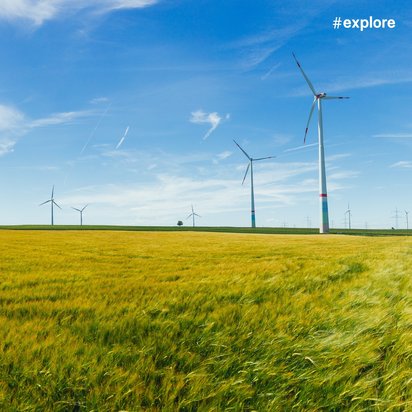
Modern wind turbines appear sparingly equipped in comparison. Nevertheless, their three rotor blades have long since established themselves as the gold standard, and that with good reason. After all, the towering pillars of the energy transition must meet three requirements: They must produce a lot of electricity, cost as little as possible and run stably. In this context, “stably” means as quietly, safely and low-maintenance as possible.
The cheap solution would be a wind turbine with only one blade, at least in theory. The problem in practice would be that a single rotor blade would be unbalanced in its rotation. This would destabilise the entire installation and quickly lever it out of its foundations.
In principle, two-blade rotors could run smoothly – if it weren’t for the altitude at which they harvest their electricity. With the rotor diameters of well over 100 metres which are easily exceeded by modern turbines, the difference in wind speeds high in the air and down near the ground is hugely significant.
In a system with two blades, the rotary action repeatedly brings one of the blades in front of the tower, thereby moving it into an air pocket. At the same moment, the upper blade is at its highest point and under maximum wind pressure. This imbalance puts massive strain on the blade mountings and causes the entire tower to vibrate. Two-blade systems must also operate at high speeds, making them noisy and increasing system wear.
This was the experience of the operators of double-bladed wind farms, such as those built in Germany and the Netherlands in the early days of wind power from the 1980s onwards. Due to their susceptibility to failure, the double-bladed turbines have now been abandoned worldwide and existing installations dismantled.
Wind turbines with four rotor blades would run into the same problems. These strains can only be prevented by having an odd number of blades. With three blades, you never have the situation where one blade is in an air pocket and another is under maximum wind pressure at the same time. When one blade of a three-bladed wind turbine is at the lowest point, the others stretch diagonally upwards – in other words, they are safely removed from the highest point with the maximum wind pressure.
But if an odd number of blades has proven to be the most stable version, why not equip wind turbines with five, seven, nine or even eleven blades to generate still more electricity?
The short answer to this question is that it's not worth it. Here’s why: A wind turbine with nine blades would indeed generate more electricity than one with three – but nowhere near three times as much. This is because the increase in performance decreases with each additional blade. Each blade passes through the turbulence created by the preceding one, meaning that the blades literally take the wind out of each other’s sails. The more blades you have, the more noticeable this effect is.
As a result, having a fourth blade would yield at best two percent more power than a three-bladed turbine, which would be too little to justify the higher construction costs. After all, the rotor blade of a typical wind turbine costs 200,000 euros – for offshore turbines, you have to factor in much more.
And then there’s the additional weight. The rotor blades of modern turbines weigh 15 to 25 tonnes. Additional mass means higher loads. An additional rotor blade would therefore require a complete adjustment of the entire statics of the wind turbine, which would in turn be reflected in the costs.
This is why having three blades is the best compromise between power yield, material costs and stability. Finally, three-blade turbines run quieter than other rotor variants and are also more pleasing to look at: their movement appears calmer and more harmonious to our eyes.
In the construction of their windmills and wind turbines, however, our forebears were not entirely on the wrong track in aerodynamic terms. Due to their comparatively small size, the differences in wind speed on the ground and at altitude were not relevant, meaning that turbines with four or six blades were not subjected to chronic strain.
The many blades of the Wild West windmills, on the other hand, which were designed to operate water pumps, would be set in motion even by gentle breezes and had a good rotational force. This allowed them to push the heavy pistons of the pumps even under suboptimal conditions.
By the way, if you want to follow in the footsteps of “Once Upon a Time in the West” today, you don’t have to travel to Monument Valley. The legendary opening scene was filmed in southern Spain, on a disused railway line near the village of La Calahorra. Today, while there is nothing left to see of the station backdrop, and the squeaking windmill has long since been dismantled, in the distance, on the edge of the barren plain, you can make out the slender silhouettes of wind turbines, whose three blades spin against the backdrop of the brown and bluish mountain ranges of the Sierra Nevada.
This is an article from #explore. #explore is a digital journey of discovery into a world that is rapidly changing. Increasing connectivity, innovative technologies, and all-encompassing digitalization are creating new things and turning the familiar upside down. However, this also brings dangers and risks: #explore shows a safe path through the connected world.