Medical technology
Updated on: November 23, 2026
Reprocessing of single-use devices (SUDs) has become an increasingly important topic as healthcare providers seek to balance sustainability objectives with patient safety and regulatory compliance. This article explains the requirements of Article 17 of the Medical Device Regulation (MDR), outlines the different approaches to reprocessing and highlights some of the challenges organizations face.
Contact us now
What does „reprocessing“ refer to?
What approaches to reprocessing does Article 17 stipulate?
What are current challenges that reprocessors face?
TÜV NORD is currently in the designation process for certifying SUDs
About the author – Dr. Alain Steinmann
FAQs on reprocessing of single-use medical devices under Article 17 MDR
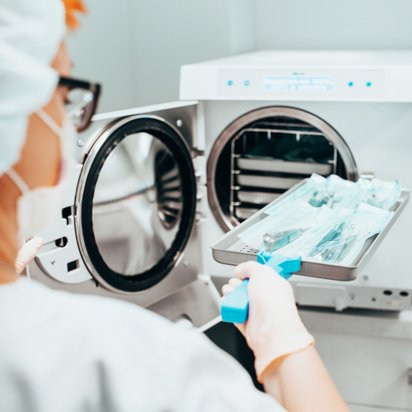
In the context of medical devices, the term “reprocessing” refers to a series of procedures carried out to enable the safe reuse of a device. The procedures include cleaning, disinfection, testing, the restoration of the device´s technical and functional safety, packaging and sterilization.
It must be demonstrated that the reprocessed products retain their safety and performance characteristics throughout their entire life cycle. This requires appropriate validation procedures and comprehensive documentation of the reprocessing steps.
Article 17 of the European Medical Devices Regulation 2017/745 (MDR) sets out the legal framework for the reprocessing of single-use products. The article defines the conditions under which reprocessing may take place and sets out the obligations applicable to the various reprocessing approaches.
MDR Article 17 outlines the reprocessing of SUDs and indicates that each EU Member State decides whether reprocessing is permitted under its national law. As a result, the acceptance and practical implementation of reprocessing vary considerably between countries. The regulation also sets out requirements for when reprocessing is permitted. Two distinct approaches exist where reprocessing is allowed and Member States permit these activities: CE (Conformité Européenne) and CS (Common Specifications).
Under CE reprocessing (Article 17(2)), the reprocessor takes upon the legal responsibilities of the manufacturer of the reprocessed device as set out in MDR article 10. Where a reprocessor reprocesses single-use devices in accordance with Article 17(2) of the MDR, it legally assumes the full role and all the legal obligations of an original manufacturer as set out in Article 10. It bears full responsibility for ensuring that the reprocessed medical device corresponds to the original device in terms of safety, functionality and performance. To this end, the reprocessor must establish a proven quality management system, maintain comprehensive technical documentation including process validations, and set up a risk management system and a continuous clinical evaluation system.
Depending on the product’s risk class, it is mandatory to undergo a conformity assessment procedure involving a Notified Body. In addition to appointing a person responsible for regulatory compliance (PRRC), the reprocessor is responsible for assigning a UDI, EUDAMED registration and full product liability. Specific requirements apply to labelling: the reprocessor must be identified on the label as the sole manufacturer, whilst the name of the original manufacturer is omitted from the label and is instead stated exclusively in the instructions for use. These obligations are complemented by an active post-market surveillance system and compliance with all vigilance and reporting obligations in the event of serious incidents.
A second approach is based on the Common Specifications (CS) described in Article 17(3) to 17(5). Under the ‘Common Specifications’ (CS) approach set out in Article 17(3) of the MDR and Implementing Regulation (EU) 2020/1207, the reprocessor is not legally classified as a manufacturer; consequently, the standard distribution and placing-on-the-market rights do not apply. The reprocessed single-use device may only be reused within the respective healthcare facility’s own premises and must under no circumstances be placed on the market. The reprocessor undertakes to implement a specific quality management system for the entire process, which must be audited at least once a year by an independent external body. Prior to the first reprocessing, a comprehensive suitability evaluation and risk assessment must be carried out for each product; on this basis, a maximum number of reprocessing cycles must be bindingly specified and tracked seamlessly for each individual component. Labelling must include the clear inscription ‘Reprocessed’ as well as an internal traceability system that ensures the patient, the medical device and the specific reprocessing cycle can be linked. If reprocessing of SUD is carried out by an external service provider on behalf of a healthcare facility, compliance with all technical and hygiene requirements must be governed by a detailed contract. Finally, the reprocessor is obliged to operate an internal incident reporting system, to report serious incidents to the competent authority, and to retain all process and reprocessing documents for at least ten years.
Furthermore, Member States may require health institutions to provide information on the use of reprocessed devices within the institution, as well as relevant information on the devices used to treat patients.
Although the MDR and Implementing Regulation (EU) 2020/1207 offer pathways for reprocessing of SUDs, implementation remains challenging for several reasons. Reprocessors of single-use products are currently facing significant hurdles, which primarily consist of regulatory, technical, market-related and economic constraints. One of the most pressing structural challenges lies in the ‘Common Specifications’ (CS) pathway under Article 17(3) of the MDR: Whilst this route is legally provided for healthcare facilities, there is simply a lack of certifiers in the market that offer audits in accordance with Implementing Regulation (EU) 2020/1207 – although a positive shift is emerging here, as the Notified Body TÜV NORD CERT is now specifically addressing this area and is available as a competent certification partner for CS reprocessing processes. At the same time, there are significant technical barriers to reverse engineering, as original manufacturers do not provide design data or material formulations, and the reprocessor must go to great lengths to demonstrate equivalence in terms of safety and function themselves.
Another problem is the highly fragmented European internal market, as the permissibility of reprocessing depends on the national ‘opt-in’ or ‘opt-out’ decisions of individual EU Member States, which makes it difficult to scale up cross-border models. Furthermore, the regulatory complexity surrounding the EUDAMED connection and the seamless tracking of every single reprocessing cycle requires considerable human and IT resources. Finally, high initial investments in validation and biocompatibility testing undermine the cost-effectiveness of the processes, whilst reprocessors must simultaneously bear the full liability risk.
In conclusion, Article 17 MDR establishes a harmonized regulatory framework for the reprocessing of single-use devices while allowing Member States to determine whether such activities are permitted at national level. Two distinct approaches exist where reprocessing is allowed and Member States permit these activities. Organizations can follow either the CE reprocessing approach, under which the reprocessor assumes manufacturer responsibilities, or the CS reprocessing approach, which is subject to specific conditions and Common Specifications. The chosen reprocessing approach determines which regulatory obligations apply.
As the demand for sustainable healthcare solutions continues to increase, organizations that can successfully combine regulatory compliance and patient safety considerations will be best positioned to take advantage of the opportunities offered by reprocessing.
The reprocessing of single-use devices in accordance with the requirements of the EU Medical Devices Regulation (MDR 2017/745) requires reliable and qualified partners for conformity assessment. The Notified Body TÜV NORD CERT plays a pioneering role in this field and offers comprehensive conformity assessment procedures for the reprocessing of single-use products in accordance with Article 17(2) of the MDR (known as ‘CE reprocessing’ or ‘medical remanufacturing’), which it is already successfully carrying out. In this way, TÜV NORD CERT supports remanufacturers in bringing their products to the European market as fully-fledged manufacturers, in a legally compliant manner and in accordance with the highest safety and quality standards. To meet market requirements and the needs of healthcare facilities even more comprehensively, the Notified Body is further expanding its portfolio: The notification procedure for the reprocessing of single-use devices in accordance with Article 17(3) of the MDR – reprocessing in accordance with the Common Specifications (CS) as set out in Implementing Regulation (EU) 2020/1207 – is currently underway. With this forward-looking commitment, TÜV NORD CERT is positioning itself as the key point of contact for medical device manufacturers and reprocessors, enabling them to implement sustainable circular economy concepts in the healthcare sector in a regulatory-compliant manner.

Dr Alain Steinmann has been working intensively in the field of medical device reprocessing for over twelve years. Since 2014, he has been applying this in-depth expertise in his role at a Notified Body, where he works as an auditor, product expert and certifier.
As an internationally recognized certification service provider, TÜV NORD CERT acts as a reliable partner to medical device manufacturers, reprocessors and healthcare facilities, providing precise assessment and certification of compliance with both statutory requirements and voluntary standards. The auditors possess in-depth expertise in the field of medical device reprocessing and work according to a strictly standardized methodology. This structured approach guarantees the highest level of neutrality and absolute independence at every stage of the assessment. Reprocessing organizations benefit not only from legally compliant conformity assessment procedures, but also from continuous and reliable support throughout the entire certification process – from the initial assessment right through to the long-term monitoring of sustainable reprocessing concepts.
Article 17 of Regulation (EU) 2017/745 on medical devices (MDR) establishes the legal framework for the reprocessing of single-use devices (SUDs). It defines the conditions under which reprocessing may take place and sets out the regulatory obligations applicable to the different reprocessing approaches.
The key difference lies in the legal responsibilities of the reprocessor.
Under the CE reprocessing approach, the reprocessor assumes the full role and responsibilities of the manufacturer of the reprocessed device. He also bears full responsibility for ensuring that the reprocessed device corresponds to the original device in terms of safety, functionality and performance.
Under the CS reprocessing approach, the reprocessor is not legally considered the manufacturer. Reprocessed devices may only be reused within the healthcare institution concerned and cannot be placed on the market. The process must comply with the Common Specifications established by Implementing Regulation (EU) 2020/1207.
Organizations involved in reprocessing SUDs currently face several challenges, including: