IMO FTP Codes
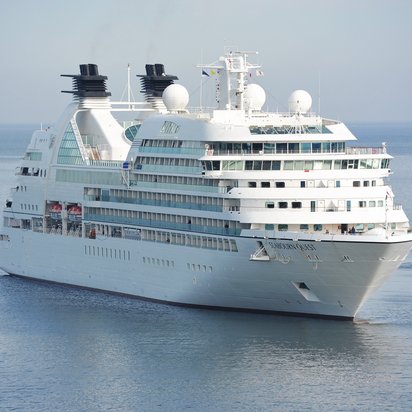
At the fire test facilities in Dortmund and Lathen, we carry out the following tests on materials and components intended for use on ships and yachts in accordance with Resolution MSC.307(88) ‘International Code for Application of Fire Test Procedures, 2010’ (2010 FTP Code) of the International Maritime Organisation (IMO):
| FTP code | Testing procedure | Guideline | Relevant test procedure |
| Part 1 | Non-flammability test | MSC.307(88) | ISO 1187 |
| Part 2 | Smoke and toxicity test | MSC.307(88) | ISO 5659-2 |
| Part 3 | Testing of Class A, B and F fire barriers | MSC.307(88) | ISO 834-1 |
| Part 4 | Testing of fire door control systems | MSC.307(88) | - |
| Part 5 | Test for surface flammability (test for surface materials and lowermost deck coverings) | MSC.307(88) | ISO 5658-2 |
| Part 7 | Testing of vertically suspended textiles and films | MSC.307(88) | ISO 6940/41, EN 1101/02 |
| Part 8 | Testing of upholstered furniture | MSC.307(88) | BS 5852-1, ISO 8191-1/2, EN 1021-1/-2 |
| Part 9 | Testing of bedding | MSC.307(88) | EN 597-1/-2 |
| Part 10, Appendix 2 | Testing of fire-retardant materials for high-speed vehicles | MSC.307(88) | ISO 5660 |
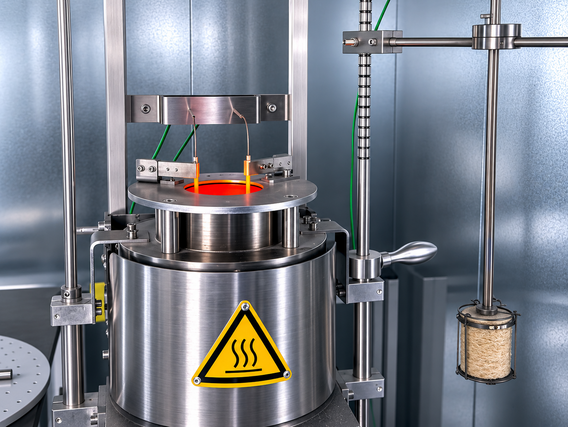
Many materials used in shipbuilding must meet the ‘non-combustible’ test criterion in accordance with IMO guidelines. The non-combustibility testing and classification of the materials under examination are carried out in accordance with the ‘International Code for Application of Fire Test Procedures, 2010’:
In an electrically heated furnace in accordance with DIN EN ISO 1182, cylindrical test specimens (H = 50 mm, Ø = 45 mm) are heated to 750° Celsius (± 5 °C). Two thermocouples measure the temperature. One thermocouple (furnace thermocouple) measures the temperature inside the furnace. The second thermocouple (surface thermocouple) measures the temperature of the test specimen’s surface.
During the test, the time at which ignition occurs and its duration are recorded.
In addition, the moisture and binder content of the test specimens are determined.
The test specimen is weighed before and after the test to determine the loss in mass of the test specimen following the test.
In accordance with IMO 2010 FTPC Part 1, the test specimens are classified as ‘non-combustible’ if the following four criteria are met:
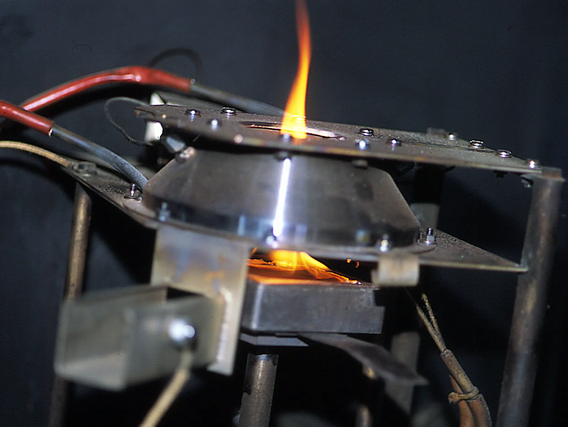
Coating materials used on board ships (paints, adhesives, laminates, carpets and many others, which are applied to bulkheads, panelling, decks, ceilings and floors) must – where required – meet the assessment criteria for smoke density and toxicity. Testing and classification of the materials under examination are carried out in accordance with the ‘International Code for Application of Fire Test Procedures, 2010’:
In a test chamber in accordance with DIN EN ISO 5659-2, square test specimens are exposed to heat fluxes of 25 kW/m² without a pilot flame, 25 kW/m² with a pilot flame and 50 kW/m² without a pilot flame. The resulting flue gases are collected in the test chamber. Once the maximum smoke density has been reached, samples are taken from the gases for toxicity assessment and analysed using an
FTIR spectrometer.
Surface coatings must not exceed a Dm value of 200 under any test conditions.
Underlay floor coverings must not exceed a Dm value of 400 under any test conditions.
Floor coverings must not exceed a Dm value of 500 under any test conditions. Plastic pipes
and electrical cables must not exceed a Dm value of 400 under any test conditions.
| Gas component | Limit value |
| CO | 1450 ppm |
| HCI | 600 ppm |
| HF | 600 ppm |
| HBr | 600 ppm |
| HCN | 140 ppm |
| NOx | 350 ppm |
| SO₂ | 120 ppm |
| SO₂ (for floor coverings) | 200 ppm |
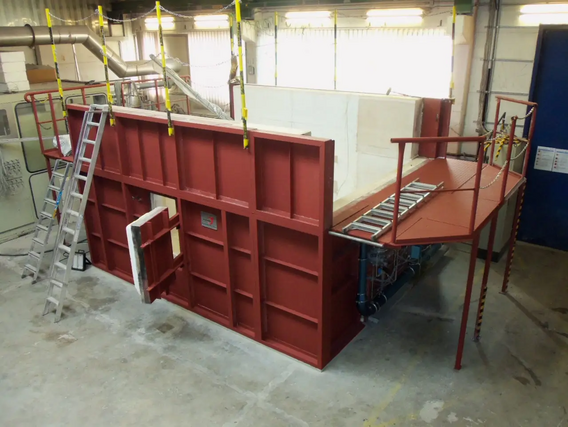
On board ships, horizontal and vertical fire barriers such as ceilings, walls, windows and doors must be capable of withstanding the effects of fire. Fire tests on Type A, B and F fire barriers are
carried out in accordance with the ‘International Code for the Application of Fire Test Procedures (FTPC)’:
For the fire resistance test, the so-called unit temperature curve (ETK) in accordance with ISO 834-1 is simulated in a specialised fire test furnace. The test duration is usually between 30 and 60 minutes. The partition surfaces must withstand the fire without the flames penetrating to the side facing away from the fire.
Furthermore, depending on the classification criteria, the temperature on the side of ceilings, walls, floors and doors facing away from the fire must not exceed 180° to 225°C. In the so-called ‘cotton-wool pad test’, the integrity (fire resistance) of the structure is deemed to have been passed if the cotton-wool pad neither smoulders nor ignites.
The test is used to assess whether the tested partition surfaces meet the specified criteria within the test duration.
| Type | Average temperature rise ≤ 140°C for | Max. temperature rise ≤ 180°C for | Room integrity maintained for |
| A-60 | 60 minutes | 60 minutes | 60 minutes |
| A-30 | 30 minutes | 30 minutes | 60 minutes |
| A-15 | 15 minutes | 15 minutes | 60 minutes |
| A-0 | Not applicable | Not applicable | 60 minutes |
| Type | Average temperature rise ≤ 140°C for | Max. temperature rise ≤ 225°C for | Room integrity maintained for |
| B-15 | 15 minutes | 15 minutes | 30 minutes |
| B-0 | Not applicable | Not applicable | 30 minutes |
| F-15 | 15 minutes | 15 minutes | 30 minutes |
| F-0 | Not applicable | Not applicable | 30 minutes |
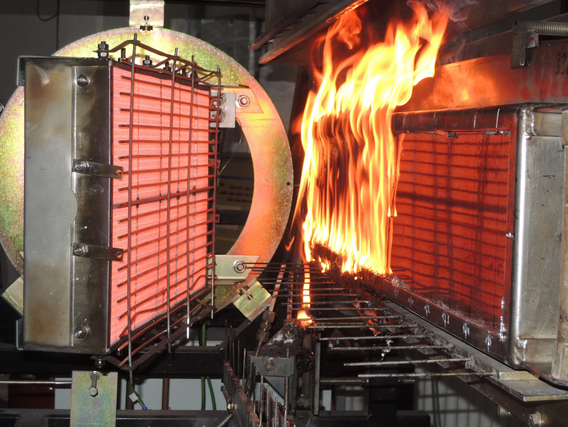
The coating materials used on board ships (paints, adhesives, laminates, carpets and many others), which are applied to bulkheads, panelling, decks, ceilings and floors, must be tested for surface flammability. The flammability testing and classification of the materials under investigation are carried out in accordance with the ‘International Code for Application of Fire Test Procedures, 2010’:
The materials are exposed to a defined irradiance generated by a heat source. During the tests, the testers measure and record the ignition time, flame spread, flame extinction and heat release. From the detected values, the testers calculate the following results:
| Limit values for coating materials for… | CFE [kW/m²] | Qsb [MJ/m²] | Qt [MJ] | Qp [kW] |
| Bulkheads, walls, cladding and ceilings | ≥ 20.0 | ≥ 1.5 | ≤ 0.7 | ≤ 4.0 |
| Lowermost floor coverings | ≥ 7.0 | ≥ 0.25 | ≤ 2.0 | ≤ 10.0 |
| Floor coverings | ≥ 7.0 | ≥ 0.25 | ≤ 2.0 | ≤ 10.0 |
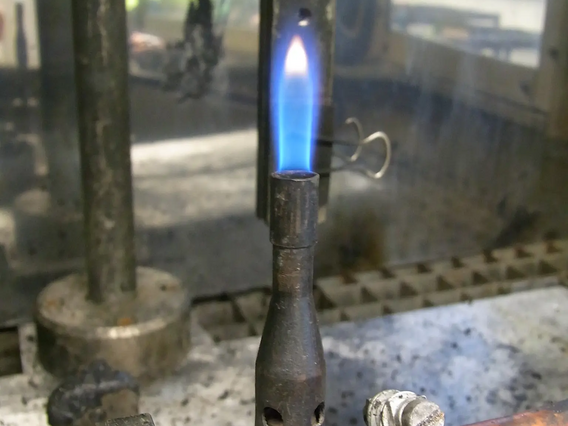
Fire tests on net curtains, curtains and other vertically hung textiles, which are intended to be resistant to ignition and flame spread, are carried out in accordance with the ‘International Code for the Application of Fire Test Procedures, 2010’:
In this test procedure, the flame application arrangement is determined in preliminary tests.
The material is subjected to surface ignition for 5 or 15 seconds. If no sustained burning is observed under this test configuration, edge ignition of the material is carried out for 5 or 15 seconds.
Once the most unfavourable test configuration for the material has been identified, the flame test must be carried out on 5 test specimens in the warp direction and 5 test specimens in the weft direction.
To determine whether burning droplets from the test specimen can ignite combustible materials on the base of the test apparatus, a 10 mm thick layer of cotton must be placed immediately beneath the test specimen holder.
Products exhibiting one or more of the following characteristics shall be classified as unsuitable for use as curtains, net curtains or free-hanging textiles:
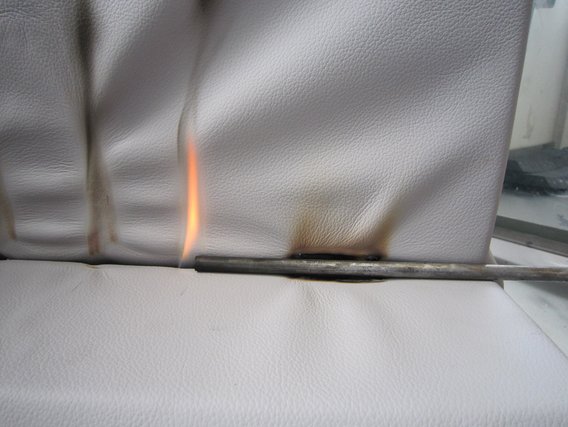
Only chairs, sofas, armchairs and similar items that are flame-retardant may be used on board ships. The flame-retardancy of upholstered furniture is governed by the relevant IMO guideline for upholstered furniture. Fire tests on upholstered furniture are carried out in accordance with the ‘International Code for the Application of Fire Test Procedures (FTPC)’:
The test assesses whether the covers and fillings give rise to a progressive smouldering fire or whether open flames occur. Smouldering cigarettes are used as the ignition source to simulate a material with low flammability. A burning match or a flickering candle is simulated using a propane gas flame. The ignition source is applied at the junction of the seat and backrest of the test specimen.
Upholstery and fillings of seating and reclining surfaces are classified as flame-retardant if:
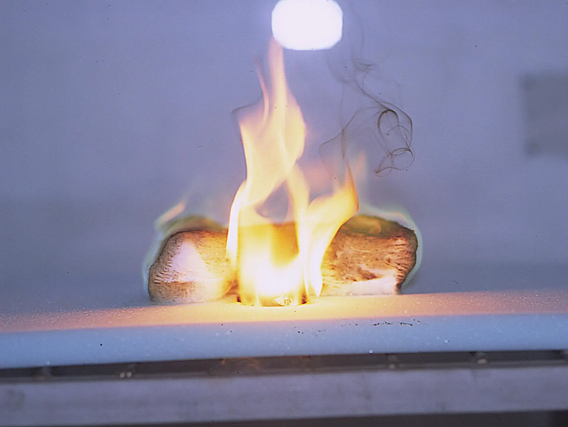
Only mattresses, duvets and pillows that are flame-retardant may be used on board ships.
The same applies to quilted bedspreads and bed covers.
Fire tests on bedding are carried out in accordance with the ‘International Code for the Application of Fire Test Procedures (FTPC)’:
The test assesses whether a smouldering fire develops or whether the test specimen bursts into flames. Smouldering cigarettes covered with cotton wool are used as the smouldering ignition source, designed to simulate falling asleep with a lit cigarette.
A burning match or a flickering candle is simulated using a propane gas flame, which is placed on top of the test specimen.
Products exhibiting the following properties are classified as suitable for use as bedding:
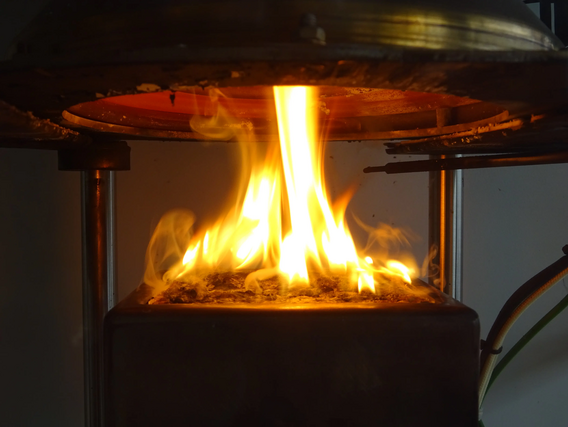
Materials used for furniture or other fittings on board high-speed craft must be fire-retardant. The test procedure and classification of the material under test shall be carried out in accordance with the ‘International Code for the Application of Fire Test Procedures (FTPC)’:
The test specimens are exposed to a controlled irradiance whilst in a horizontal orientation. The heat release rate is determined by measuring the oxygen consumption. In addition, the time to ignition and the smoke development rate are recorded.
Materials used for furniture and other furnishings are classified as ‘fire-retardant materials’ if the following four criteria are met:
